
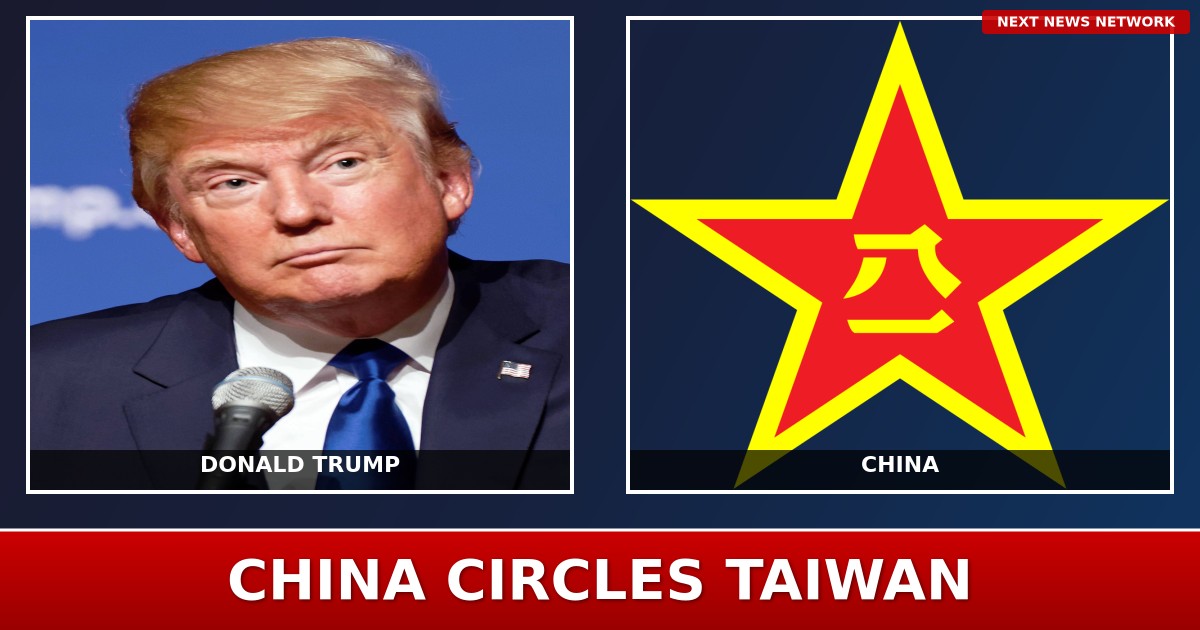
Communist China launched massive military exercises encircling Taiwan on Monday, timing the provocative show of force to coincide precisely with President Donald Trump's return to the White House in what defense analysts are calling a deliberate test of American resolve.
The People's Liberation Army dubbed the aggressive operation "Justice Mission 2025," deploying warships, fighter jets, and military assets to surround the sovereign island nation in a brazen display of intimidation that Beijing claims is a response to so-called "separatist forces."
Beijing's Calculated Provocation
The timing of these war games is no coincidence. China's communist regime chose Inauguration Day to send a clear message to the new Trump administration, probing for weakness after four years of the Biden administration's perceived soft approach to Chinese aggression in the Indo-Pacific region.
Taiwan's Ministry of National Defense reported detecting dozens of Chinese military aircraft and naval vessels operating in the Taiwan Strait and surrounding waters, with several crossing the median line that has traditionally served as an unofficial boundary between the two sides.
"This is classic Chinese Communist Party behavior—testing a new administration from day one," said one defense official familiar with the situation. "They want to see how President Trump will respond."
The drills represent one of the largest shows of military force against Taiwan in recent months, involving multiple branches of China's armed forces in coordinated exercises that simulate a potential blockade or invasion scenario.
A New Sheriff in Town
Unlike his predecessor, President Trump has signaled a tougher stance on Communist China throughout his campaign, promising to restore American strength and credibility on the world stage. The Chinese regime appears eager to test whether the 47th president will back up his strong rhetoric with action.
During his first term, Trump took unprecedented steps to confront Beijing's trade abuses, military expansion, and technological theft. His return to power has clearly unsettled the communist leadership, which grew accustomed to a more accommodating approach under the Biden administration.
Taiwan, a thriving democracy of 24 million people and a critical American ally in the Pacific, has faced increasingly aggressive pressure from Beijing, which claims the island as its territory despite never having controlled it.
America's Strategic Interests at Stake
The semiconductor industry centered in Taiwan produces the vast majority of the world's advanced computer chips, making the island's security a vital American economic and national security interest. Any Chinese move against Taiwan would send shockwaves through the global economy and fundamentally alter the balance of power in Asia.
Conservative defense experts have long warned that projecting weakness only invites aggression from adversaries like Communist China. The Biden years saw repeated Chinese provocations, from spy balloons traversing American airspace to unprecedented military buildup in the South China Sea.
President Trump now faces an early test of his commitment to peace through strength. How his administration responds to this blatant act of intimidation will set the tone for U.S.-China relations over the next four years—and potentially determine whether the Pacific remains free and open or falls under communist domination.
The world is watching, and so is Beijing.
