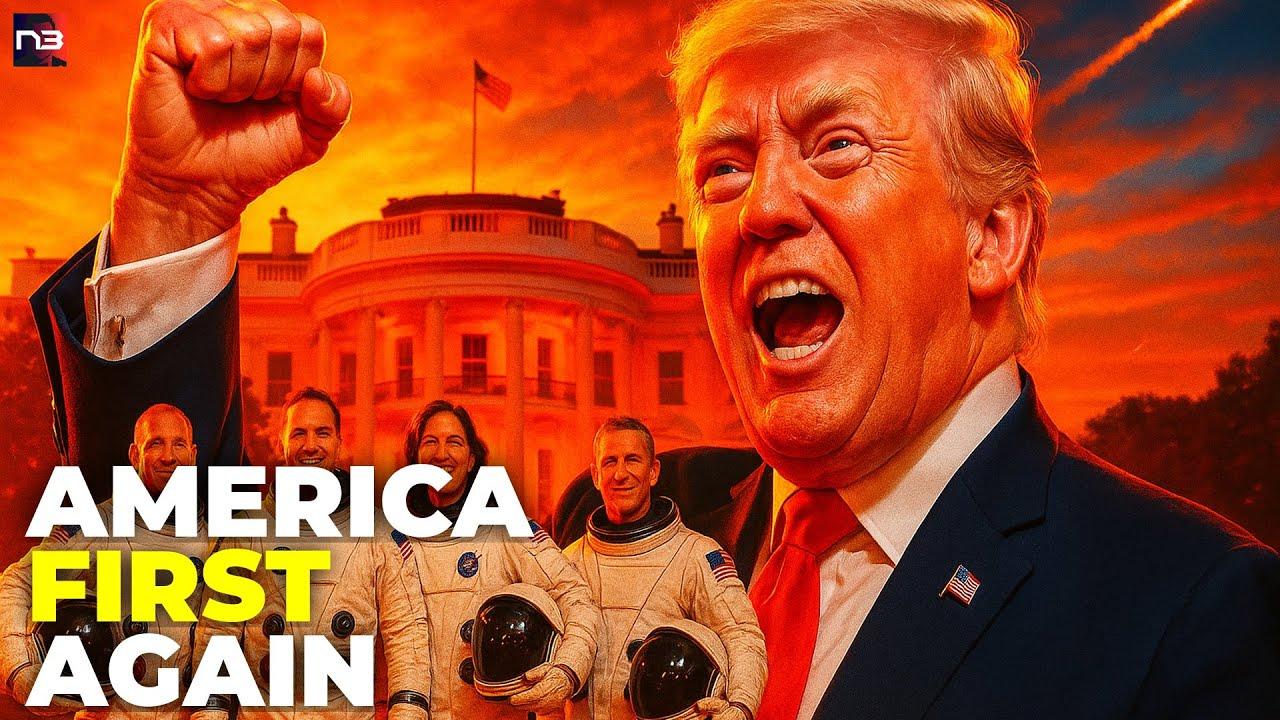
For the first time in more than fifty years, American astronauts are voyaging to the moon — and the world is watching as the United States reclaims its rightful place as the undisputed leader in space exploration.
The Artemis II mission launched successfully, carrying four American astronauts toward lunar orbit in what marks the most significant manned spaceflight achievement since the Apollo era. This isn't just a technological triumph — it's a thundering declaration that under President Donald Trump's leadership, America refuses to play second fiddle to anyone, especially not China.
Trump Addresses the Nation from the White House
President Trump delivered a powerful address outside the White House following the historic launch, reaffirming America's commitment to space dominance and the pioneering spirit that made this nation great.
The President made clear that this mission represents far more than scientific achievement — it's about American resilience, ambition, and the refusal to accept decline. While the Biden administration spent four years focused on DEI initiatives and climate hysteria, Trump's return to office has reignited the engines of American exceptionalism.
"America is setting the stage for future explorations, potentially leading to establishing lunar bases and, ultimately, Mars missions."
Let that sink in, Patriots. Lunar bases. Mars missions. This is the kind of bold, forward-thinking leadership that Make America Great Again has always been about.
A Strategic Imperative — Not Just a Victory Lap
Make no mistake: this mission isn't just about planting flags and taking photographs. Space dominance translates directly to national security, technological supremacy, and economic momentum. While China races to catch up with their own lunar ambitions, America just lapped them on the track.
The Artemis II mission lays the groundwork for a sustainable human presence on the moon — a staging ground for future Mars expeditions that will cement American leadership in space for generations. Under Trump's governance, the space program has become a catalyst for revitalizing American manufacturing, engineering, and science education.
Remember when we were told America's best days were behind us? Remember when the so-called "experts" said we needed to manage decline and defer to international bodies? President Trump just sent that narrative into orbit — literally.
What This Means for Everyday Americans
This historic achievement extends far beyond national pride. The technological and scientific advancements driven by Artemis will create jobs, spark innovation, and inspire a new generation of American children to dream big again.
For too long, American kids were told to lower their expectations, to accept mediocrity, to apologize for their country's greatness. Now they're watching American astronauts voyage to the moon under a President who believes in American exceptionalism without apology.
The economic implications are staggering. Manufacturing, engineering, aerospace, materials science — entire sectors of the American economy stand to benefit from the technological spillover of renewed space exploration. This is what happens when you have a President focused on winning rather than managing decline.
The Trump Legacy Takes Shape
In a time of high geopolitical tensions, with adversaries like China and Russia seeking to challenge American supremacy at every turn, the successful launch of Artemis II sends an unmistakable message: America will not be overtaken. America will not surrender its position. America will lead.
This is the Trump era — a pivotal period that history will remember as the moment America reached for the stars once again and refused to let go.
So here's the question every American should be asking: Are you proud of what this country can achieve when we have leadership with vision and backbone? Because this is just the beginning, folks. The moon today. Mars tomorrow. And a future where American boots walk on worlds we've only dreamed of.
God bless the Artemis II crew. God bless President Trump. And God bless the United States of America.