
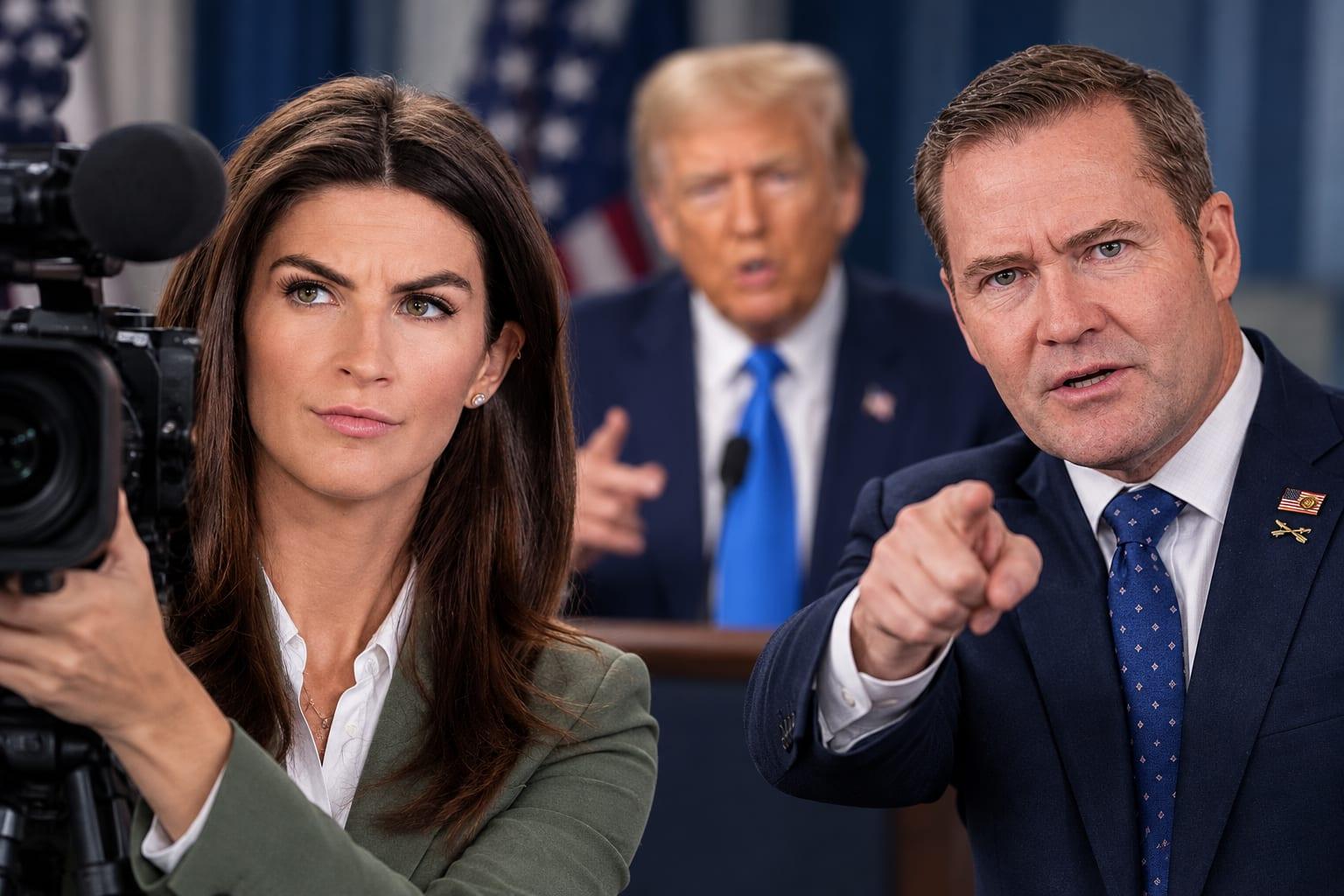
CNN anchor Kaitlan Collins went to the United Nations to ask Ambassador Mike Waltz about President Trump removing three outlets from the White House press pool. She asked the same question five different ways. She got the same answer five times, and then she got the line that ended the exchange.
"I'm standing here talking to CNN," Waltz told her.
The clip has been circulating since Monday because of how plainly it lands. Collins was pressing a network that had just lost its hard passes, while the man she was pressing was giving her an interview on camera, at length, at the UN.
The argument Collins would not engage
Waltz's position did not change across the interview. He drew a line between the right to publish and the right to enter a federal building.
"We have a First Amendment, your right to publish, your right to free speech," he said. "But what you don't have an inherent right to is to have access to any government institution that you want."
He pointed to the courts, saying the question had been settled "by multiple Supreme Court cases, the 60s, 70s, and recently as a few years ago." When Collins put the question a third time, Waltz stopped answering it as though it were new.
"You just ignored what I just said," he told her. "You don't have an inherent right to any government facility that you want, whether it's Langley or the White House."
Collins pushed back on the precedent itself, saying the case he cited "found that reporters don't have carte blanche access to everything, but you can't just ban outlets based on their viewpoint or their reporting." Waltz answered that nobody had been silenced.
"He's not saying no reporters can come in the Oval Office. He's not saying don't go out and report," he said. "Heck, we're talking right now."
The story she did not want
Waltz came to the interview with a different subject. He wanted to talk about what the administration has done at the United Nations, and he said so directly.
"I'd hope we talked about the reforms that we're going to do at the United Nations, an important international institution," he said. "But if we want to spend the entire time talking about this, fine."
The numbers he cited never made the segment. A billion dollars in cuts. Three thousand UN employees being let go. A quarter of the peacekeeping force. Waltz noted that many people expected Trump to walk away from the institution entirely, and instead his administration stayed and cut.
Collins returned to the press pool.
The national security question
Her sharpest line came late: the President had not called the coverage a national security threat on Friday, Saturday or Sunday, and was calling it one now. How, she asked, is reporting on the President a threat?
Waltz did not treat it as rhetorical.
"When we have outlets that are relying on anonymous sources and talking about the levels of ammunition we have in the middle of conflict, when we're talking about vulnerabilities that the United States have, when in fact we're talking about deployment orders for our soldiers, our Navy, our Air Force that are highly classified — that's absolutely a national security threat and should be investigated and prosecuted."
That is a specific charge about specific reporting, and Collins did not take it up.
Our Take
Watch what the exchange actually demonstrates. A cabinet-rank official stood in front of a CNN camera for three minutes and answered every question put to him, including hostile ones, on the day his critics say the administration is silencing the press. The interview was the rebuttal.
There is a real argument to be had about pool access, and Collins was entitled to make it. But she had an Ambassador in front of her who wanted to talk about a billion dollars in cuts to an institution conservatives have wanted reformed for forty years, and she spent the time on her own network's credentials.
Waltz noticed. So did everyone who watched it.
