
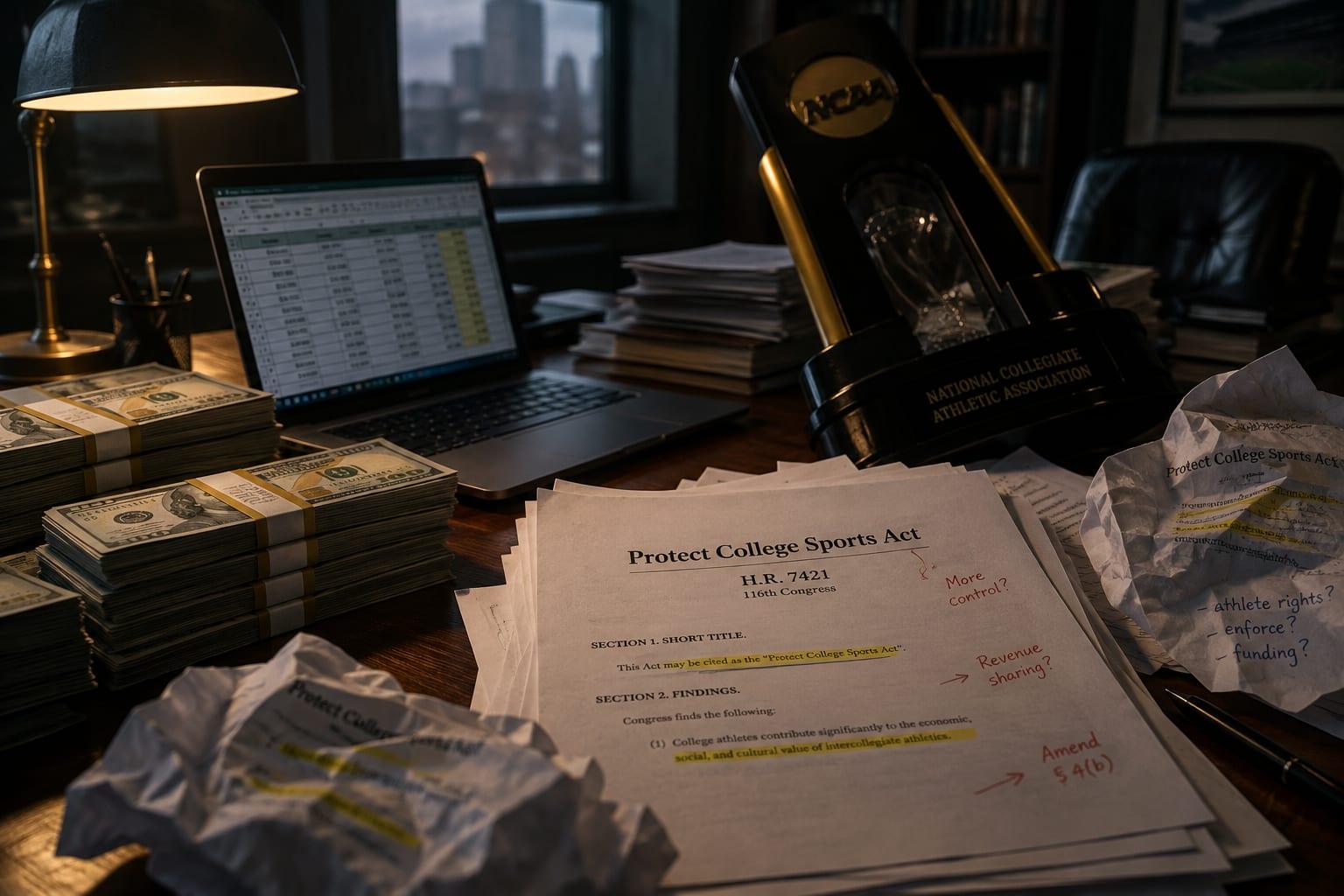
Before senators take advice from the agents attacking the Protect College Sports Act, they should ask one question: who makes money if the bill fails?
That is the challenge The Federalist threw down this week — and it is the question that should be hanging over every Capitol Hill meeting where a sports agent with a client list tells a senator this bill is bad for the kids.
The piece is blunt about the dynamic: the people lining up against the Protect College Sports Act are, in many cases, the same people whose income depends on the current anything-goes environment in college athletics. Agents. Middlemen. The broker class that sprouted up the moment the NCAA lost control and money started moving in every direction but toward the athletes actually putting their bodies on the line.
The Federalist's framing is simple and it is hard to argue with: follow the money. If a bill cracks down on the predatory arrangements that have turned recruitment into an auction and turned teenagers into signing-day commodities, the agents who built businesses on that chaos have every reason to kill it. Their testimony should be weighed accordingly.
What the bill actually does, and the specific provisions agents are objecting to, is where the reported record matters most. The Protect College Sports Act is aimed at the pay-for-play free-for-all that followed the NCAA's collapse on name, image and likeness rules. It is designed to put guardrails back around a system that, right now, has almost none.
Critics — including agents with skin in the game — argue the bill would restrict athletes' earning power and hand power back to the universities and the NCAA. That is their stated case. It is a case worth hearing. It is also a case being made, in large part, by people who take a cut of every deal they are defending.
There is no shortage of member offices that will tell you privately they are getting hammered by agent lobbying on this. On the record, most of them won't say a word. That silence is its own tell.
For everyday Americans — the parents driving to travel-ball tournaments, the boosters writing checks, the fans who just want to watch a game without a contract dispute breaking out at midfield — the stakes are not abstract. The current system has produced a transfer portal that functions like free agency, collectives that function like shadow franchises, and a recruiting calendar that never stops. Nobody asked the fans if this is what they wanted.
The Federalist's point is that Congress should not let the people profiting off that system write the rules for fixing it. Senators should ask, on the record, for every agent who testifies against the Protect College Sports Act: what is your book of business worth if this passes? What do you lose if the guardrails go up?
Those are fair questions. They are also the questions nobody in the Capitol press corps seems interested in asking.
Our Take
This is not complicated. When a sports agent tells a United States senator that a reform bill is dangerous, the senator's first follow-up should be: dangerous to whom?
The agent class did not build college sports. They showed up after the money started moving and figured out how to skim it. They are not protecting athletes. They are protecting a business model that requires chaos to function. Every rule Congress writes back into this system is a rule that cuts a middleman out of a deal.
So when you see agents, consultants and the usual paid mouthpieces lining up against the Protect College Sports Act, do not ask whether they care about the kids. They don't. Ask what they bill. Ask who signs their checks. Ask what happens to their commissions if the pay-for-play pipeline gets capped.
Patriots, Congress works for you, not for the brokers. Call your senators. Tell them to stop taking meetings with the people cashing in on the chaos and start asking who actually benefits when this bill dies in committee.
The answer, every time, is the guy who told you he was just looking out for the players.
