A brief wire item reporting that Iran's president and Qatar's prime minister held talks on efforts to reduce tensions has fed a widening swirl of competing claims about a possible end to hostilities — claims that remain unconfirmed and are being pushed by regional players, UN speakers and social media accounts alike.
The account @FirstSquawk posted shortly before eleven in the morning UTC on September twenty-fifth: "IRAN'S PRESIDENT AND QATAR'S PM HELD TALKS ON EFFORTS TO REDUCE TENSIONS." That post, which drew nineteen likes and two reposts, is the only concrete piece of the exchange Next News Network can point to directly. It does not describe what was discussed, what was agreed, or whether anything was agreed at all.
What followed in the broader information space was a sequence of claims. The New York Times reported, roughly eleven hours before this writing, that Iran had proposed a seven-day plan to end the war — an offer under which, according to that report, the Strait of Hormuz would reopen and nuclear talks would be revived. That reporting is a claim by the newspaper about an Iranian proposal. It is not independently confirmed by Next News Network, and readers should treat it as an allegation being advanced rather than an established fact.
At the United Nations, Iran's President Masoud Pezeshkian struck a notably different tone than the one implied by talk of a seven-day plan. According to coverage of his UN address, Pezeshkian vowed never to "bend at the knee" — a phrase that surfaced in multiple accounts of the day's events, including The Guardian's running coverage, which quoted "We will never bow our head" in connection with Iran. The same coverage described US-Iran talks, a sixty-day ceasefire roadmap and a Hormuz blockade as dominating the conversation around the conflict.
The combination is unusual on its face: a president publicly refusing to capitulate, while reports circulate of a short-term proposal that would reopen the strait and restart nuclear negotiations. Neither the seven-day plan nor the sixty-day roadmap has been confirmed by Next News Network, and the underlying event that sparked this cycle of reaction — whatever was or was not agreed between Tehran and Doha — could not be independently verified by this outlet.
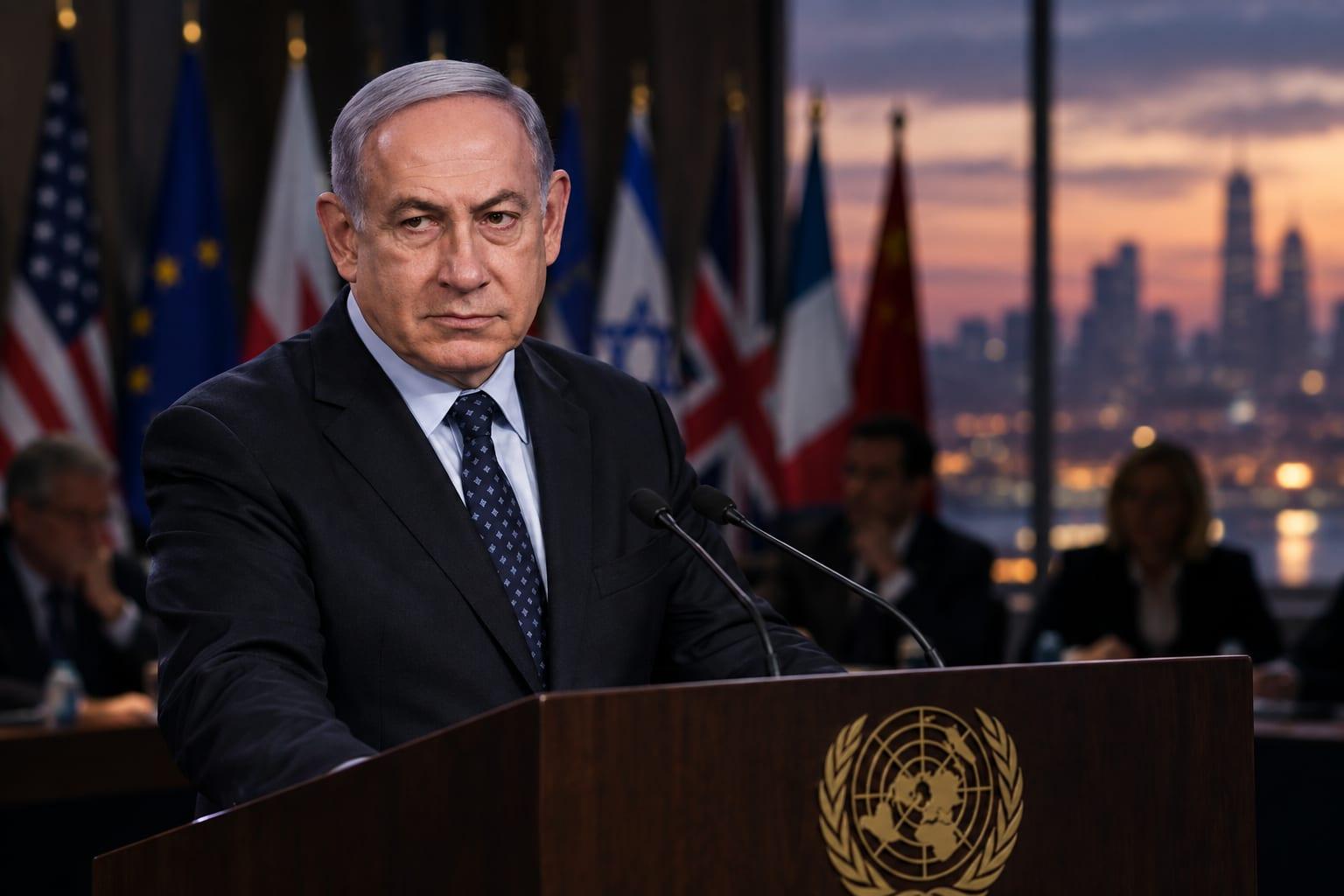
Into that vacuum stepped Israeli Prime Minister Benjamin Netanyahu, whose UN address became its own flashpoint. Coverage from Fox News Digital reported that Netanyahu blasted New York City Mayor Zohran Mamdani at the UN, telling him, "You can't silence me. You can't silence the truth," and accusing the mayor of distorting facts and embracing Hamas supporters. The Times of Israel, in its account of what it called a fiery speech, reported that Netanyahu blasted Iran, Qatar and Turkey, characterized a Gaza genocide accusation as the "lie of the century," defended the morality of the Israel Defense Forces, downplayed settler violence, and did not mention the Saudis or the Abraham Accords. Many envoys walked out before he began, according to that report.
Netanyahu's decision to single out Qatar is notable given that Qatar's prime minister is the very official named in the @FirstSquawk post as having held de-escalation talks with Iran's president. The Israeli prime minister's remarks do not, in the coverage available, address those talks directly. What they do is frame Qatar — a mediator in several regional files — within a broader critique that also took in Iran and Turkey.
The UN session produced other headlines that day. The Guardian's live coverage reported that Venezuela's acting president, Delcy Rodríguez, told the assembly her country was being "reborn," saying, "I do not promise you an easy way forward," and that "Rebuilding our national soul will be the priority." That same live file noted Rodríguez is being held not far from the organization's headquarters as she awaits trial — a detail included in the outlet's reporting and carried here as that outlet's account. The Guardian also recorded the "We will never bow our head" line attributed to Iran in the same running file.
For readers trying to track how a single wire item became a day of competing narratives, the sequence matters. First came the terse @FirstSquawk post — talks described only as "efforts to reduce tensions." Then came reporting, roughly half a day earlier, of a seven-day Iranian proposal involving Hormuz and nuclear talks. Running alongside that was Pezeshkian's public refusal at the UN to "bend at the knee," plus descriptions of a sixty-day ceasefire roadmap and a Hormuz blockade as the dominant issues. And layered on top was Netanyahu's UN speech, which named Qatar among his targets and drew walkouts from multiple delegations.
None of these threads has been reconciled in the public record. A seven-day plan and a sixty-day roadmap are not the same thing. A blockade and a reopened strait are not the same thing. A president vowing defiance and a president quietly offering a short-term deal are not obviously the same posture, though both can be true at once if the offer is tactical. Next News Network could not independently verify the existence, terms or status of the seven-day proposal, the sixty-day roadmap, the Hormuz blockade, or the reported Iran-Qatar talks themselves.
What can be said with confidence is narrower: an account identified as @FirstSquawk reported that Iran's president and Qatar's prime minister held talks on reducing tensions; multiple outlets subsequently reported claims about ceasefire timelines and a strait reopening; Iran's president publicly refused to "bend at the knee" at the UN; and Israel's prime minister used his own UN appearance to attack Iran, Qatar and Turkey while dismissing a genocide accusation as the "lie of the century." The reaction, in other words, is the story — and it is spreading across wire services, UN live files and primetime speeches faster than any of the underlying claims can be checked.
Our Take
Notice what the establishment press is doing here. A nineteen-like wire post about talks becomes, within hours, a New York Times report about a seven-day plan, a sixty-day roadmap, a reopened Strait of Hormuz and revived nuclear talks — none of it confirmed, all of it presented as the shape of things to come. Meanwhile the same Iranian president those reports cast as ready to deal stood at the UN and vowed never to bend at the knee. Those two stories cannot both be the whole truth, and the American public deserves to know which one the briefing class is actually selling. What we can see plainly is the pattern: leaks and anonymous roadmaps get laundered into headlines, Israel's prime minister gets walked out on for telling uncomfortable truths about Iran, Qatar and Turkey, and the only thing missing from the coverage is proof. Next News Network will keep asking the questions the legacy outlets skip — who proposed what, who benefits from the leak, and why the deal talk always seems to surface right when the tough talk starts.