
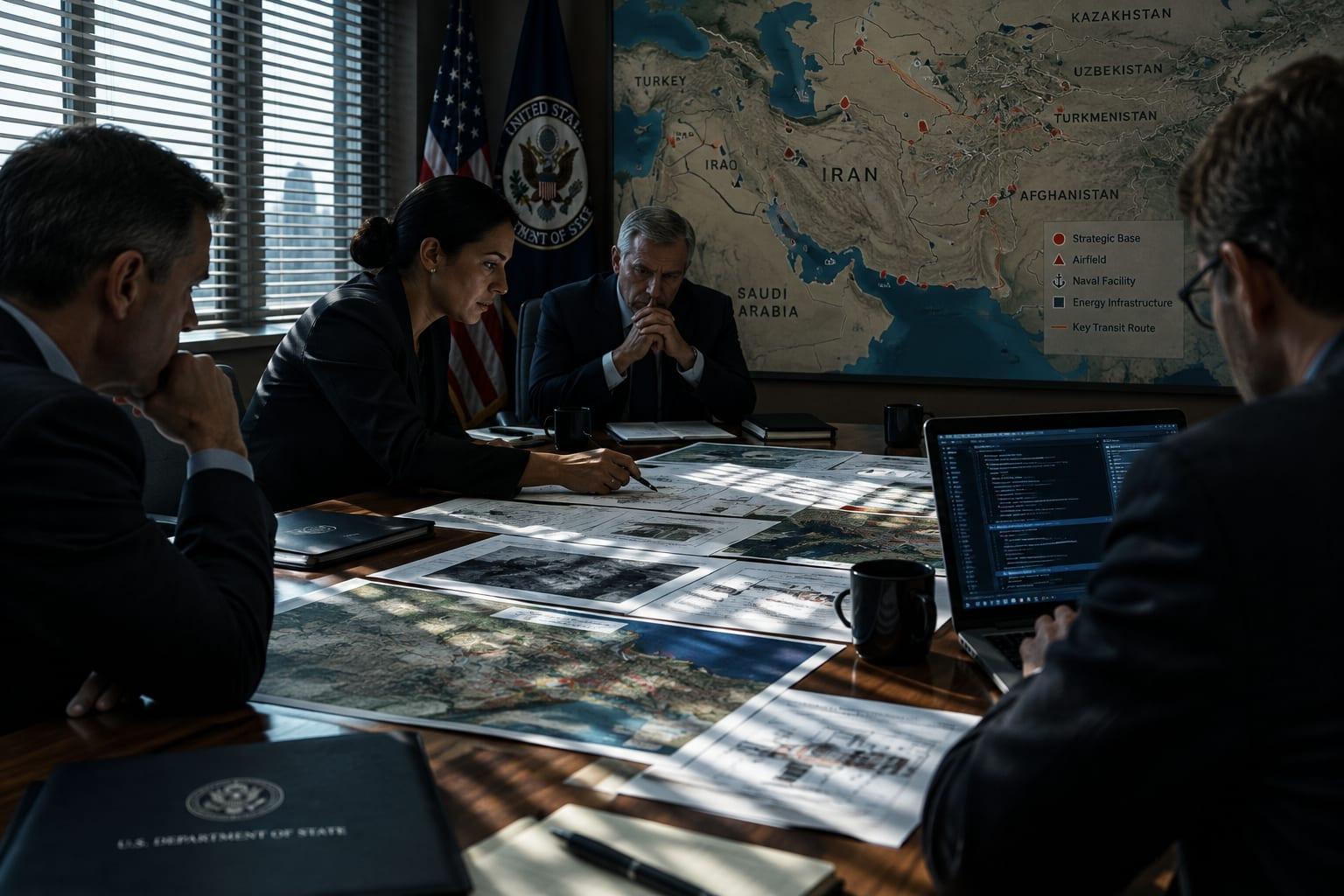
Negotiations between the United States and Iran have moved beyond initial diplomatic contacts into a more detailed technical phase, according to Al Jazeera's bureau chief in Tehran, Nourddine Dgheir, who reported Friday that sources in the Iranian capital described the atmosphere around the talks as increasingly positive.
The account, carried by the breaking-news account @FirstSquawk, followed an earlier bulletin from the same account stating that Iran-U.S. talks had entered a technical stage. The reported shift comes as other outlets describe a wider diplomatic push: The New York Times reported that Secretary of State Marco Rubio said U.S. negotiators had restarted conversations about Iran's nuclear program, while adding that there had been no breakthroughs. The Times also reported that Iran has proposed a seven-day plan under which the Strait of Hormuz would reopen and nuclear talks would be revived.
Iran's president, Masoud Pezeshkian, has said Tehran wants a deal with the United States before November's midterm elections, according to accounts of his exchange with news organizations. The same reporting stated that Pezeshkian described meeting twice with the Islamic Republic's new supreme leader, who has not been seen in public. A separate assessment published by the Institute for the Study of War noted that Iran's deteriorating economy and its difficulties exerting control over the Strait of Hormuz may have contributed to its willingness to engage with Washington.
Against that backdrop, the reaction inside the United States is being carried less by the State Department than by lawmakers who say any warming of relations must be weighed against the conduct of America's other adversaries — and against China, the country Washington simultaneously calls its biggest strategic competitor.
On Newsmax's "National Report," Representative Greg Steube, a Florida Republican, was asked about the just-concluded three-day state visit by Chinese President Xi Jinping and what it accomplished. He said the most significant outcome was a two-month pause on trade measures, which he described as helpful to Midwestern farmers at a time when they are being squeezed by pricing, diesel and fertilizer costs. He added that many subjects were not discussed openly, naming Iran, Taiwan and the flow of fentanyl precursors into Mexico as matters he hopes were addressed behind closed doors.
"Them not cooperating with Iran or Russia on military type things, the fentanyl precursors is obviously huge," @Newsmax quoted Steube as saying. In the accompanying transcript, Steube pointed to an interview that had aired earlier in the program, in which he said an ambassador had made clear that China should not be helping Iran with targeting, with oil, or with military capabilities. "So hopefully that's going to be the case and that's not going to happen," he said.
Pressed on what he wants the president to secure from Beijing before the trade truce expires, Steube put national security first. "Well, obviously good trade relations with them are very important. But on the national security front them not cooperating with Iran or Russia on military type things," he said, calling the fentanyl precursor issue enormous and noting that hundreds of thousands of Americans have died of fentanyl overdoses. He said the precursors come into Mexico for the cartels, and that the president has said going back years that he has asked China not to sell them into Mexico. On trade, Steube said the United States should not run a deficit with China and argued that decades of what he called bad trade policy made China wealthy. "We have to get that right," he said, adding that a two-month window helps farmers but that longer-lasting agreements are needed.
The program then turned to the visit's closing stop: the National Archives, where the Chinese president and President Trump were to tour the Constitution and the Bill of Rights. Steube called the setting interesting, noting that the country is marking its two hundred fiftieth anniversary and that letting the Chinese see where America comes from — how it was founded and what values it stands on — matters in bilateral relations. The host remarked that the feed from the room was poor and that he was almost positive he heard "Stand by Me" playing in the background, a bit of color he acknowledged he might have imagined.
Steube also responded to a sound bite from State Department spokesperson Tommy Pigott, who said the president has put the United States in position to make things at home again, that trillions in investment are returning in large part because of tariffs, and that Washington wants deals that are wins for both sides. Steube agreed, citing the tax-cut package Republicans passed to incentivize manufacturing to return to the United States. "We have to have that here and we have to put America first," he said.
Separately, Reuters reported that Russia's Perm oil refinery halted operations after a drone attack on Friday, according to sources — a reminder that the energy and security file extends well beyond the Iran talks.
What is being described here is a reported diplomatic opening and the political reaction to it. The claim that the Iran-U.S. talks have advanced into a technical phase rests on the Al Jazeera bureau chief's sourcing in Tehran as relayed by @FirstSquawk, not on any announcement by either government. The proposed seven-day plan to reopen the Strait of Hormuz and revive nuclear talks comes from the reporting of The New York Times, and the description of positive atmosphere and Iranian interest in a pre-midterm deal comes from that outlet and from Pezeshkian's own remarks as reported. No text, joint statement or formal terms of a technical agreement have been released publicly. Next News Network could not independently verify the claims about the status and tone of the negotiations.
The reaction has spread through a recognizable set of channels: Newsmax carried Steube's television comments and posted them through @Newsmax; @FirstSquawk relayed the Al Jazeera reporting and the earlier technical-stage bulletin; Reuters carried the Perm refinery disruption; and the broader diplomatic picture has been documented by The New York Times and the Institute for the Study of War. Each of those accounts is carrying its own portion of the story, and none of them constitutes confirmation of the others.
Our Take
Two things can be true at once, and conservatives should hold both. It is not weakness to talk to Tehran if the alternative is a wider war, and the reported reopening of the Strait of Hormuz would relieve pressure on global energy prices that American families feel at the pump and on the farm. But there is no deal yet, and the only thing being described so far is an atmosphere. An atmosphere is not a verification regime, a nuclear inspection schedule, or an enforcement mechanism — and the fact that Tehran's apparent motive is its own deteriorating economy and its shaky grip on the Strait should tell us who needs this more.
Steube's point deserves more attention than the diplomatic headlines getting the airtime. If Washington is simultaneously easing trade pressure on Beijing for two months while asking Iran to disarm, the China file cannot be an afterthought: fentanyl precursors are still crossing into Mexico, and Beijing's willingness to help Iran on targeting, oil or military capability is the variable that decides whether any Iran deal holds. Trade peace with a strategic competitor should buy American farmers relief and American security a harder line — not one at the expense of the other. Republicans should insist that any Iran agreement, before an election-year signing ceremony, be judged by what is verifiable, not by what is said to be positive.
