
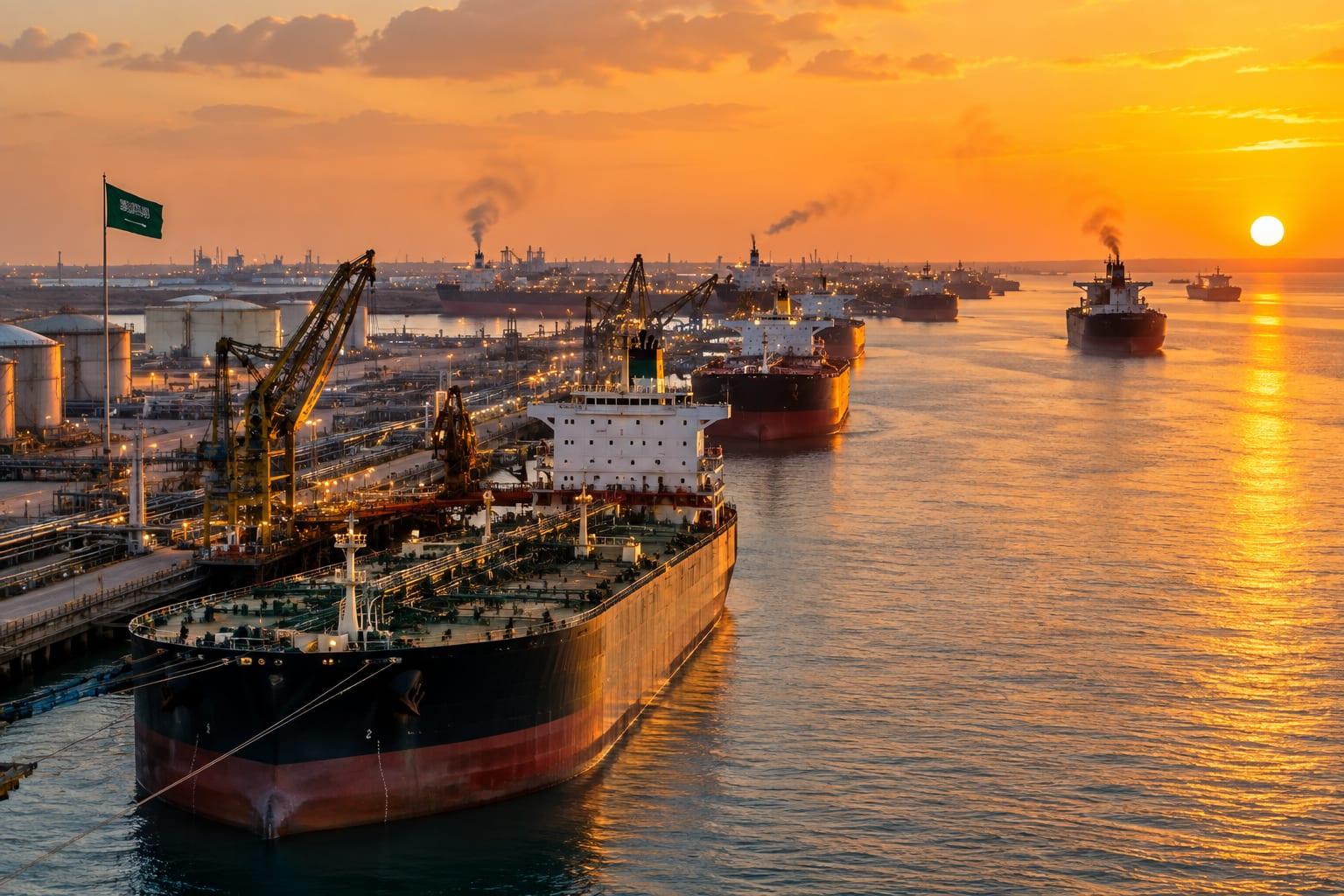
Saudi Arabia's crude oil shipments in September reportedly reached their highest level since the Iran war began, according to financial news outlet CNBC, which reported the figure in a post from the account @FirstSquawk on Thursday. The report attributes the surge to a rapid ramp-up of exports through the Strait of Hormuz following an attack on one of the kingdom's key bypass pipelines.
The claim, if accurate, marks a significant reversal from the early days of the conflict, when Iran's closure of the Strait of Hormuz — the narrow waterway through which roughly a fifth of the world's oil passes — prompted widespread fears of skyrocketing prices and a global economic shock. Those fears have so far not materialized in the form of a sustained price spike, though the costs of moving oil through the region have climbed sharply.
According to Bloomberg, which first reported the export figures, Saudi Arabia moved quickly to increase shipments through Hormuz after the pipeline attack, compensating for the lost bypass capacity. The report from the account @FirstSquawk carried the headline: "SAUDI CRUDE OIL EXPORTS HIT HIGHEST LEVEL SINCE IRAN WAR BEGAN DESPITE PIPELINE OUTAGE – CNBC."
The broader story, however, is not simply one of volume. As Bloomberg reported, the kingdom's effort to bypass the Strait of Hormuz is being squeezed by soaring tanker insurance and shipping costs in the Red Sea. OilPrice.com reported the same day that Saudi export costs are surging as risks in the Red Sea mount, a development that could erode the margins on those record shipments even as they reach their highest levels since the war began.
Seeking Alpha, aggregating the Bloomberg report, noted that "Saudi Arabia's crude oil shipments in September jumped to the highest level since the start of the Iran war, after the kingdom quickly ramped up exports via the Strait of Hormuz following an attack on its key bypass pipeline." The account @FirstSquawk then carried the CNBC version of the same claim to its followers on Thursday afternoon.
What is not in dispute is that the war has disrupted the region's oil logistics in ways that Gulf producers are still adapting to. When Iran shut down the Strait of Hormuz at the start of the war, many feared that prices would skyrocket, cratering the world economy. That scenario has so far been avoided, in part because Gulf nations have found ways to keep oil flowing — but the costs are mounting, according to reporting from two days ago.
The pipeline outage mentioned in the @FirstSquawk post refers to an attack on a Saudi bypass pipeline, an alternative route designed to move crude without passing through the Strait of Hormuz. Bloomberg reported that the kingdom ramped up exports via Hormuz after that attack, effectively routing more oil through the very chokepoint the bypass was meant to avoid. The result, according to the report, was a September export total that eclipsed any month since the war began.
The claim has spread through financial news accounts and aggregators, with @FirstSquawk carrying the CNBC headline to its audience and Seeking Alpha simultaneously amplifying the Bloomberg version. The same subject has been covered by OilPrice.com, which focused on the cost side of the equation, and by outlets tracking Asia's crude imports, which are reportedly on track to hit their highest volume since the start of the U.S.-Iran war.
Oil prices pulled back from session highs on Thursday after a report of talks for a phased reopening of the Strait of Hormuz, suggesting that traders are watching diplomatic signals as closely as they are watching export volumes. The @FirstSquawk post, by contrast, emphasized the volume milestone, framing the September export surge as a sign of Saudi resilience despite the pipeline outage.
The account @FirstSquawk is a financial news aggregator known for carrying headlines from major outlets to a fast-moving audience. Its post contained no additional detail beyond the CNBC headline. The Bloomberg report cited by Seeking Alpha added the context of the Hormuz ramp-up and the pipeline attack. OilPrice.com added the context of rising insurance and shipping costs.
Taken together, the coverage paints a picture of a Gulf oil export system that is still functioning but under increasing strain. Saudi Arabia and its neighbors have found ways to keep crude flowing, but the routes are more expensive, the insurance is more costly, and the risks are higher. The September export surge, if confirmed, would represent a high-water mark in volume even as the underlying costs of achieving that volume continue to climb.
It is not yet known how long the kingdom can sustain exports at September's reported level, or whether the rising costs in the Red Sea will eventually force a pullback. It is also not known whether the phased reopening of the Strait of Hormuz reportedly under discussion will materialize, or what terms might accompany it. The talks, first reported Thursday, remain unconfirmed by the parties involved.
For now, the picture is one of a market that has absorbed the initial shock of the Iran war better than many feared, but at a price that is still being calculated. The September export figures, carried by @FirstSquawk, Bloomberg, Seeking Alpha and others, suggest that Saudi Arabia in particular has managed to keep its crude moving. The cost data from OilPrice.com suggests that doing so is becoming more expensive by the day.
Next News Network could not independently verify the reported export figures or the details of the pipeline attack.
Our Take
The headline — Saudi exports at their highest since the war began — sounds like a story about Saudi strength. It is not. It is a story about Saudi adaptation under pressure, and the pressure is not letting up. The kingdom lost a key bypass pipeline to an attack, and its answer was to push more oil through the very Strait of Hormuz that the bypass was built to avoid. That is not a victory; it is a workaround.
The costs tell the real story. Insurance and shipping rates in the Red Sea are climbing. Export costs are surging. Every barrel that moves is moving at a higher price, and the margin for error is shrinking. The Gulf producers have kept the oil flowing, but they have done so by accepting more risk, more expense, and more exposure to a chokepoint that Iran has already shown it can close.
Conservatives have argued for years that American energy independence is a national security imperative, not just an economic one. This story is the proof. When a single waterway — or a single pipeline — can be attacked and force the world's largest exporter into a costly workaround, the global economy is one bad day away from a crisis. The September export surge is good news for volume. It is not good news for stability. And it should be a reminder that the only durable answer to Middle East volatility is to produce more energy here at home.
