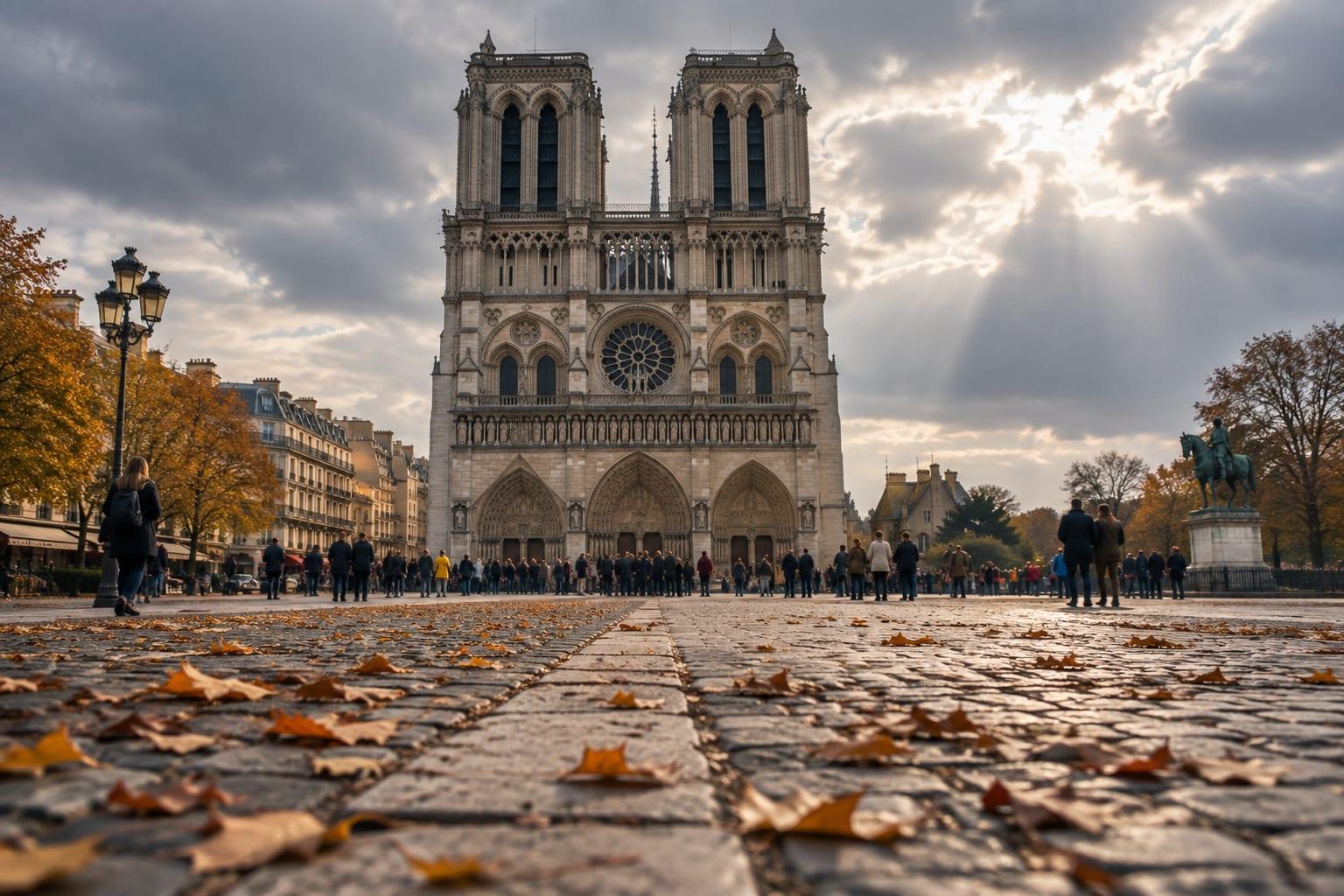
A crying baby outside Notre Dame cathedral was unenthusiastic about receiving the Pope's blessing, according to the New York Post, as Pope Leo XIV made his first papal visit to the restored Paris landmark since the 2019 fire. The @nypost told readers the infant's reaction was one of displeasure at the moment of blessing; the image and the line were posted to the account at 11:16 p.m. Eastern on September twenty-fifth.
The account @nypost put it plainly: "This crying baby outside Notre Dame cathedral was unenthusiastic about receiving Pope's blessing." The post carried no byline detail, no location line beyond the cathedral, and no indication of who the child or the family was. What it offered was a caption on a moment, and the moment is what other accounts picked up.
The scene unfolded against a backdrop that Vatican News described as the Gothic cathedral "flooded with light," where Pope Leo XIV celebrated Vespers with the French Church and called it, like Notre Dame itself, to be reborn. The National Catholic Reporter, in its account of the visit, said the pope echoed his predecessor's vision, describing the reconstructed cathedral as offering an encounter "that has expanded horizons of welcome and participation beyond the boundaries of ecclesial affiliation." The Catholic Sun noted that Leo is the first pope to visit the iconic temple after it was reopened following the devastating fire of 2019, and that he would pray vespers there during his France tour.
None of that, however, was the subject of the @nypost post. The subject was the baby. And once the @nypost framed the moment, the frame traveled.
The wording of the post is doing specific work. It does not say the baby cried at the blessing, and it does not say the blessing happened at the moment the baby cried. It says the baby was "unenthusiastic about receiving" the blessing. That is an interpretation of a facial expression, offered as a joke, and it is the interpretation that carried.
The underlying event -- the pope's visit to Notre Dame and the vespers service there -- is well documented by Catholic and Vatican outlets. The specific claim about the baby's reaction is not independently confirmed, and Next News Network could not independently verify it. What is verifiable is the posting: the account @nypost published the line, and other accounts carried it forward.
The visit itself was the first papal stop at Notre Dame since the 2019 fire that gutted the cathedral's roof and spire. France 24 reported that an estimated eighty thousand people welcomed Pope Leo XIV to the Stade de France in Saint-Denis near Paris for a youth vigil, capping the first day of the France tour. Earlier in the day, France 24 added, the pontiff warned that an AI "paradise of machines" risked undermining human dignity. Vatican News correspondent Deborah Castellano Lubov reported from outside the Cathedral of Notre Dame on the eve of the pope's arrival.
Against that weight -- a rebuilt cathedral, a pope preaching about machines and humanity, a stadium vigil with tens of thousands of young people -- the @nypost post chose the crying baby. That is the editorial move that made it spreadable. It is short, it is visual, and it lets the reader supply the punchline.
The same dynamic shaped coverage elsewhere. The Catholic Sun's headline focused on the seven years since the fire and the significance of a pope praying vespers in a reopened Gothic temple. Vatican News framed the visit as an encounter of light and heaven. National Catholic Reporter emphasized the pope's language of expanded welcome. None of those framings involved a baby.
What the @nypost added was a human reaction that cut against the solemnity of the scene. A baby crying during a blessing is a common occurrence at any religious ceremony -- parents bring infants to public events, infants cry, and the cry is not a statement of theology. But a photograph of a crying baby at a moment of papal blessing, posted with a wry caption, turns a private moment into a public one. That is what the post did, and that is why it traveled.
It is not known who the child or the family is, whether they were part of the crowd gathered for the pope's arrival, or what the family's own view of the moment might be. The @nypost post does not say, and no other account reviewed for this story supplied those details.
The spread of the @nypost line is the story here, not the underlying event. The account posted the caption; other accounts carried it; readers encountered it in their feeds. That is the mechanism. The underlying claim -- that the baby was unenthusiastic about the blessing -- remains what is being claimed. It is a caption, not a confirmed fact, and it should be read that way.
Pope Leo XIV's France tour continues, with the vespers at Notre Dame and the stadium vigil behind him. The Vatican has not commented on the baby, and there is no indication it intends to. The cathedral, for its part, was doing what cathedrals do: hosting a pope, a crowd, and whatever sounds the crowd brought with it.
Our Take
The @nypost found the one person in Paris who was not impressed by Pope Leo XIV, and that person was small enough to be held. That is the whole joke, and it worked. But it is worth saying clearly: the crying baby is not evidence of anything about the pope, the church, or the visit. It is evidence that babies cry. The real story of the day was a rebuilt cathedral that was nearly lost seven years ago, a pope praying vespers in it, and eighty thousand young people filling a stadium outside Paris to hear him warn about a machine-run future. The New York Post chose the crying baby instead, and the internet ran with it, because the internet always runs with the crying baby. That is not a scandal. It is a preference, and it says more about what readers click than about what happened at Notre Dame. If the goal is to understand the moment, the baby is a footnote. If the goal is to get a laugh, the baby is the whole show. Both things can be true, and in this case, both were.