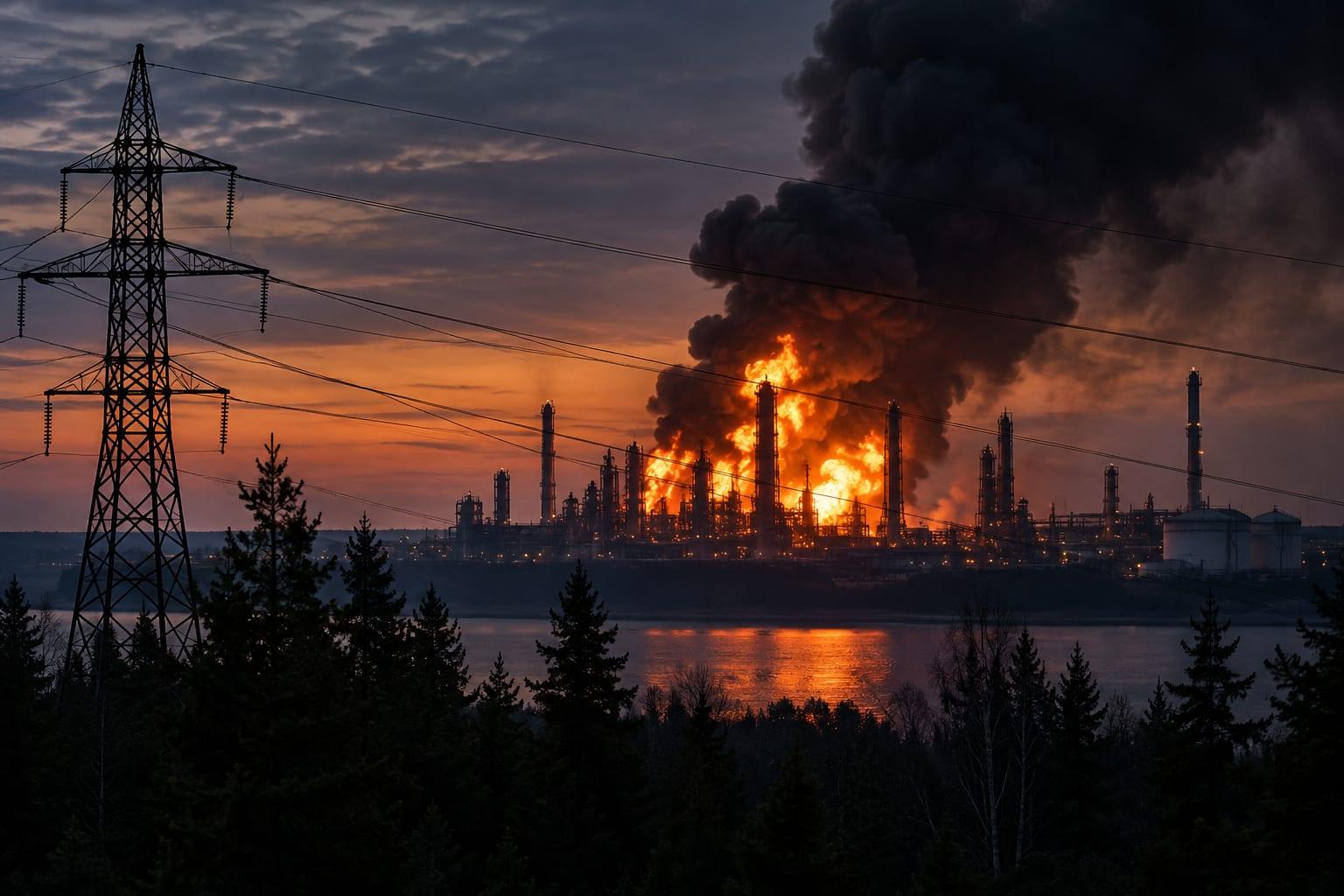
Ukrainian President Volodymyr Zelenskyy says his country struck two refineries inside Russia overnight, a claim that has set off a wave of international reaction over whether attacks on Russian oil infrastructure are worth the pressure they put on global energy prices. The claim, posted by the account @FirstSquawk, states that Zelenskyy himself announced the strikes. Next News Network could not independently verify that the strikes occurred or that they achieved any particular result.
The post from @FirstSquawk, dated September 25, 2026, carried the terse formulation that has since circulated widely: “UKRAINE ZELENSKYY SAYS UKRAINE HIT 2 REFINERIES IN RUSSIA OVERNIGHT.” By itself it is a headline, not a record of confirmed damage. What gives the claim weight in the news cycle is not evidence from the ground but the chain of response it triggered — from allied governments, from Western news organizations covering the same briefings, and from Zelenskyy himself, who has spent the past several days defending the strategy in public.
The most direct pushback comes from within Ukraine’s own coalition. Reporting from The Guardian notes that Zelenskyy’s strikes on Russian oil infrastructure have drawn caution from other countries concerned about “growing energy costs.” That concern is not abstract. Refinery outages inside Russia reduce global refined product supply, and allied capitals have quietly signaled that they would prefer Ukraine focus on military targets rather than the export infrastructure that underpins global fuel markets.
Zelenskyy’s answer to that pressure, according to the same coverage, was blunt: “Ukrainian lives are more important than the price of energy.” It is a line he has repeated as he makes the case that hitting Russian oil revenues is a form of self-defense, not an escalation. The Ukrainian position, as he has framed it, is that Russia funds its war machine through hydrocarbon exports, and that degrading that revenue stream is a legitimate military objective regardless of the knock-on effects on fuel prices in Europe and beyond.
That argument landed in New York this week, where Zelenskyy addressed the United Nations as the war’s diplomatic track remains stalled. According to The Guardian’s live coverage of the UN proceedings, Zelenskyy warned Moscow that Ukraine would strike back and make the coming winter “deeply painful” for Russia if the two sides could not agree a truce on energy attacks before the cold sets in. The phrasing is itself a signal: Ukraine is offering a narrow, sector-specific truce on energy infrastructure — refineries, pipelines, power grids — as a way to limit the war’s economic fallout, but only if Russia accepts reciprocal restraint.
There is no indication Russia has accepted such a truce. Instead, the same Guardian coverage reports that Moscow hammered Kyiv with drone and missile attacks that began on Wednesday and stretched into Thursday, killing two people and wounding forty-one in the capital. ABC News, covering the same wave of strikes, reported that Russian drone and missile attacks on Ukraine killed at least eight civilians overall as the UN debated how to end the war. The image of a UN General Assembly discussing peace while air raid sirens sound in Kyiv is the backdrop against which Zelenskyy’s refinery claim is being received.
The allied response has been equally conflicted. NATO’s top commander, Alexus Grynkewich, said the range of Russian threats means “we are all eastern flank countries,” according to The Guardian’s live reporting. He added that the United States would continue to provide “critical but more limited capabilities” to the alliance. The phrase captures the mood in Brussels and Washington: continued support, but with an explicit ceiling. That ceiling is part of why Ukraine has turned to long-range drone and missile strikes on Russian oil infrastructure — it is a capability Kyiv can deploy without waiting for allied permission or additional weapons transfers.
Venezuela’s delegation also took the UN stage, with Rodríguez telling the assembly the country is being “reborn,” according to The Guardian’s live coverage. The remark is unrelated to the refinery strikes but underscores the broader geopolitical texture of the week: energy producers are positioning themselves as the war reshapes global supply routes, and every strike on a Russian refinery is read in capitals from Caracas to Riyadh as a signal about the reliability of Russian exports.
The sequence matters. On September 25, @FirstSquawk posted that Zelenskyy said Ukraine hit two refineries overnight. The same day, The Guardian’s live coverage recorded Zelenskyy’s defense of the strategy — “Ukrainian lives are more important than the price of energy” — alongside reporting that allied countries have urged caution on energy costs. Earlier in the week, the same live blog captured his UN warning that winter would be “deeply painful” for Russia absent an energy truce. And throughout, Russian strikes on Ukrainian cities continued, with the civilian toll in Kyiv and elsewhere climbing.
What the public record does not contain is independent confirmation of the refinery strikes themselves. The @FirstSquawk post attributes the claim to Zelenskyy. The Guardian’s coverage attributes the defense of the strategy to Zelenskyy. Neither provides satellite imagery, refinery operator statements, or third-party verification of damage. Next News Network could not independently verify that two refineries were hit, where they are located, or what damage they sustained. Readers should treat the claim as exactly that — a claim — until corroborated by independent sources.
The reaction, however, is real and measurable. Allied governments are on record worrying about energy costs. Zelenskyy is on record rejecting that concern as secondary to Ukrainian lives. NATO’s commander is on record describing a widened threat perimeter with more limited American capabilities. And Russian strikes on Ukrainian cities are on record killing civilians while the UN debates how to end the war. The refinery claim is the spark; the response is the fire. And the response is spreading — from Brussels to New York to the airspace over Kyiv — regardless of what is ultimately confirmed about the targets themselves.
Our Take
Zelenskyy has now made the strategic bet explicit: he would rather risk allied irritation over fuel prices than let Russian refineries keep funding the war that is killing his people. That is a defensible position, and the Biden-era posture of telling Kyiv which Russian assets are off-limits while Russian drones hit Ukrainian apartment blocks has always been morally inverted. But the White House and NATO should be honest about the trade. If the alliance is going to keep supplying “critical but more limited capabilities,” as General Grynkewich put it, then Ukraine will keep using the tools it has — long-range drones and its own missiles — to hit the revenue streams that sustain Moscow’s war machine. The alternative is a spring and summer of Ukrainian cities absorbing strikes while Western capitals fret about the price at the pump. Zelenskyy has chosen the former. His partners should stop pretending they get to choose the latter.