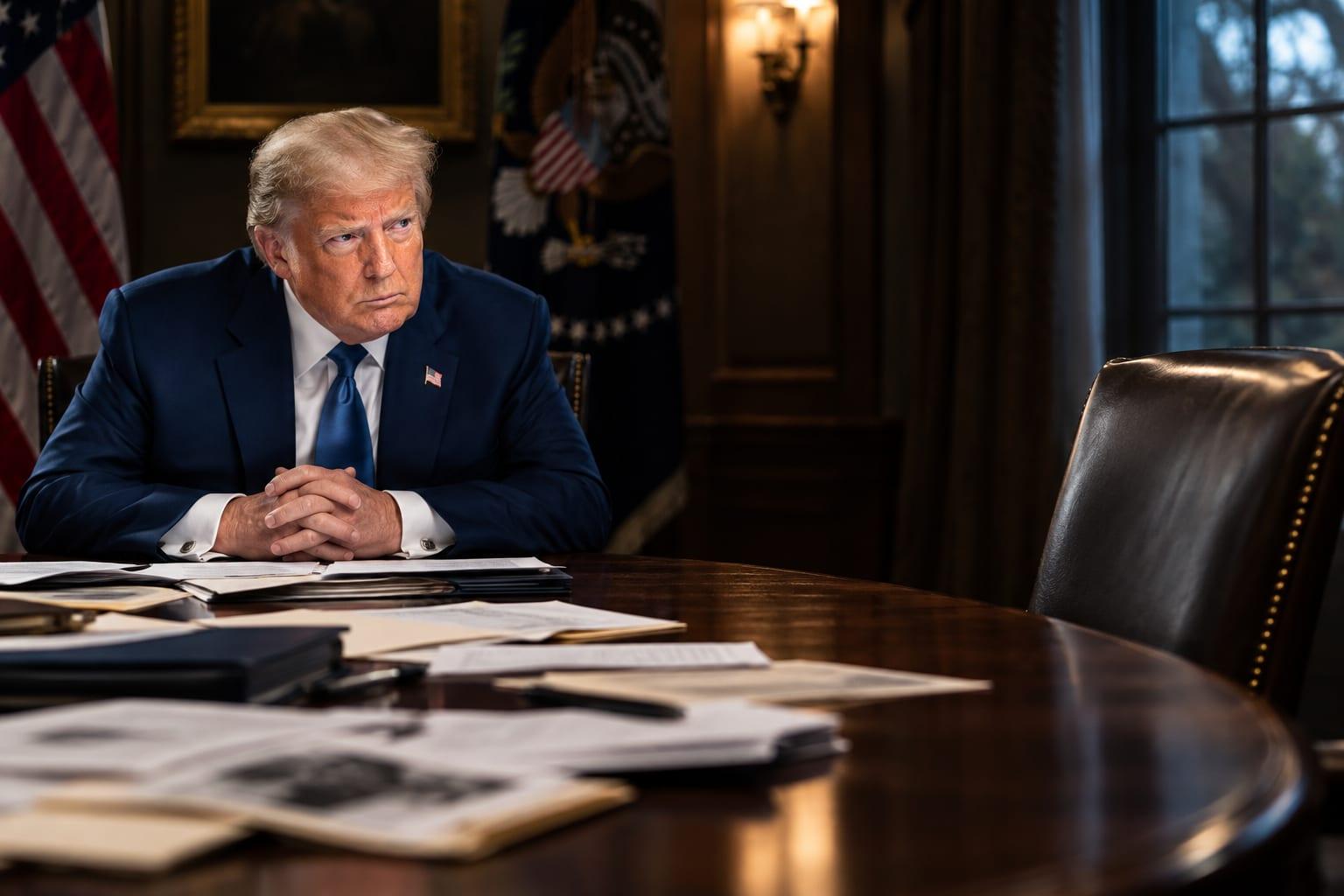
President Donald Trump said Saturday that he rejected Iran's latest proposal to end the war, a plan Tehran said would reopen the Strait of Hormuz and restart peace talks within seven days. Tehran had delivered the proposal through mediators earlier this week, according to a Washington Post report posted Saturday afternoon.
Iranian President Masoud Pezeshkian told CBS News in an interview that despite what he called an "atmosphere of distrust," Iran would "abide by whatever we commit to" if the United States accepted the offer to reopen the Strait of Hormuz, and said Iran would allow United Nations inspectors access. The report from @CBSNews did not carry the full text of the proposal.
The offer came as the Houthis launched a new wave of missile and drone attacks at Saudi targets Friday morning, and as negotiations with Washington continue through regional mediators including Qatar. According to @FirstSquawk, citing Axios and a US official, "positive and constructive talks are ongoing between Washington and Tehran through intermediaries," including on nuclear issues — a characterization that sits awkwardly beside the public rejection from the White House.
Commentator Mario Nawfal, whose X account @MarioNawfal carried a wide-ranging livestream discussion of the developments Saturday evening, said the phased proposal was a quicker version of an earlier memorandum of understanding, and that the Wall Street Journal reported Trump rejected it and may restart the war after the midterms. Nawfal also said US negotiators told Iran it does not control the Strait of Hormuz and therefore cannot bargain with it — a point he called the central unresolved dispute. A second @MarioNawfal clip presented Pezeshkian in his own words: "How can we believe that they are ready to do what they say? Those who came here martyred our leader. Those who came here martyred the students of Madrasa... Now we go and talk to them with humiliation? We die but we don't die under humiliation."
On the livestream, the two hosts disagreed sharply about whether any of the diplomacy is real. One argued the Iranians are demonstrating to the Chinese, who have asked for diplomacy, that they gave it a genuine chance and that Washington refused the deal. The other was blunter: "The Iranians in the room with you now, Mr. Trump, that is very much a real thing. I don't think he's talking to anybody. I think this is all for show... Until I see something real, I don't buy it." The same host argued that Pezeshkian does not have final authority in Tehran's system, and that there is no consensus inside the Iranian leadership on any deal.
The skeptics on the broadcast pointed to military movements as the real tell. One host said radar data showed a surge of refueling tankers and AWACS aircraft over the Persian Gulf in the previous twenty-four hours, describing it as the largest such presence in weeks, and said a temporary buildup of bombers flying in from Europe last weekend was tied to the same pressure campaign. The other host pushed back, saying there has been no significant new aircraft, troops, or assets arriving in the region in recent weeks, and that the tanker traffic is routine escort activity connected to the Strait of Hormuz, not a preparation for strikes. Both agreed that a genuine wind-down would show forces moving out of range of Iran — not merely repositioning within it.
The economic picture on the ground is contested just as hotly. One host said oil loadings out of Iran have fallen by roughly ninety percent, and that Pezeshkian did not deny it when asked on television, instead attributing the collapse to American pressure. Roughly twelve million barrels a day are moving through the Strait, per tanker trackers cited on the broadcast, though a US official told News Nation that nearly forty million barrels transited in the last forty-eight hours — a figure one host dismissed as implausibly double the satellite count.
Regional pressure is compounding. Turkey, the UAE, Oman, Georgia, and Azerbaijan have restricted Iranian flights or banking ties, while Pakistan's prime minister called the Strait of Hormuz and Bab el-Mandeb "arteries of the global economy" that "must remain open." The broadcast also cited a report in Haaretz, later confirmed by the New York Times, that the UAE president personally warned Israeli Prime Minister Benjamin Netanyahu of an imminent Hamas attack before October 7, and an Atlantic report that Egypt's intelligence chief delivered a similar warning in Jerusalem.
The Iran diplomacy is playing out against a broader escalation in Europe. The broadcast noted the first meeting between Germany's foreign minister and Russia's Sergey Lavrov since the 2022 invasion, Latvian border sensors sabotaged on the Belarus frontier, a Ukrainian drone strike on Russia's seventh-largest oil refinery, and Russian state media briefly publishing — then deleting — an article suggesting a "very short war" against Lithuania using nuclear-armed missiles. Poland and Lithuania are now preparing joint civilian evacuation plans for the Baltics.
No independent confirmation has been provided for the reported strike timing, the internal Iranian deliberations described on the broadcast, or the oil-loading figures. Next News Network could not independently verify these claims.
Our Take
The sequence matters more than the spin. Iran put a concrete offer on the table — reopen Hormuz, restart nuclear talks, seven days — and the White House turned it down flat. Within hours, anonymous US officials were telling Axios the talks were "positive and constructive." Both things cannot be fully true, and the American public deserves to know which one the administration actually believes.
The livestream argument between the two hosts captures the real fault line in this story: is Iran buying time, or is Washington? The tell is not the talking. It is the tankers. If refueling aircraft are surging over the Gulf while negotiators shake hands in Doha, then the "diplomacy" is a rearming window with better lighting. If they are not, then the pessimism is its own form of propaganda.
Meanwhile, the people who will pay for this are already paying. Iranian oil loadings are collapsing, the region's airspace is closing to Iranian carriers, and the two waterways that carry the world's energy — Hormuz and Bab el-Mandeb — are being treated by every party as bargaining chips rather than lifelines. President Trump rejected a deal that would have reopened one of them within a week. Whatever the merits of his conditions, he should explain to the country why the answer was no, and what the plan is if the next round of talks fails the same way.