
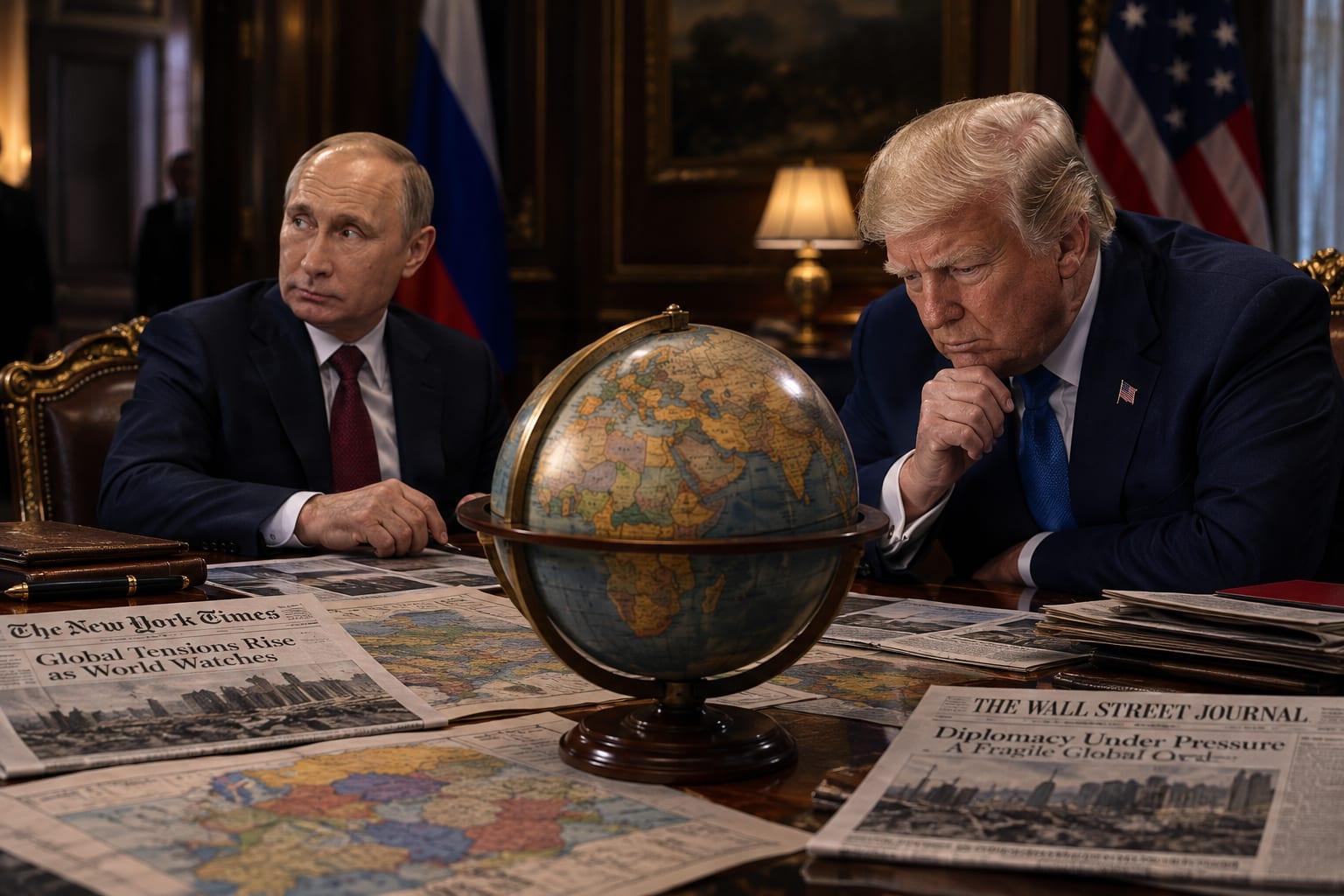
French presidential candidate Jean-Luc Melenchon said he supports Russia withdrawing from Ukraine, arguing that France cannot accept the resolution of any problem through the invasion of a neighbor. The remarks, circulated Saturday by the conflict-monitoring account @clashreport, put the left-wing candidate at odds with the French government's prevailing posture toward Moscow and added a new voice to a widening set of international reactions to the war.
"I am in favor of Russia withdrawing from Ukraine, because we, the French, cannot accept in any way that any problem is solved by the invasion of our neighbor," Melenchon said in the video carried by @clashreport. "We have an experience of this. We have been invaded four times by our neighbor. So, definitely, a French person cannot admit that problems are solved in Europe."
The transcript of the video provided by @clashreport ends mid-sentence as Melenchon begins a second point, leaving the remainder of his argument unclear from the available material. It is not known from the posts reviewed whether the candidate elaborated further, or in what setting the remarks were delivered.
Melenchon's position arrives as other European figures are testing the boundaries of what negotiations might look like. German Foreign Minister Johann Wadephul said Friday that the participation of Russian President Vladimir Putin at a G20 meeting could be the start of "serious negotiations" to end Russia's full-scale invasion of Ukraine, according to the news account @FirstSquawk. The comment, attributed to Wadephul by the account, signals that at least some European officials are contemplating a format in which Putin would appear alongside Western leaders for the first time since the invasion began.
Whether such a meeting has been scheduled, proposed through formal channels, or remains a hypothetical floated by the foreign minister is not established by the posts reviewed. The account @FirstSquawk reported the remark without indicating where Wadephul made it or whether it reflected a coordinated German position.
On the same day, Ukrainian President Volodymyr Zelensky said he urged President Trump to enlist China's help in ending Russia's invasion, according to the New York Post account @nypost. The appeal places Beijing at the center of Kyiv's diplomatic strategy, a notable shift for a government that has spent years pressing Western capitals for weapons and sanctions rather than Chinese mediation. Neither the substance of Trump's response nor any follow-up from Beijing is described in the post.
Together, the three statements -- from Paris, Berlin, and Kyiv -- sketch a diplomatic environment in which the question of how the war ends is being asked in public by actors who have spent much of the conflict focused on how it is fought. The @clashreport post carrying Melenchon's remarks, the @FirstSquawk post on Wadephul, and the @nypost post on Zelensky all appeared within roughly five hours of one another on Saturday, an indication that the reaction to the war's trajectory is not confined to any single capital or political faction.
The diplomatic activity unfolded against a battlefield picture that has shifted in Moscow's favor in at least one dimension. The Washington Examiner account @dcexaminer reported Saturday that Russia turned the tide of the summer air war in Ukraine, a development that follows months in which Ukrainian forces had claimed successes against Russian aviation and air defenses. The account offered no details in the post beyond the headline assessment.
Recent reporting from the Institute for the Study of War, cited in coverage reviewed for this article, assessed that recent incidents in Europe were conducted by Russia and warned that Western officials increasingly describe intensified kinetic activity against the continent. That assessment, dated September 24, places the Melenchon and Wadephul remarks in a context of heightened European security concerns rather than a purely diplomatic conversation.
Meanwhile, the economic and cultural toll of Russian strikes continues to accumulate. The New York Times reported that the economic damage from Russian strikes -- lost sales, disrupted workdays, and logistical snarls -- runs into the billions of dollars, and separately that Russian attacks have destroyed millions of books, with one publisher whose warehouse was hit twice saying Moscow "thinks that books are more dangerous for them than military equipment."
Ukraine's military, for its part, said it struck the Ilsky Oil Refinery in Russia's southern Krasnodar region during an overnight attack, according to the news account @FirstSquawk. Ukraine's General Staff said a fire broke out at the facility, the account reported. The claim has not been independently confirmed, and Russian authorities have not issued a statement on the matter in the material reviewed.
Next News Network could not independently verify the claims and statements described in this report, including the Ukrainian military's account of the refinery strike, the remarks attributed to Melenchon, Wadephul, and Zelensky, and the accounts of battlefield and economic developments cited from other outlets.
Our Take
The most telling item in Saturday's crop is not the refinery strike or the air war assessment. It is the sight of a French presidential candidate declaring, in plain language, that Russia should withdraw from Ukraine -- and doing so as a matter of French national memory rather than NATO solidarity. Melenchon's invocation of France having been invaded four times by its neighbor is a reminder that European skepticism of Russian intentions predates the current conflict by generations. The question his remarks raise is whether that skepticism translates into support for Ukrainian victory or into pressure on Kyiv to settle. The transcript ends before he answers.
Wadephul's float of a Putin G20 appearance deserves scrutiny rather than applause. A summit photograph is not a negotiation, and the foreign minister's phrasing -- that participation "could be the start" of serious talks -- concedes that no such talks are underway. The risk is that the format becomes a reward for Russian aggression rather than a mechanism to end it. If Berlin wants to test Moscow's seriousness, it should demand withdrawal as the price of the table, not the topic of conversation at it.
Zelensky's turn to Trump and China reflects the hard arithmetic of a war entering another winter. Kyiv has watched Western air defense deliveries lag, watched its energy grid absorb another round of strikes, and watched its cultural institutions -- libraries, publishers, warehouses of books -- be deliberately targeted. Asking Washington to bring Beijing into the equation is not a sign of confidence in the West. It is a sign that the West has not yet given him reason to rely on it alone.
