
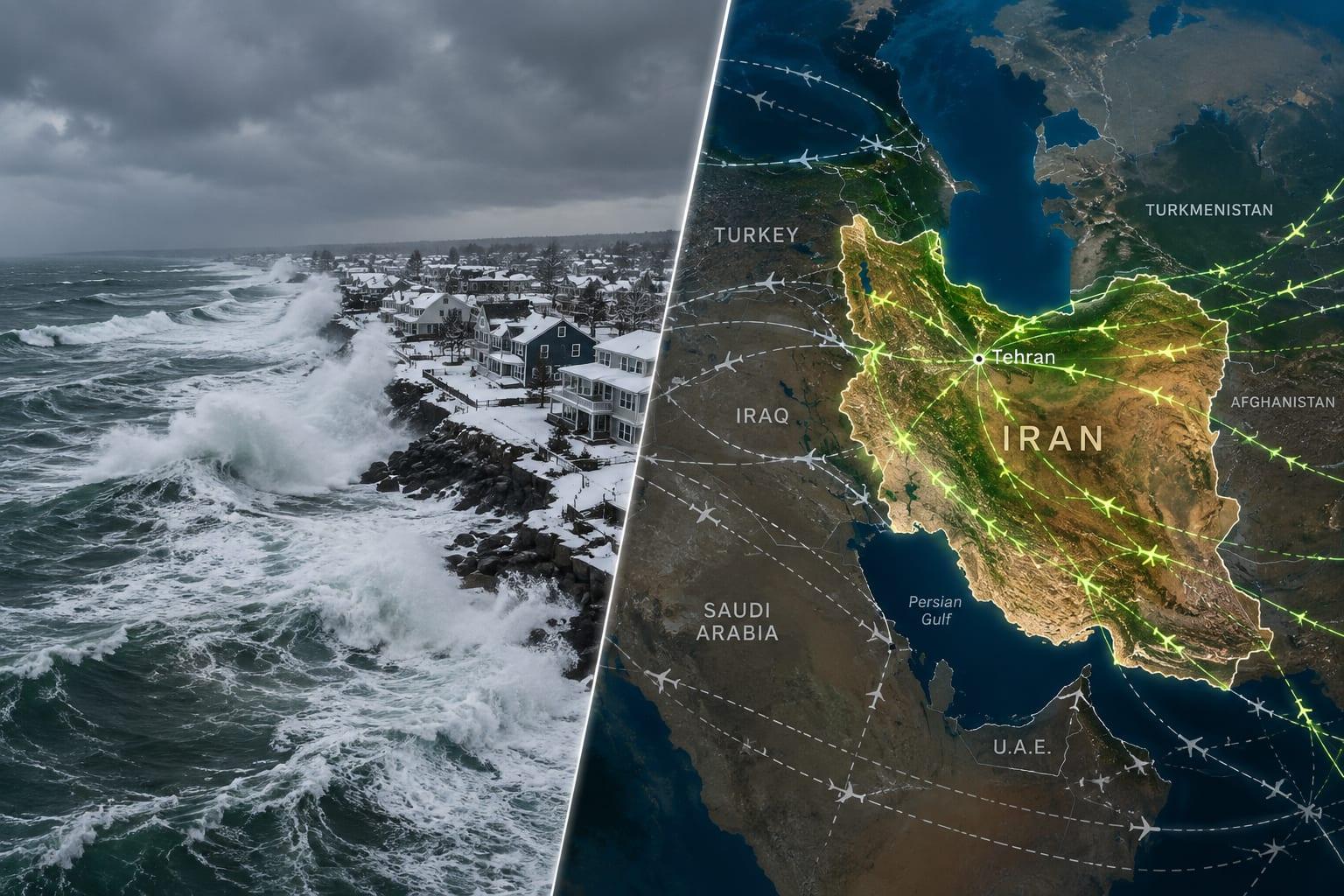
More than forty million Americans are in the path of a powerful nor'easter hammering the East Coast, with hundreds of flights canceled and thousands of customers left without power, according to Fox News. The storm is ramping up along the Jersey Shore, bringing heavy rain, strong winds and coastal flooding that has already begun eating into beaches and back bay neighborhoods.
In a live report from Ocean City, New Jersey, a correspondent described days of pounding surf and erosion that has pulled sand away from the shoreline and pushed water into the back bays. "We've had a lot of strong winds for the last few days, but we finally have both the wind and the rain impacting us here on the coast of New Jersey," the correspondent said. "We're an ocean city where we've had days of pounding surf and erosion that have actually eaten away at the beaches here."
The reporter explained that sustained north and northeast winds have been piling water into the back bays, making it harder for each tide to drain fully. With multiple high tide cycles already logged and more still to come, the entire New Jersey coast is now expected to experience major flooding. "The governor's declared a state of emergency here in eight counties ahead of this just to make sure that those resources should be available," the correspondent said, adding that high water trucks are staging in several shore towns and residents have been told to move their cars to higher ground, especially in low-lying areas of Ocean City.
The storm is not expected to stay in the Mid-Atlantic. According to the Fox News report, it will move up into New England, and with the track running closer to the coast, some of the heaviest rain could fall anywhere from coastal New Jersey to Long Island or one of the New England shore towns. "We still have a number of high tide cycles to get through, which each will bring a renewed threat for flooding and erosion," the correspondent said. "The next high tide is about two and a half hours away."
As the East Coast braces for water, Iran's aviation map is being redrawn by sanctions. According to a post from the account @FirstSquawk, flights from Iran to Turkey, Malaysia, China and Pakistan remain operational, while services to the United Arab Emirates, Iraq, Oman and Georgia remain canceled, as reported by IRIB. Flights to Vietnam and Afghanistan are also operating, the post said. Iran International reported that Iran threatened to disrupt regional air travel if its airlines lose access to flights and airport services, as Iraq's Najaf, Erbil and Sulaimaniya joined other destinations restricting Iranian connections under mounting US sanctions pressure.
Al Jazeera reported that Baghdad, Najaf, Erbil and Sulaimaniyah airports suspended flights as Washington ramped up pressure on Iran's aviation sector. The UAE joined Oman, Iraq, Azerbaijan, Georgia and Turkmenistan in restricting access to Iranian airlines, according to Al Jazeera. The Times of India, in live updates on the wider Middle East conflict, reported that Iran warned it would target all US interests in the region if the United States "makes a mistake," with the latest developments dominated by an address from Israeli Prime Minister Benjamin Netanyahu.
WANA reported that despite the suspension or disruption of some flights from Iran to regional destinations, flights between Iran and several countries, including China, Russia, Turkey, Pakistan and Thailand, continued. Several international flights to and from Iran were operated that morning, according to WANA.
The competing accounts sketch a picture of an aviation network under pressure rather than shut down. Iran says some routes are still running. Its neighbors are closing their airspace to Iranian carriers one by one. The same Iranian state media that listed Turkey, Malaysia, China and Pakistan as operational also confirmed the cancellations to the UAE, Iraq, Oman and Georgia. The result is a patchwork: an airline sector that can still reach Beijing, Moscow, Ankara and Islamabad but increasingly cannot reach its closest Arab neighbors.
The aviation restrictions follow a broader pattern of US sanctions aimed at Iran's ability to operate internationally. The Iranian response, as carried by Iran International, was a threat to disrupt regional air travel if its airlines lose access to flights and airport services. That threat has not been independently confirmed as carried out, and no specific action has been reported by the outlets covering the story. The airports in Iraq that suspended Iranian flights did so as Washington escalated its pressure campaign, according to Al Jazeera.
Together, the two stories show a country dealing with disruptions on two fronts: an East Coast storm that has already forced a state of emergency in eight New Jersey counties and grounded hundreds of flights, and an Iranian aviation sector that is losing landing rights across the region while insisting that key routes remain open. The Fox News report from Ocean City made clear that the worst of the nor'easter is still ahead, with more high tide cycles to come. The reporting on Iran's flight map made clear that the sanctions pressure is ongoing, with more destinations potentially joining the list.
Next News Network could not independently verify the claims about which flights remain operational or which airports have suspended service. The statements are being attributed to the outlets and accounts that carried them.
What is not yet known is how many flights have been affected in total, whether additional countries will bar Iranian airlines, and how high the water will ultimately rise along the Jersey Shore and into New England. The storm's peak is still unfolding, and the aviation restrictions are still spreading.
Our Take
Two crises, one week, and the American public gets the bill for both. On the East Coast, forty million people are watching a nor'easter swallow their beaches and flood their towns while the governor of New Jersey declares a state of emergency in eight counties. That is what happens when infrastructure and emergency planning are treated as afterthoughts. On the other side of the world, the sanctions campaign against Iran is working exactly as intended, cutting off its airlines from one regional hub after another. But Tehran is not backing down; it is threatening to disrupt regional air travel and vowing to target US interests if Washington "makes a mistake." That is not the language of a cornered regime. That is the language of one that still believes it has leverage. The West needs to decide whether it is serious about deterrence or whether it is content to play whack-a-mole with flight bans while American families on the Jersey Shore wonder if their cars will be underwater by morning.
