
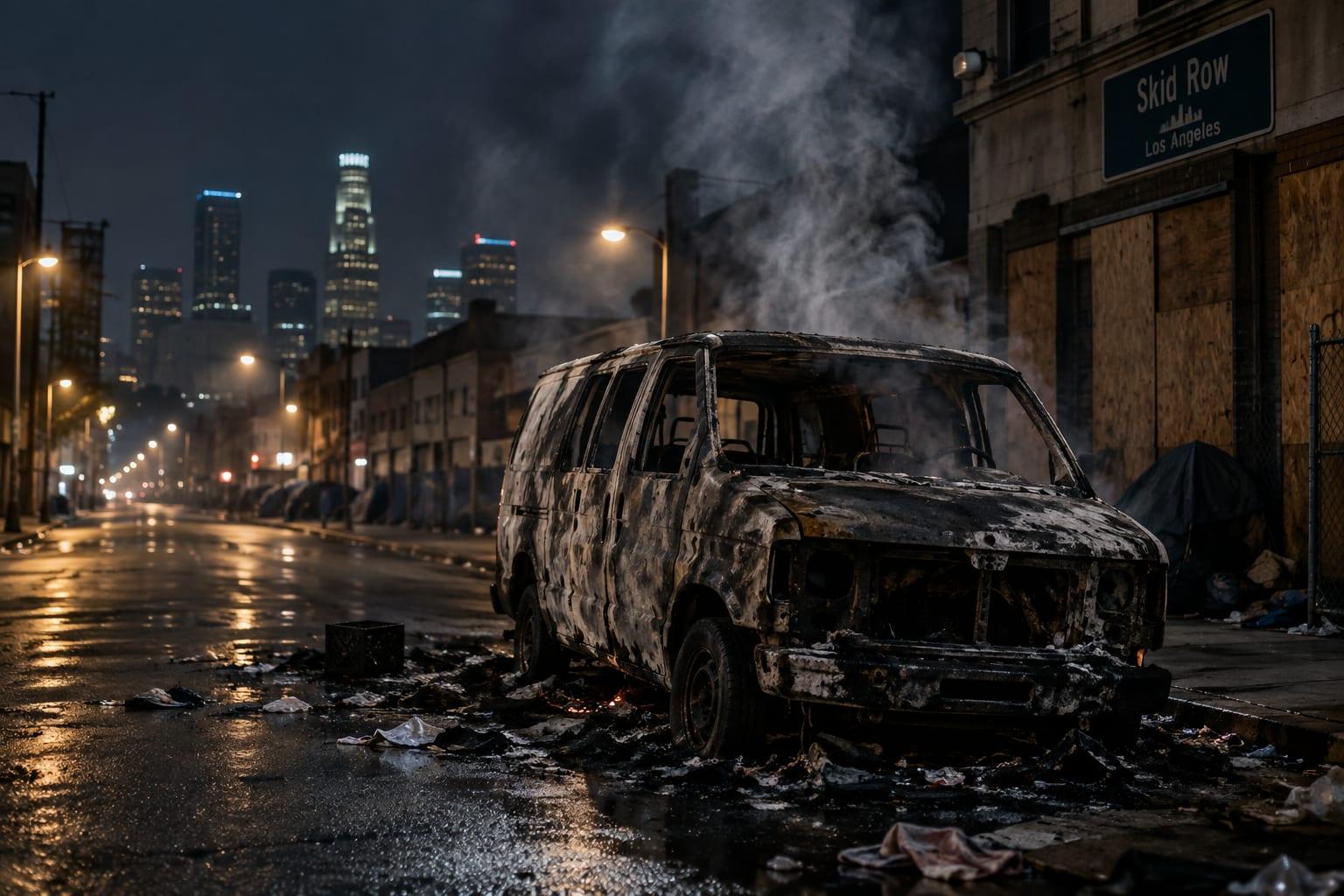
A stranger pulled a four-year-old pit bull named Rosie from a burning van parked on Skid Row after an arsonist threw a flammable object into the vehicle, according to reporting by FOX 11 Los Angeles. The station identified the dog and described the rescue as the work of a passerby who intervened as the fire spread. The New York Post's account referred to the animal as a “helpless dog chained to Skid Row van” and to the rescuer as a “hero stranger.”
The episode drew attention across several outlets and social accounts in the hours after it was first described. The New York Post's post carrying the account was posted at 7:46 p.m. Eastern on September twenty-sixth. Other coverage described a different rescue in different circumstances — a paralyzed and malnourished dog chained to a tree, and a starving pit bull freed by an officer with bolt cutters — but the Skid Row account is the one that centers on a burning vehicle and a stranger who acted as flames advanced.
FOX 11 Los Angeles reported that a stranger stepped in to save the dog after an arsonist threw a flammable object into the van. That is the claim as the station carried it. The account spread to other sites that repeated the detail of the dog's name and age, and the detail that the dog had been chained to the van.
That the animal was chained is a central element of the account as it has been described. It is also the element that explains why the dog could not free itself as the fire grew. The New York Post's phrasing — “helpless dog chained to Skid Row van after it's set on fire” — captures the sequence as the outlet presented it: the chaining, then the fire, then the rescue.
What is not in dispute in the coverage is the identity of the dog and the place. Multiple accounts name the dog Rosie, a four-year-old pit bull, and place the van on Skid Row. The person credited with the rescue is described only as a stranger who intervened. No name has been attached to the rescuer in the coverage reviewed.
Within hours, the story had moved from the local station to national aggregators and to individual accounts that recirculated the headline. The pattern is familiar for animal-rescue stories: a local report with a clear image and a simple arc, then a rapid pass through national outlets and social feeds. The New York Post's post was among those. So were the other animal-rescue items that appeared in the same news window, including the account of a paralyzed and malnourished dog kept chained to a tree and finally rescued, and the account of a starving pit bull found chained to a tree and freed with bolt cutters by an officer named Nick who gave her food and comfort first.
The dog-in-a-backpack story out of a Starbucks, carried by The Washington Post, moved in the same current. In that account, a man named Steve Wruble said, “I literally gave my heart away to this dog so quickly,” after the dog was adopted almost on the spot. The Brad Pitt item — the actor getting choked up over a script for a film about a veteran and his military dog — sits in a different register but the same broad category of dog-centered news that travels well across outlets and feeds.
What makes the Skid Row account distinct is the fire. A fire in a van on a street where people live out of vehicles and tents turns a rescue into a public-safety story as well as an animal story. The arsonist in the account threw a flammable object into the van. That is the alleged act. The dog was inside. The dog was chained. The dog could not get out. A stranger got the dog out.
It is not yet known whether anyone has been arrested or charged in connection with the fire. It is not yet known whether the arsonist and the dog's owner are the same person or different people. It is not yet known what condition the dog is in beyond having been rescued from the van. It is not yet known whether the dog has been returned to an owner or placed with a rescue or shelter.
Next News Network could not independently verify the account of the fire, the chaining, or the rescue as described in the coverage and social posts.
The absence of those details does not change what the accounts agree on. They agree on the place, the animal, the fire, and the intervention. And they agree on the shape of the story: an animal that could not save itself, and a person who did.
Animal-rescue stories travel because they are simple, and because they allow readers to take a side without ambiguity. The side here is the dog. There is no faction that defends chaining a dog to a van and setting the van on fire. That is part of why the account moved as quickly as it did through outlets that otherwise disagree on nearly everything. A pit bull named Rosie, a stranger, a fire, a street where the visible misery of American cities is concentrated — the elements are legible to any reader in any market.
What the coverage does not do, in the versions reviewed, is answer the questions that follow any such rescue. Who owned the dog. Whether the dog was chained by an owner or by someone else. Whether the fire was set to destroy the van, to hurt the dog, or for a reason that has nothing to do with either. Whether the rescuer knew the dog or was simply passing by. Whether there were other animals or people in the van. Whether the arsonist has a name.
Those are the questions that separate an account that travels from an account that holds up. Until they are answered, the story is what the posts and the station said it was: a dog chained to a van, a van set on fire, and a stranger who got the dog out.
Other outlets in the same window carried different animal-rescue stories with different details and different outcomes. The paralyzed dog chained to the tree had a suspected fungal infection or tick disease, though the test was negative, according to the account. The starving pit bull was comforted with food before the bolt cutters came out. Each of those accounts stands on its own details. None of them confirms the Skid Row account, and the Skid Row account confirms none of them.
The one thing the accounts share is the thing that made them worth carrying: a dog that could not help itself, and a person who did.
Our Take
If the account holds up as reported, the stranger on Skid Row did what a decent person does when an animal is trapped in a burning vehicle: got the animal out. That should be said plainly, and it should be said without turning the man into a monument. The interesting question is not whether he is a hero. The interesting question is why the story travels as a hero story and not as a story about a city where a van on Skid Row can be set on fire with a dog chained inside it, and the arsonist is a footnote.
Los Angeles has spent years arguing about Skid Row. The arguments are about tents, about enforcement, about housing, about who is allowed to sleep where. What the arguments have not produced is a street where a fire in a parked van is a rare event. If the account of the arson is accurate, the arsonist committed a crime against property and against an animal, and the coverage should not lose that fact in the warmth of the rescue.
Note what the accounts do not say. They do not say whether the dog was chained by an owner who left her there or by someone with no claim to her at all. They do not say whether the fire was meant to kill the dog, to destroy the van, or to settle something between people. They do not say whether anyone has been arrested. Those are the details that would turn a viral rescue into a public-safety story, and they are missing.
Readers should hold two things at once. The stranger's act deserves credit. The account, as it stands, is not independently confirmed, and the questions that would make it a complete story are unanswered. Credit the man. Do not credit the narrative beyond what it can carry.
The broader lesson is about how animal-rescue stories function in the news cycle. They are the one category of American news that nearly everyone agrees on, which is why they are promoted so heavily and why they crowd out the harder stories from the same street on the same night. A dog pulled from a burning van is worth covering. So is the van, the fire, and the street it was parked on. The first gets shared. The second gets filed. That imbalance is not the fault of the stranger who reached into the flames. It is the fault of the rest of us, who would rather share the rescue than ask what happened to the arsonist.
