
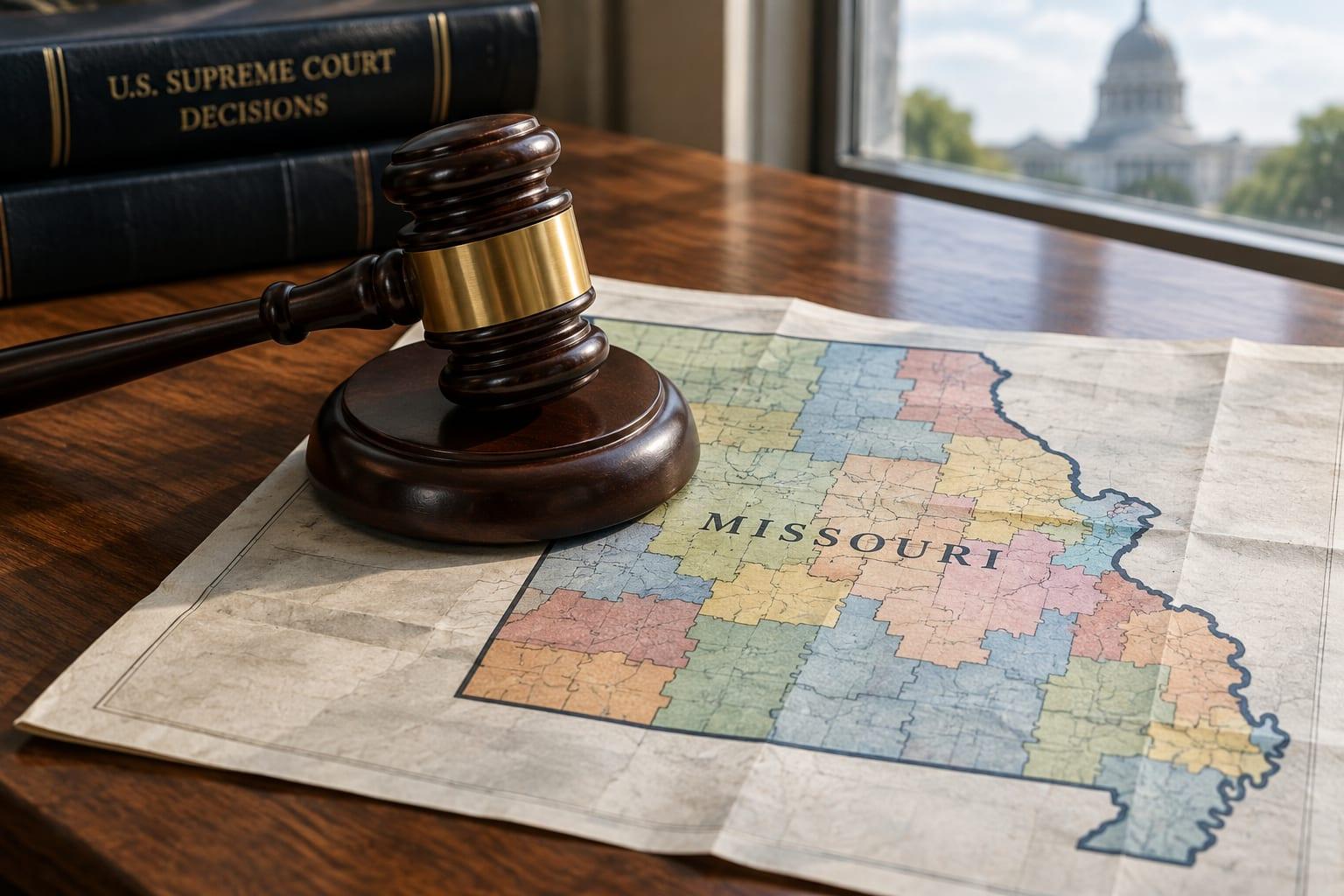
The Supreme Court on Friday ordered Missouri to use its 2022 congressional map for the 2026 election, blocking the state from implementing a newer map drawn in 2025. The ruling marks the third time the high court has rejected a Trump-backed Missouri congressional map, according to a post from the Washington Times.
"Supreme Court rejects a Trump-backed Missouri congressional map for the third time" — @WashTimes
The decision forces Missouri election officials to revert to boundaries that were in place for the 2022 midterms, a map that predates the redistricting efforts aligned with President Trump's second term. The 2025 map, which had been approved by Missouri's Republican-controlled legislature, would have adjusted district lines in a way that critics argued diluted the influence of certain voters. Supporters of the newer map contended it better reflected population shifts and political realities across the state.
The Supreme Court's order did not include a lengthy written opinion, and it is not yet known how the justices divided on the decision. The practical effect is immediate: Missouri's 2026 congressional primaries and general election will proceed under the 2022 boundaries, which were originally drawn after the 2020 census.
Roughly eight congressional districts are at stake in Missouri, and the difference between the two maps could shape which party holds the advantage in a handful of competitive seats. Missouri has leaned heavily Republican in recent statewide elections, but the 2022 map included at least one district that Democrats have targeted in past cycles. The 2025 map, by contrast, was seen by analysts as a more aggressive gerrymander that could have made it harder for Democratic candidates to compete in suburban and exurban areas.
The ruling is a setback for Missouri Republicans who invested significant political capital in redrawing the map. It also represents another legal defeat for redistricting efforts tied to Trump, who has publicly encouraged Republican-led states to maximize their congressional advantages ahead of the 2026 midterms. The Washington Times noted that this is the third such rejection, suggesting a pattern of federal courts pushing back on maps that were designed to benefit the GOP.
Democrats and left-leaning advocacy groups celebrated the decision, framing it as a victory for fair representation. But the ruling also underscores a broader legal fight unfolding across the country: courts have increasingly intervened in state redistricting battles, often overriding legislatures on procedural or constitutional grounds. For Missouri voters, the immediate consequence is that their congressional boundaries will remain unchanged from the last election cycle, despite the legislature's attempt to update them.
The Supreme Court's order came without a public hearing or oral arguments, which is typical for emergency applications in redistricting cases. It is not yet known whether Missouri will attempt to appeal or introduce a revised map before the 2026 filing deadlines. State election officials have not yet commented publicly on how the ruling will affect their preparations.
For now, the 2022 map stands. That means Missouri's congressional districts will look the same in 2026 as they did in 2022—a reality that frustrates Republicans who hoped to lock in an advantage and relieves Democrats who feared being shut out of key races. The decision also raises questions about the limits of state legislative power when federal courts step in, a tension that is likely to persist as both parties jockey for control of Congress.
Missouri joins a growing list of states where redistricting has been decided not by elected officials but by federal judges. The Supreme Court's action on Friday is the latest example of that trend, and it leaves both parties adjusting their strategies for the upcoming midterms under maps they did not choose.
Our Take
Once again, the Supreme Court has stepped in to block a Republican-led state from drawing its own congressional lines—and this time, it's Missouri's turn. The 2025 map was approved by a GOP legislature and signed by a Republican governor, yet three times now the high court has said no. Why? Because the game is rigged. The same justices who allow Democrat-run states like Illinois and Maryland to gerrymander with impunity suddenly find procedural problems when a red state tries to level the playing field.
Patriots, this is not about "fair maps." It's about power. The left knows that if Missouri's new map had taken effect, Republicans would have likely picked up seats in 2026. The Supreme Court's decision—issued without a full opinion or hearing—hands Democrats a win they could not achieve at the ballot box. It also sends a chilling message to every red state: don't bother trying to redraw your districts, because the courts will slap you down.
Meanwhile, the legacy media is silent on the double standard. They cheered when courts struck down GOP maps in North Carolina and Ohio, but they ignore the fact that blue states continue to carve up districts to their advantage. The Washington Times called it a "rejection" of a Trump-backed map. We call it what it is: the administrative state and its judicial allies protecting the status quo.
So what happens now? Missouri will use the 2022 map, which means a handful of districts could remain competitive for Democrats. That's a loss for conservatives who wanted to maximize their influence in Congress. But it's also a wake-up call. If we want fair maps, we need to fight at every level—state legislatures, courts, and the ballot box. The left will never stop trying to rig the system. Neither should we.
