
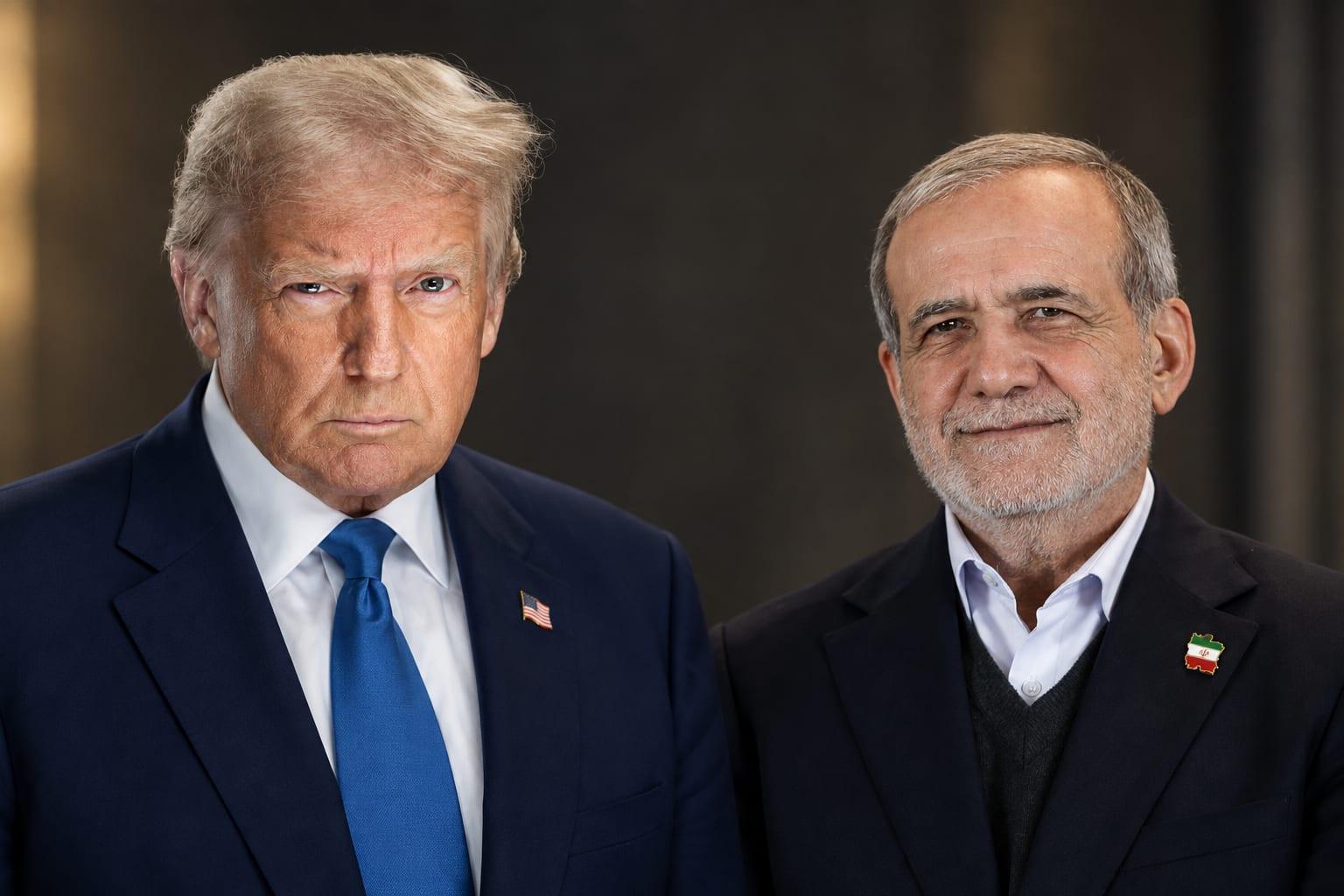
President Donald Trump said Iran cannot have a nuclear weapon, restating a position his administration has carried through months of indirect talks and a stalled conflict, as Iranian President Masoud Pezeshkian publicly insisted that Tehran was never pursuing one in the first place.
The president's statement was carried by the account @FirstSquawk, which posted: "TRUMP: IRAN CAN NOT HAVE A NUCLEAR WEAPON!!! President DJT." The declaration came as negotiations between Washington and Tehran remain active through mediators in Qatar and as reports circulate that the White House has rejected an Iranian proposal to reopen the Strait of Hormuz and halt fighting within seven days.
Pezeshkian's response came in remarks circulated by the account @clashreport, which posted an excerpt in which the Iranian president asked when Tehran had ever said it was seeking nuclear weapons. "When did we ever say that we are seeking nuclear weapons? Developing nuclear weapons is haram from a standpoint of belief, not from a legal perspective," Pezeshkian said, according to the account.
In the fuller transcript carried with the same post, Pezeshkian framed the question against earlier discussions about inspections and guarantees. "Where Iran says, I will not, in the future, pursue a weapon and allow in inspectors and give up peace. Are you aware of the previous conversations that we've conducted?" he said, before returning to the same denial.
He then invoked the religious dimension of the question directly, tying the prohibition to a clerical decree rather than to treaty obligations. "Yes. They have martyred a supreme leader that according to his clerical decree. Iran has always said you're not seeking a nuclear weapon, intelligence agencies," Pezeshkian said. "Developing nuclear weapons is haram. From a standpoint of belief, not from a legal perspective."
The Iranian president went further, acknowledging that individuals inside the country could have reason to want such a weapon while maintaining that the faith forbids it. "Even if some individuals in Iran may have the incentive to develop nuclear weapons, religiously speaking, they are not allowed to pursue that path," he said in the same remarks.
The exchange lands at a point of open friction between the two governments. Reports carried over the weekend describe Iran's president as saying Tehran wanted a deal with the United States before November's midterm elections, a characterization described as contrary to President Trump's own public claims. The president has reportedly rejected a seven-day plan put forward by Iran that would have reopened the Strait of Hormuz and brought a halt to regional fighting within a week, with reporting suggesting American strikes could resume after the midterms.
A United States official said Friday that Washington is having positive, constructive discussions with Iran through mediators and continues to discuss nuclear issues, according to one of the reports. Qatar has been mediating between the two sides as they continue indirect talks over the conflict and over Iran's nuclear program.
The disagreement over intent is not the only nuclear question moving through the region. A classified United States intelligence assessment delivered to Congress reportedly warns that Saudi Arabia has not ruled out developing a nuclear weapons program, according to reporting on the assessment.
Against that backdrop, Pezeshkian's argument rests less on a legal defense than on a religious one. His phrasing separates the prohibition from any treaty or international legal framework, grounding it instead in the concept of haram — conduct forbidden under Islamic belief. That distinction matters to how his statement should be read: he is not describing a weapons program that was abandoned under pressure or shut down under inspection, but rather an intention he says was never held. He also gestures at the internal dimension of the question, allowing that incentives could exist among some Iranians while asserting that religious authority bars acting on them.
The president's position, by contrast, is unqualified. The statement carried by @FirstSquawk sets a condition on the outcome rather than on Tehran's stated intention: the weapon itself is the line, whatever Iran's government says about its aims.
What neither statement settles is the state of the broader negotiations. Reporting on the rejected proposal indicates the two sides remain in indirect contact through Qatari mediators even after the ceasefire framework was turned down, and the same reporting notes continued discussion of nuclear issues. The sequence — an Iranian proposal, its rejection, an American restatement of the red line, and a fresh Iranian denial of intent — leaves the core dispute exactly where it has been: not over whether inspections might resume or a deal might be signed, but over what Tehran was doing in the first place.
It is not yet known whether the current round of indirect talks has produced any movement on inspections, enrichment limits, or the timing of a possible agreement relative to the midterm elections. It is also not known what specific proposal, if any, the Iranian side has put on the table beyond the seven-day arrangement that was reportedly turned aside, or what conditions Washington has attached to any resumption of talks.
Next News Network could not independently verify the claims described in this report.
Our Take
Notice what Pezeshkian actually said. He did not say Iran's program is peaceful and open to any inspection regime the international community demands. He said the weapon is haram — forbidden by belief, not by law — and then, in the same breath, allowed that some Iranians may have the incentive to build one. That is not a denial. That is a denial with an escape hatch built into it, and it is the kind of formulation that sounds reassuring in translation and considerably less so when read twice.
The religious framing is doing a great deal of work here. A prohibition grounded in clerical decree is a prohibition that can be reinterpreted by whoever holds the clerical authority to reinterpret it. A treaty obligation, an inspections regime, a verified enrichment cap — those are constraints that do not move when the scholarship moves. Tehran has spent years declining to accept the second category while offering the first as a substitute, and this statement is that trade in its purest form.
Meanwhile, the reporting around this exchange is that the president rejected a seven-day plan to reopen the Strait of Hormuz and stop the fighting, and that American strikes may resume after November. Read together, that tells you the administration has concluded that a short-term arrangement buys Tehran time without buying Washington anything. The president's statement that Iran cannot have a nuclear weapon is not a negotiating position. It is a condition.
The Saudis, for their part, reportedly have not ruled out a program of their own, which is what happens when a region watches one country hedge for two decades while everyone else is asked to accept assurances. The only outcome that holds is verification, and the only statements worth weighing are the ones that invite it.
