
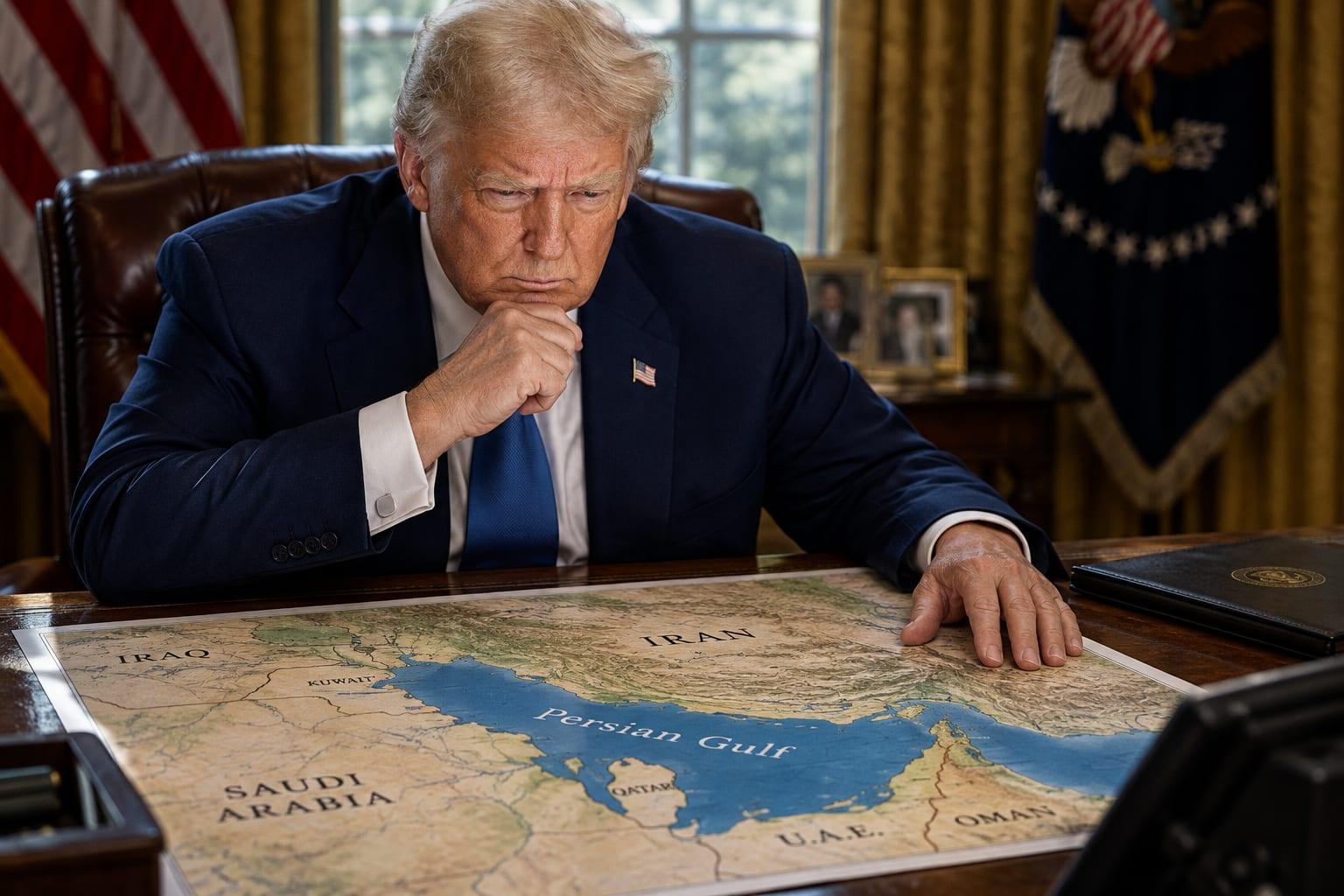
President Donald Trump has rejected an Iranian proposal to reopen the Strait of Hormuz for seven days, according to reports circulating Friday, with a U.S. official saying he expects American strikes against Iran to resume after the November midterm elections.
The claim was first carried by the financial newswire account @FirstSquawk, which posted shortly before 2 p.m. Eastern that "Trump says he has rejected Iran's proposal." Within hours, the report had been picked up by Axios, Al Jazeera and a cluster of aggregator accounts on X, all describing the same basic sequence: Tehran offers a short-term reopening of the strait, Washington declines, and the White House signals that military operations will wait until after voters go to the polls.
According to the Axios report, which was aggregated by several accounts, the Iranian proposal called for a seven-day pause in hostilities during which the Strait of Hormuz would be reopened to commercial traffic. Trump reportedly rejected the offer and told aides he expects U.S. strikes to resume once the midterms are over. The report did not specify what conditions, if any, the administration attached to a longer-term arrangement.
Al Jazeera, in its own coverage, quoted an analyst saying Trump may opt to resume attacks on Iran after the November midterm elections. The network framed the rejection as the opening of a new phase in the U.S.-Israel war on Iran, noting that the seven-day ceasefire proposal had been floated through intermediaries but was never formally accepted by Washington.
A U.S. official, speaking on condition of anonymity, said Friday that the United States is having "positive, constructive discussions with Iran through mediators" and continues to discuss nuclear issues. That statement, reported by Reuters and carried by other outlets, appeared to conflict with the harder line attributed to the president. It was not immediately clear whether the official was describing a separate channel or attempting to soften the public posture.
Iranian officials have pressed publicly for a deal before the November vote. Iranian President Masoud Pezeshkian said Thursday that Tehran wanted an agreement before the U.S. midterm elections, according to reports. Foreign Minister Abbas Araghchi said the seven-day proposal could provide a window for broader negotiations, though he did not detail what Tehran expected in return.
The Strait of Hormuz, a narrow waterway at the mouth of the Persian Gulf, handles roughly a fifth of global oil shipments. Its closure or reopening has immediate consequences for energy markets, insurance rates and naval deployments. The seven-day plan, as described in the reports, would have restored commercial passage for a week while talks continued.
The rejection, if confirmed, would mark the second time in recent weeks that a short-term Iranian offer has been turned down. It is not known whether a revised proposal is being prepared or whether the mediators — reported to include Oman and Qatar — remain involved.
Trump has declined to say publicly whether he would make a decision on renewed strikes before or after the elections. The reports citing the U.S. official said he expects bombing to resume after the midterms, but no timetable has been announced and no formal order has been described.
The accounts carrying the story Friday included @FirstSquawk, which posted the initial claim, along with aggregators that amplified the Axios and Al Jazeera reports. The claim spread quickly across financial and foreign-policy channels on X, where it was discussed alongside oil futures and regional security analysis.
Next News Network could not independently verify the claim that Trump rejected the Iranian proposal or that he expects strikes to resume after the midterms. The reports rely on unnamed officials and sources described as familiar with the discussions; neither the White House nor the Iranian mission to the United Nations has issued a formal statement confirming the sequence.
It is also not known whether the seven-day plan remains on the table in any form, whether the mediators have delivered a counteroffer, or what conditions the administration would require for a longer pause. The U.S. official's description of "positive, constructive discussions" suggests that some channel remains open, even as the public posture hardens.
What is clear from the reporting is that the proposal, as described, would have traded a temporary reopening of the strait for a temporary halt in hostilities. The president, according to the reports, declined that trade and signaled that military pressure would continue after the election. Iran, for its part, has said it wants an agreement before the vote — a timeline that now appears unlikely to be met.
The story is being carried by outlets across the spectrum, from Axios to Al Jazeera, and the framing differs: some emphasize the rejection as a sign of escalation, others as a negotiating tactic. The underlying facts — what was offered, what was rejected, and what comes next — remain attributed to unnamed sources and have not been confirmed by either government.
Our Take
The reporting Friday paints a picture of a White House that has decided to keep its options open until after the midterms. That is a political calculation as much as a military one. By declining a seven-day reopening of the Strait of Hormuz, the president avoids a pre-election pause that could be portrayed as weakness, while preserving the option to resume strikes once voters have had their say. The U.S. official's talk of "positive, constructive discussions" gives the administration room to claim diplomacy is alive even as the public posture remains firm.
But the lack of confirmation cuts both ways. If the reports are accurate, Tehran has now been rebuffed twice on short-term offers, and the mediators who carried those offers may conclude that Washington is not serious about a near-term deal. If the reports are wrong or overstated, the administration has done little to correct the record, leaving markets and allies to trade on rumor. Either way, the Strait of Hormuz remains a flashpoint, and the next move — whether a revised Iranian proposal or a resumption of strikes — will shape the region's trajectory well beyond November.
