
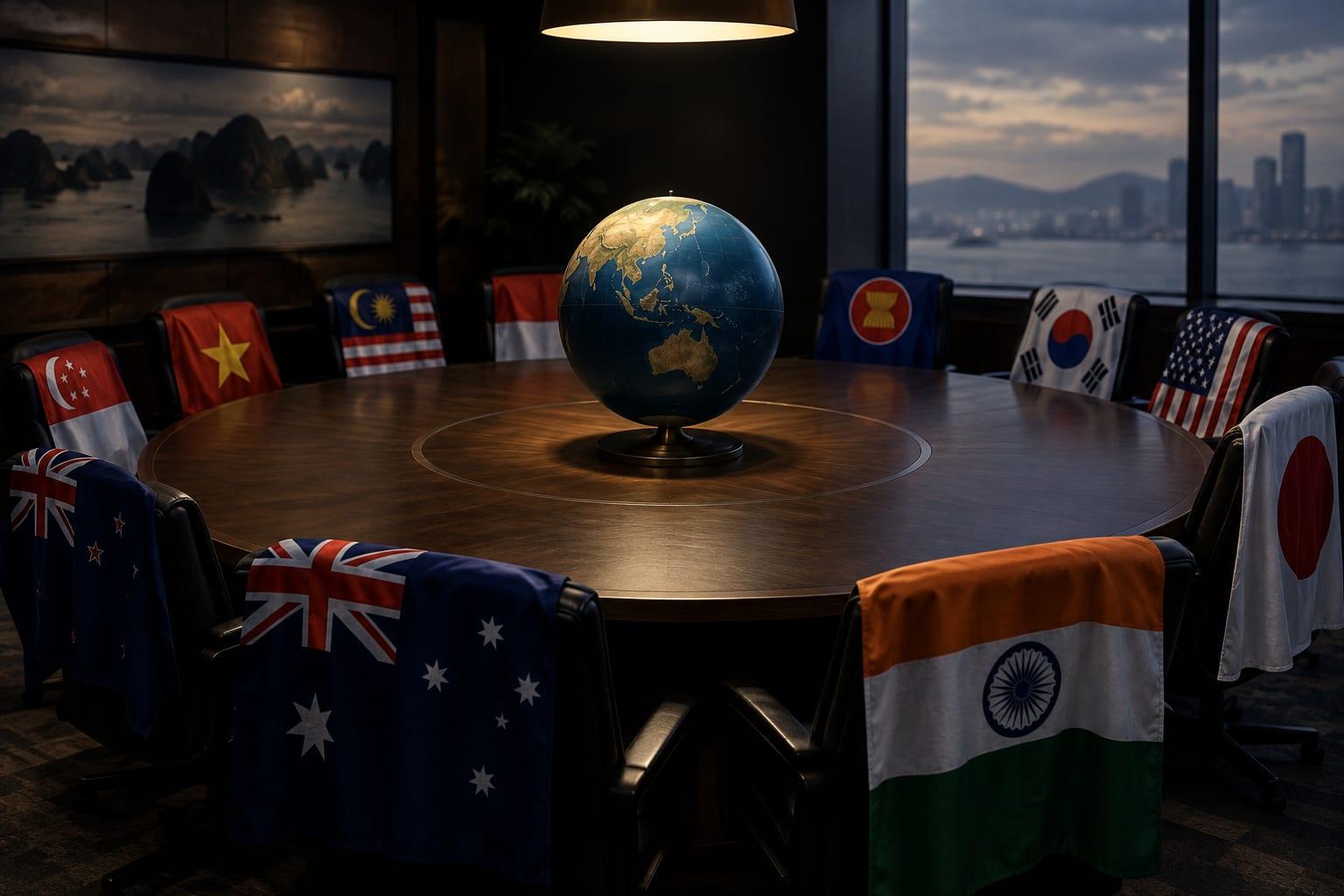
A potential United States strategy long feared by America's Asian allies has been given shape, according to a Washington Times post published Sunday evening, and the reaction from allied capitals and American commentators has spread quickly across the accounts carrying it.
The claim, as described in the Washington Times post under the account @WashTimes, is that a plan for the United States to pull back from its Asian alliances and defer to China has moved from speculation among diplomats into something with a described shape. The post, timestamped at 5:33 p.m. Eastern, offered no further detail in the text itself. The same language appeared in separate coverage of the same subject, headlined "Call for U.S. to pull back on Asia alliances, defer to China has Indo-Pacific on edge," published roughly forty minutes before the Washington Times post and carrying the identical opening line.
What is being claimed is a shift in American posture toward the Indo-Pacific, one that would reduce the American security role in the region and accept a larger Chinese role in its place. It is that claim, rather than any confirmed change in policy, that has driven the reaction. Next News Network could not independently verify it.
The anxiety is not new. What is new is the company it is keeping. For years, allied governments in Tokyo, Seoul, Canberra and Taipei have privately worried that American commitments to the region could be traded away in a deal with Beijing. Those worries were usually expressed through diplomatic channels and rarely in public.
That changed over the weekend. The New York Times reported that at a summit two days ago, Chinese leader Xi Jinping sought to tilt President Trump's stance on America's place in Asia, using praise, warnings and wartime history in his talks with the president to challenge American support for Taiwan and Japan. The White House released a fact sheet describing the same visit as President Trump advancing "a fair and reciprocal relationship with China while hosting a historic state visit," describing the week as delivering for Americans.
The World War II references did not land quietly in Tokyo. The South China Morning Post reported that President Trump and Japanese Prime Minister Takaichi reaffirmed U.S.-Japan ties in a phone call after the Xi state visit, with the Japanese leader's office saying the two exchanged views on various issues surrounding China. The call followed concern in Tokyo over the wartime history references, according to the same report. A phone call reaffirming ties is a normal diplomatic readout; that one was deemed necessary immediately after the summit is the tell.
Into this environment came the Washington Times post, which put a name to what allies had been describing only in private: a strategy of pullback. By Sunday afternoon, the Atlantic had added a longer fuse. In a post under the account @TheAtlantic, reporter @vmsalama reported that America's allies no longer believe the country's isolationism and protectionism will end with Trump.
That is a significant claim. The operating assumption in allied capitals through two American administrations was that the turn toward protectionism and burden-shifting was a Trump phenomenon, and that a successor would restore the older consensus. According to the Atlantic's reporting, that assumption is gone. Allies, in other words, are no longer pricing in a snapback. They are pricing in permanence.
The posts do not stand alone. They entered a debate already underway in Washington over what the United States should actually be doing abroad, and over what it should be producing at home to sustain it. Rep. Nick Begich, writing in a post carried by the Washington Times account at 4:01 p.m. Eastern, argued that "a baseload energy strategy cannot stop with the resources we have traditionally produced," adding that "energy independence also requires America to innovate and unlock additional domestic resources."
The Begich post is not about Asia policy on its face. But it attaches to the same argument. A country that cannot power itself cannot project force across the Pacific, and a country that chooses not to is a country whose allies plan around its absence. The energy argument and the alliance argument are being made in the same afternoon, on the same platform, by figures on the same side of the American political divide.
The Chinese side, meanwhile, has its own view of American technological confidence. The New York Times reported that in China, warnings about artificial intelligence doomsday scenarios can feel distinctly Western, or like a ploy to stop Chinese AI companies from overtaking their American rivals. That skepticism matters here because it bears on how Beijing reads American statements about strategic competition: as commitments, or as positioning.
What allies are reacting to, in other words, is not a single document or a single speech. It is a pattern. A summit in which the Chinese leader pressed the American president on Taiwan and Japan. Wartime history invoked in that room. A follow-up call from Tokyo to Washington to make sure the alliance still stood. An American lawmaker arguing that domestic energy production is a national security question. And a report that allied governments have stopped expecting the pendulum to swing back.
The accounts carrying the story are the ones named here: the Washington Times posts at @WashTimes, the Atlantic post at @TheAtlantic citing @vmsalama, and the reporting from the New York Times and South China Morning Post on the summit and its aftermath. Whether the described strategy exists in any formal sense, and whether any American official has endorsed it, is not established by the material available. What is established is that the claim has been made, that it was made on the record by named outlets, and that it arrived on top of a week of events that gave it credence in allied capitals.
Next News Network could not independently verify the claim that a U.S. strategy of pulling back on Asian alliances and deferring to China has been given shape. It is being reported as what is being alleged, not as what has been confirmed to have happened.
It is not yet known whether the White House intends to address the reports directly, whether the strategy described has any formal standing in the administration, or how allied governments plan to respond beyond the statements already made public. The Japanese prime minister's office has described the Trump phone call as a reaffirmation of ties. The White House fact sheet describes the Xi visit as a diplomatic success. Neither addresses the pullback claim.
Our Take
The most important sentence in this whole story is the one from the Atlantic: allies no longer think the isolationism and protectionism will end with Trump. Read that carefully, because it is not a complaint about one president. It is a statement about the United States as a reliable partner, and it means the damage is now structural. Allies plan in decades, not in election cycles. Once they conclude that American commitments can be withdrawn by any future administration, they hedge. They build their own capabilities. They cut their own deals. Some of them cut those deals with Beijing. That is what a vacuum looks like, and vacuums do not wait for us to decide whether we want to fill them.
The Begich point on energy deserves more attention than it usually gets in this debate. You cannot deter anyone across an ocean if you cannot fuel the ships and the plants at home. Energy independence is not a slogan about gas prices. It is the precondition for the kind of presence that keeps Tokyo and Taipei from having to wonder whether we will show up. If the pullback claim is true, and if it is coupled with a refusal to develop our own resources, then the retreat is not a choice anyone made. It is a math problem we refused to solve.
And the people telling us not to worry should be asked a direct question. If the strategy is not real, say so plainly and say it on the record, from the podium, in front of the cameras. The allies are listening. So is Beijing. Silence reads as confirmation, and right now the only thing filling the silence is a claim that our friends believe, that our adversaries are happy to let stand, and that no one in Washington has bothered to knock down.
