
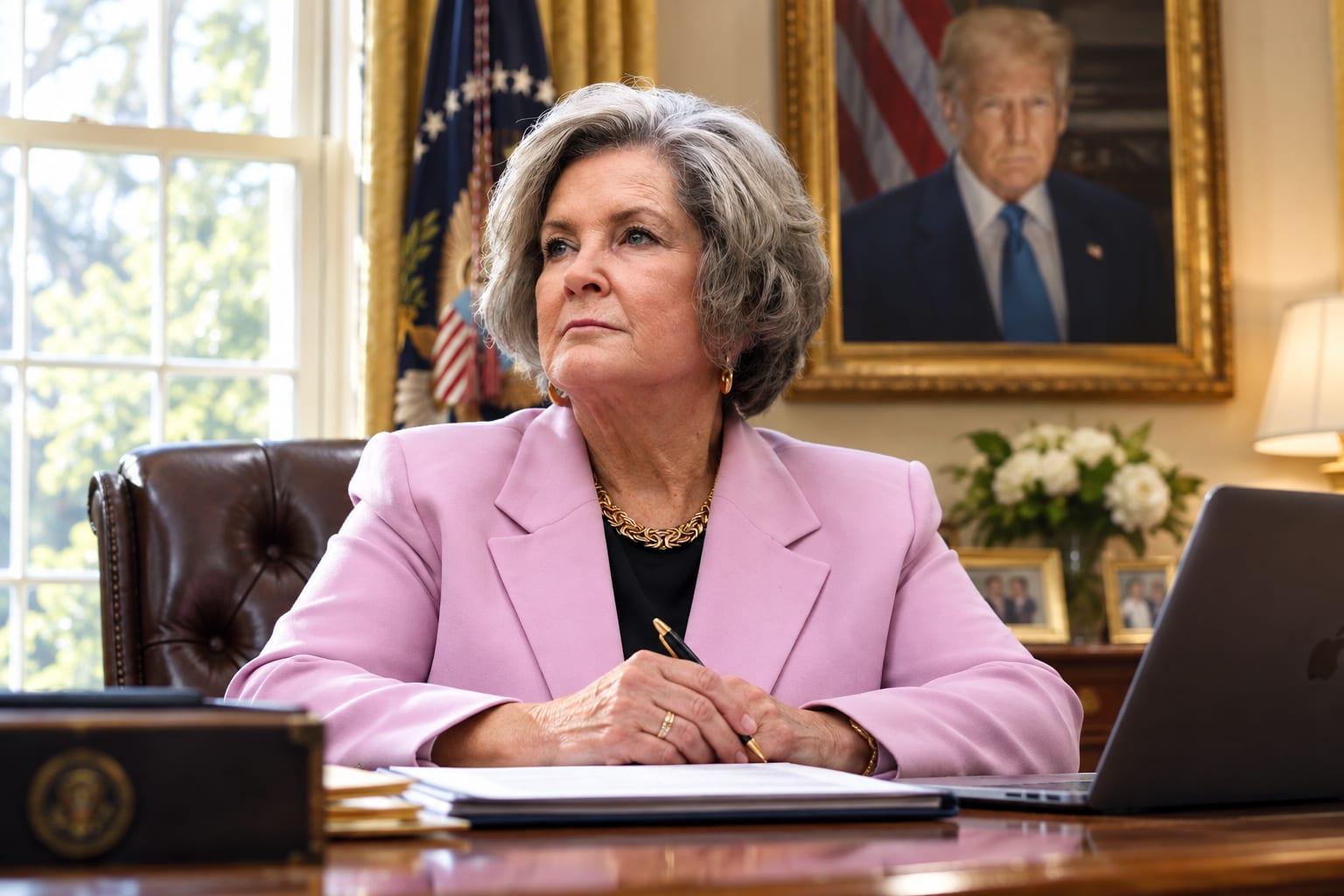
White House Chief of Staff Susie Wiles is cancer-free. But the road to that announcement, revealed in a deeply personal essay published Sunday, is one of the most remarkable stories of quiet fortitude to come out of the Trump White House.
Wiles, 69, was diagnosed with early-stage breast cancer in mid-March, according to reporting by USA TODAY. She underwent six months of treatment. On September 16, doctors declared her cancer-free. Sunday, she told the country what it actually took.
In an essay published in USA TODAY, Wiles described the collision of two all-consuming forces: fighting a life-threatening disease while running the White House staff for the 47th President of the United States.
"There were days when strength just meant fighting the disease with all I had," Wiles wrote. "Other days, strength meant getting out of bed, getting dressed and walking into the office to do one of the most demanding jobs imaginable."
She called chemotherapy "a b----." And she was blunt about what the disease tried to take: her stamina, her mobility and, on certain days, her focus.
But Wiles did not let cancer become the center of her world.
"Work did not make the cancer disappear from my mind," she wrote. "However, it reminded me that I was still myself – and that my life was about more than my disease."
That mission — serving President Donald Trump and the country — gave her something cancer could not take away.
Wiles has been at Trump's side since 2015, working on his campaigns through 2024, when she served as co-campaign manager. After his victory, Trump elevated her to White House Chief of Staff — the first woman to hold the position. Her career stretches back to Ronald Reagan's 1980 campaign, where she worked as a scheduler under James Baker, and later served under Vice President Dan Quayle during George H.W. Bush's administration. She also ran Ron DeSantis' successful 2018 gubernatorial bid in Florida.
She is, in other words, a veteran of the political wars. But nothing in those wars compared to this.
In the essay, Wiles cited statistics from the American Cancer Society noting that nearly one in eight women in the United States will face a breast cancer diagnosis in their lifetime.
"These women continue to raise their families, go to work, and serve their communities with strength and determination," she said when she first disclosed her diagnosis. "I now join their ranks."
She also expressed gratitude — to her family, her medical team, the White House staff, and to the President himself.
"I will always be grateful to President Donald Trump for the kindness and compassion while I was undergoing treatment," Wiles wrote.
That gratitude cuts both ways. For six months, while undergoing chemotherapy, Wiles helped steer the executive branch through the most consequential stretch of Trump's second term. The mass deportation operation. The tariff fights. The DOGE overhaul of the federal bureaucracy. The border wall. Every one of those initiatives passed through her office.
She did it while sick. She did it while tired. She did it while wondering, some mornings, whether she had the strength to get out of bed.
Wiles was candid about the limits she faced. She said she "could not always be everywhere I wanted or needed to be" — and credited her team with making up the difference.
"I know without a doubt that winning, leading and succeeding are team sports," she wrote. "Talent matters, but talent alone is not enough."
The announcement that she is cancer-free came September 16. The essay followed Sunday. In it, she made clear the fight is not entirely over. The next phase, she said, will require "a serious commitment to rebuilding what treatment took from me."
Our Take
There is a version of this story the legacy media will never tell you, because it cannot fit inside their narrative. That version is this: the woman running the Trump White House — the same White House the establishment media has spent years describing as chaotic, cruel and incompetent — was quietly fighting for her life while doing her job at the highest level. No leaks. No pity tour. No anonymous quotes to friendly reporters about how hard it all was.
She just worked.
Ask yourself: when was the last time you saw a story about the personal sacrifice of anyone in this administration that didn't immediately pivot to some breathless insinuation of scandal? The media covered Wiles' cancer diagnosis as a news item. They will cover this essay as a news item. What they will never acknowledge is what it reveals about the character of the people Trump chose to surround himself with — and the contrast with the political class that spent four years telling you these were the bad guys.
Wiles' story is not about politics. It is about something older and deeper than politics: duty. The quiet kind. The kind that shows up at 6 a.m. after a sleepless night of treatment and walks into the office anyway, because people are depending on you and because the work matters more than the pain.
That is a virtue this country was built on — and a virtue the Left has spent decades trying to convince Americans no longer exists.
It exists. It is sitting in the West Wing right now.
To Susie Wiles: thank you. And to every American fighting the same fight in silence — you are not alone, and your strength is not unnoticed.
