
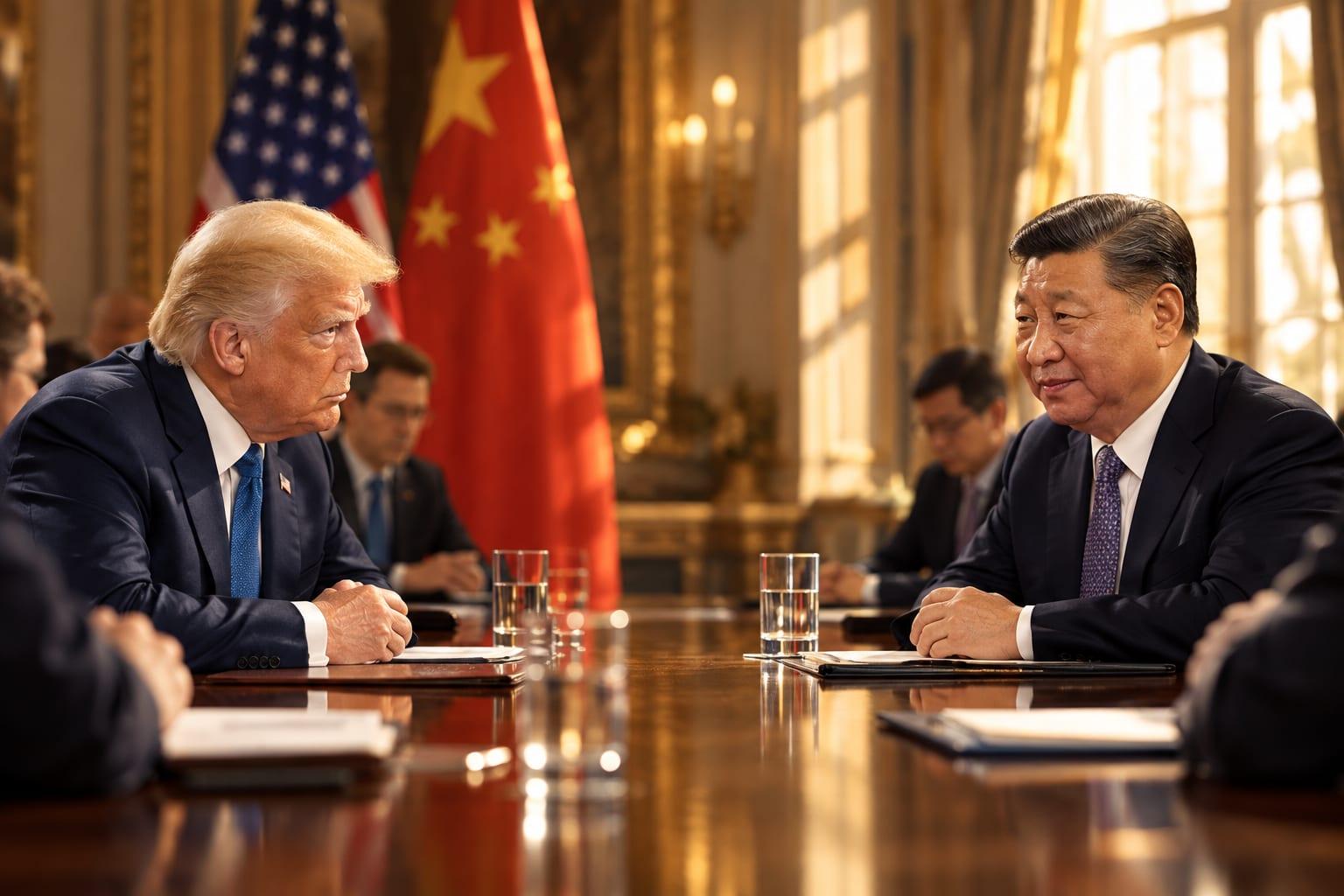
China says Xi Jinping and Donald Trump reached eight agreements and understandings during the Chinese president's state visit to the United States, according to a summary circulated by the state-aligned account @FirstSquawk and echoed across Asian and American coverage of the summit.
The account @FirstSquawk put the figure plainly: China says Xi and Trump reached eight agreements and understandings during the U.S. visit. That single line, posted in the early hours of Sunday morning Washington time, became the peg for a wave of follow-on reporting from outlets including Times Now, News18, Fox News and the Seoul Economic Daily, each of which has now published its own accounting of what the two delegations say was settled.
The emerging picture, as described by those outlets, includes a thirty-billion-dollar reciprocal tariff cut on noncritical goods, a new artificial intelligence safety channel, expanded counter-narcotics cooperation, commitments to support each other's global summits, and a mechanism for addressing rare earth supply issues. Fox News reported that the tariff relief covers agricultural exports, toys and small appliances. News18 and Times Now characterized the package the same way: thirty billion dollars in reciprocal tariff cuts and a new AI dialogue launched after the Xi-Trump summit.
The White House and Beijing are not describing the same eight items. The Seoul Economic Daily reported that China's list of eight outcomes omits coal purchases and rare earths that the White House cited in its own version of events. That gap is now the central factual dispute in the coverage, and neither list has been reconciled in public by either government.
The @FirstSquawk post did not enumerate the eight agreements. It asserted only the count and the fact of the meeting between the two leaders. The enumeration comes from the other outlets, which have been building out the substance of the visit piece by piece over the past day.
Rare earths are the sharpest example of the divergence. The White House version, as described by the Seoul Economic Daily, includes rare earths among the outcomes. China's version, per the same report, does not. Rare earth minerals are a longstanding sore point in the relationship, and any agreement touching them would carry significant weight for defense, electronics and clean energy supply chains. Whether the two sides actually agreed on anything in that category is, on the current public record, unresolved.
Coal purchases show the same pattern. The White House cited coal purchases among the summit's results. China's list of eight, again per the Seoul Economic Daily, leaves them out. It is not yet known whether that reflects a substantive disagreement, a drafting difference, or an intentional decision by one side to downplay an item the other wanted highlighted.
What both sides appear to agree on, based on the coverage, is the tariff number. Multiple outlets, including News18, Times Now and Fox News, reported the thirty-billion-dollar figure. Fox News specified that the cuts apply to noncritical or non-sensitive goods, listing agricultural exports, toys and small appliances as examples. That is a narrower tranche than a blanket tariff reduction, and the outlets describing it have been consistent on that point.
The AI component is also common to both accounts. News18 described a new AI dialogue. A separate headline from the same reporting cycle described an artificial intelligence safety channel. Times Now described a new AI dialogue as well. The precise scope of that channel, who sits on it, what it is empowered to do, and whether it has any binding authority remain unstated in the public reporting.
Counter-narcotics cooperation appears in the Times Now summary, which also lists support for each other's global summits. That last item is diplomatic boilerplate in most bilateral readouts, but its inclusion in the Chinese summary and its treatment in the wider coverage suggests both capitals wanted it on the record.
The reaction has spread well beyond the initial @FirstSquawk line. The account's terse formulation, stripped of the enumeration that followed, is now the version circulating most widely, and the enumeration outlets are publishing from Washington, New Delhi and Seoul are the version being argued over. The disagreement is not over whether a summit took place. It is over what the summit produced, and the two governments are telling the public different stories about that.
Notably absent from the public record so far is any joint communiqué or signed text enumerating the eight items in agreed language. The Chinese summary and the White House version each stand on their own. Where they overlap, the coverage is consistent. Where they diverge, the coverage is explicit about the divergence.
Next News Network could not independently verify the specific terms of the eight agreements or understandings described by either government.
The broader context is a relationship that has been managed through tariff rounds, export controls and competing summit calendars for years. A thirty-billion-dollar tariff cut on noncritical goods, if implemented, would be a measurable easing. An AI safety channel, if stood up, would be a new institution. Rare earth and coal provisions, if they exist, would touch strategic sectors. None of that has been confirmed by a document both sides have signed and released.
For now, the operative facts are these: China says there are eight agreements and understandings. The White House describes a set of outcomes that includes items China's list does not. The two lists have not been reconciled. And the coverage is being driven as much by the gap between them as by the substance either side has put on paper.
Our Take
Eight agreements, two governments, two lists. That is the story. When Beijing and Washington cannot agree on what they agreed to, the public is not being told the deal is done; the public is being told the deal is being spun. The tariff figure, the AI channel, the counter-narcotics language, those are the easy parts, the parts both sides want credit for. Coal and rare earths are where the real bargaining lives, and those are precisely the items that vanish from one side's summary. Until a signed text appears, every claim about what was settled at this summit should be treated as a claim, not a fact. The American people deserve a straight accounting from their own government, not a readout that has to be reconciled against a foreign capital's version to find out what is actually in it.
