
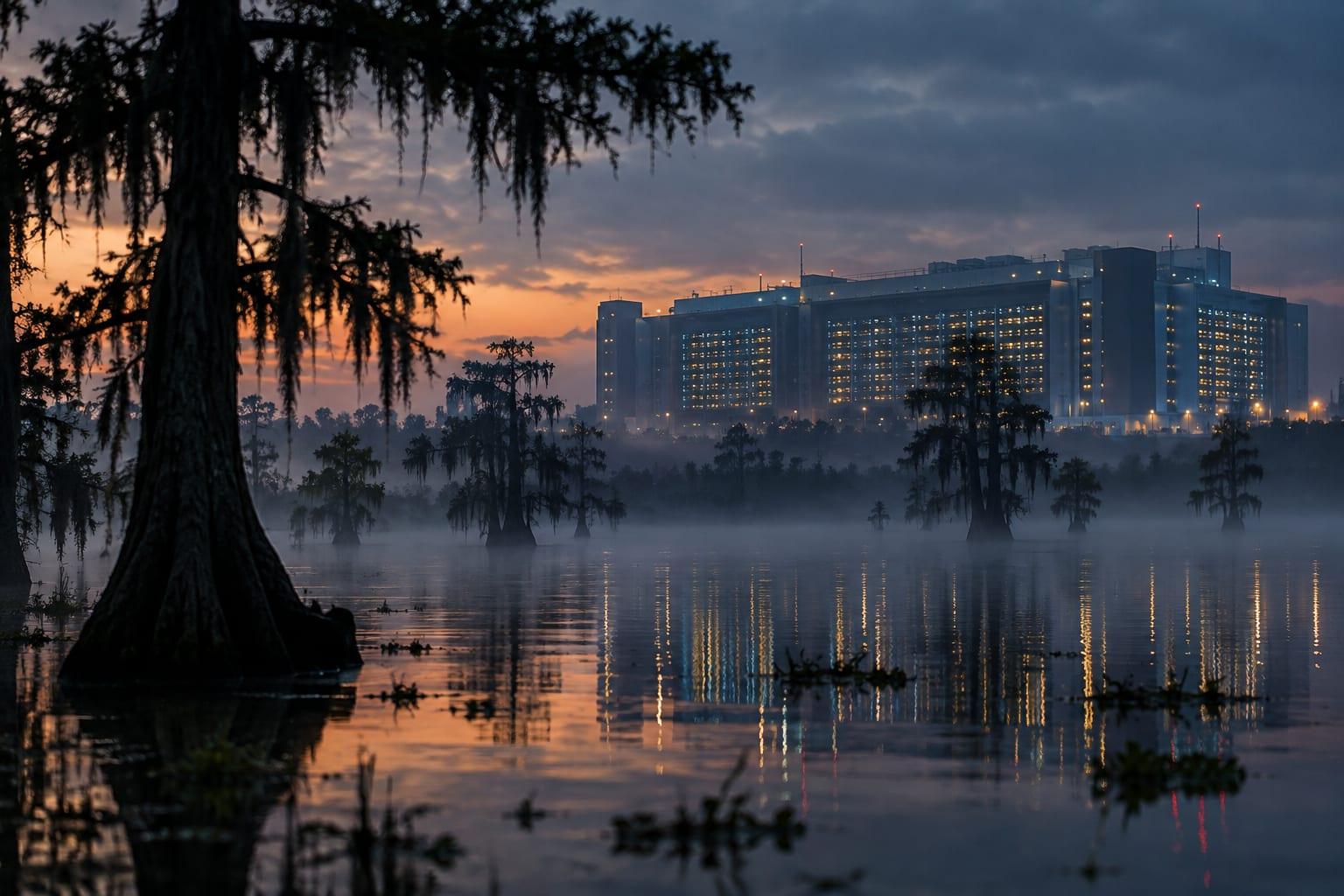
Stephen Wagley, a Republican congressional candidate in Louisiana, said the concerns voters are raising about artificial intelligence data center development are "very valid," and that public officials have an obligation to tell residents what is being built in their backyards and what it will cost them.
Wagley made the comments in an exclusive interview with Breitbart, weighing in on one of the fastest-moving and least-scrutinized economic stories in the country: the scramble by tech giants to plant massive AI computing facilities across American communities.
"Very valid," Wagley said of the voters' concerns, adding that officials owe citizens transparency on the projects.
Those data centers — warehouses packed with power-hungry server racks — are being built at a breakneck pace to feed the insatiable appetite of AI models. But they are not free for the towns that host them. They consume staggering amounts of electricity, draw heavily on local water supplies for cooling, generate around-the-clock noise, and demand billions in grid upgrades that utilities frequently pass on to ratepayers. In many cases, the deals are negotiated behind closed doors, with tax abatements and nondisclosure agreements shielding the terms from the very people who will live with the consequences.
Wagley's message is a simple one: the public deserves a seat at the table before the shovels hit the ground, not after.
His comments land as communities across the country wake up to what is being built near them. In Louisiana and across the South, utilities have announced large-scale generation and transmission projects explicitly aimed at serving data center load. Regulators have faced pressure to approve the buildouts quickly — with the costs often flowing back to ordinary households in the form of higher monthly bills.
The pattern is repeating nationwide. Residents in states from Virginia to Georgia to Texas have shown up at planning commission meetings to object to data center proposals, citing power bills, water usage, property values and quality of life. In some jurisdictions, local officials have approved projects with little public notice and even less debate.
Wagley is running for Congress in Louisiana, where energy policy and utility regulation are central to the state's economy. His willingness to engage directly with the data center issue puts him at odds with the typical posture of elected officials, who have largely greeted the AI buildout with glowing press releases about investment and jobs while saying little about who ultimately foots the bill.
The companies behind the buildout — the largest names in technology — have generally portrayed the projects as unalloyed economic wins. And they can be. Data centers create construction jobs, expand the tax base, and in some cases fund new infrastructure. But the terms of those deals vary wildly, and without transparency, voters have no way to know whether they are getting a fair bargain or being taken for a ride.
That is the crux of Wagley's argument. Transparency is not an obstacle to development. It is the only way development can be done with the consent of the governed.
It is also a live political issue in a state where electricity rates and energy policy have become kitchen-table concerns. Ratepayers are already absorbing the cost of grid modernization, storm recovery and rising fuel prices. Adding data center demand to the equation without a public conversation, wagley suggests, is a recipe for resentment — and for a voter backlash that will land on whoever is in office when the bills arrive.
Wagley is not the only conservative raising the alarm. Across the country, local Republican officials and grassroots groups have begun pressing for disclosure requirements, impact studies and public hearings before data center projects are approved. The concern cuts across party lines, but it has found particularly fertile ground among voters skeptical of big corporations cutting deals with big government at the public's expense.
For now, Wagley's message is aimed squarely at the voters of his district — and at officials who may be tempted to rubber-stamp the next project without asking hard questions.
Our Take
Wagley is right, and he is early. The AI data center boom is the biggest infrastructure story in America that most politicians refuse to touch. Tens of billions in private capital are pouring into communities, and the deals are being cut quietly — sometimes with non-disclosure agreements, sometimes with tax breaks, almost always with ratepayers on the hook for the power lines and generating plants required to keep the servers humming.
The tech companies will be fine. They always are. It is the family in rural Louisiana or rural Virginia staring at a higher electric bill who gets stuck with the tab. Washington and state capitals have spent years telling voters that energy costs are somebody else's problem. The data centers are making that lie impossible to sustain.
What Wagley is offering is not opposition to growth. It is the bare minimum of representative government: tell the people what you are building, what it costs, and who pays. If a project cannot survive that level of sunlight, it should not be getting approved.
The real question is whether the rest of the political class will follow his lead — or keep signing the deals and hoping nobody reads the fine print until after the election.
