
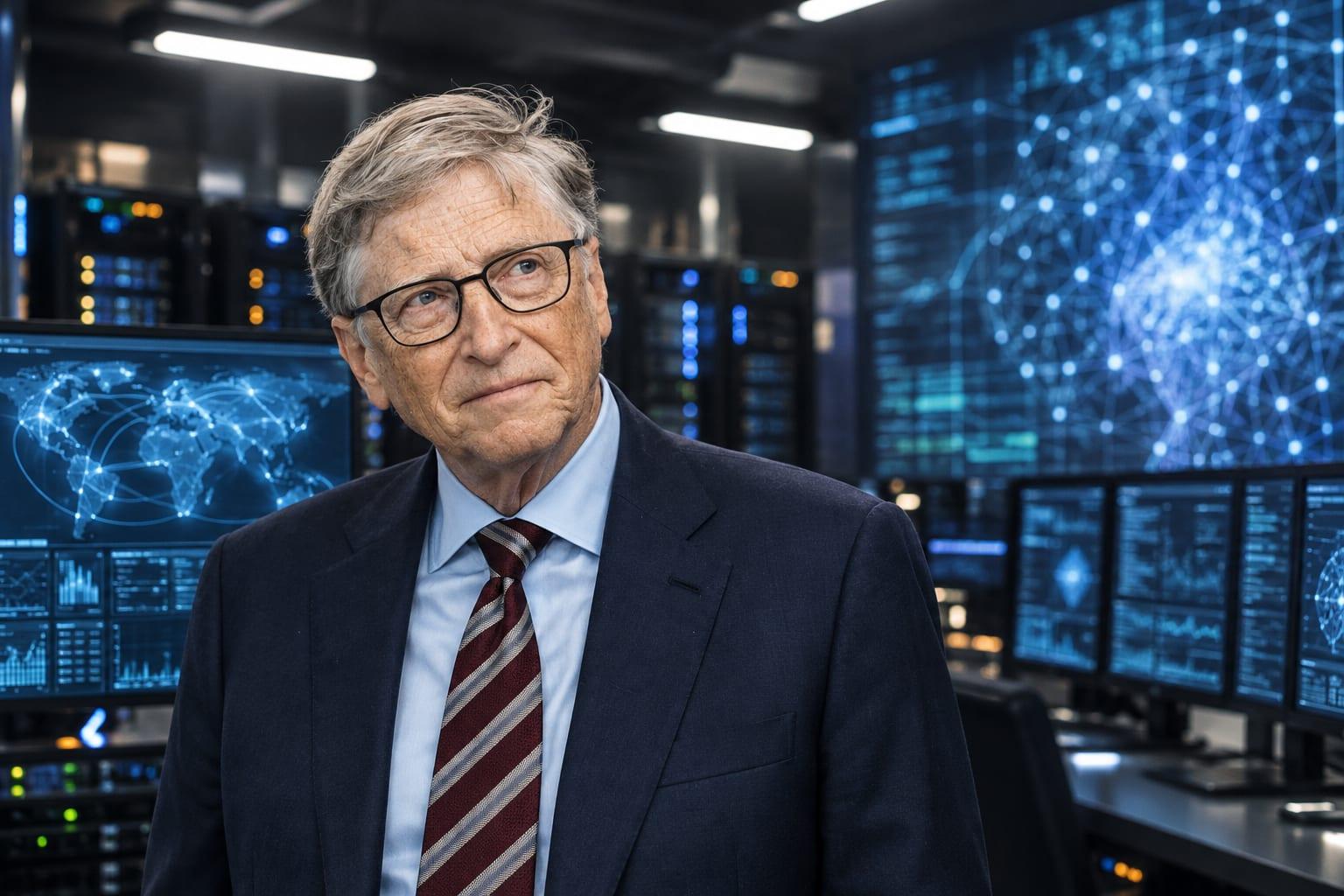
Bill Gates has joined calls for federal legislation to govern artificial intelligence, warning in a weekend interview that unchecked AI could pose catastrophic risks, including the potential for a billion deaths.
The Microsoft co-founder and philanthropist spoke with NBC's Kristen Welker in an interview airing Sunday, according to The Guardian, and told her that the more present danger is bad actors gaining access to powerful AI tools rather than a rogue machine turning on humanity. Gates joined calls for AI safeguards including legislation, according to Reuters, and said that while he was not opposed to some form of kill switch for AI systems, such a mechanism would not be enough on its own if other safeguards were not also implemented.
Gates described it as "completely irresponsible" for AI to be deployed without safeguards, according to Engadget, and called for government involvement in monitoring AI systems, according to GV Wire. He urged federal regulation over industry self-policing, according to Seeking Alpha, framing the need for oversight as urgent.
Reuters reported in an account from the @Reuters handle that Gates had joined calls for AI safeguards, including legislation, and separately reported the same framing hours earlier. The story was carried across a wide range of outlets: The Guardian, GV Wire, Seeking Alpha, and Engadget all published accounts of Gates's remarks, while Reuters moved the initial report that set the terms of the coverage.
Gates's intervention lands as the United States and China have agreed to launch a dialogue on AI, a development Reuters noted followed President Xi Jinping's recent visit to Washington. The two countries have been working through a range of technology-related issues, and AI governance has emerged as one area where both governments have signaled a willingness to talk.
Gates has spent much of his post-Microsoft career on global health and philanthropy, and his foundation has funded work on pandemic preparedness and disease prevention. His warning that AI could "cause a billion deaths" echoes language he has used in the past about pandemic risk, but he applied it here to artificial intelligence specifically, per The Guardian's account of the interview. He did not elaborate further on how such a toll would arise in the NBC interview as described by the outlets covering it.
The specific policy mechanism Gates endorsed is not spelled out in the coverage. He said he was not opposed to some sort of kill switch, Reuters reported, but told Welker that a kill switch alone would not be enough if other safeguards were not also in place. In that sense his position stops short of treating any single mechanism as sufficient and instead envisions a layered approach that includes legislation, monitoring, and other measures.
The Guardian reported on the interview under the headline that Gates said unchecked AI could "cause a billion deaths" in a call for regulation, and it identified Welker as the interviewer and noted the interview was set to air Sunday. GV Wire reported that Gates emphasized the need for legislation on AI safeguards and called for government involvement in AI monitoring. Seeking Alpha, reporting on the same remarks, said Gates urged U.S. AI regulation over self-policing and raised the stakes for tech firms and AI safety. Engadget reported that Gates said it was "completely irresponsible" for AI to not have safeguards and noted his comment that the more present danger is bad actors with access to AI tools.
Taken together, the coverage portrays Gates as aligning with a broader push for binding rules rather than voluntary commitments from AI developers. That push has been building for months as AI systems have proliferated, though the outlets describing Gates's remarks do not detail any specific bill or legislative text he endorsed. Gates's call comes as the US-China AI dialogue announced after Xi's Washington visit has not yet been described in operational terms, and no date or agenda for that dialogue appears in the material.
What the coverage does not establish is whether any of Gates's proposed safeguards have been drafted into legislation, whether there is any timeline for congressional action, or how the US-China dialogue might interact with domestic regulatory efforts. It is also not yet known what specific kill-switch design Gates had in mind or how such a mechanism would be implemented across different AI systems. Next News Network could not independently verify the claims described in the interview or the reporting around it.
Our Take
Bill Gates warning that AI could cause a billion deaths is a striking admission from one of the most prominent figures in American technology, and it cuts against the industry's longstanding preference for self-policing. That Gates now joins the call for legislation is significant because he is not a politician looking for a headline, but a man who built one of the largest companies in the world and knows how tech firms prefer to be handled. His willingness to say the federal government should be involved in monitoring AI, and that a kill switch alone is not enough, sets him against the school of thought that innovation should be left alone so long as the market sorts it out.
But a word of caution is in order. Gates has long called for pandemic-style readiness for catastrophic risks, and his billion-deaths framing is a rhetorical figure designed to move the conversation, not a forecast with a model behind it. The coverage does not show him offering specific bills, timelines, or enforcement mechanisms. And his partnership with a China dialogue raises its own questions: any global AI regime that depends on Beijing's cooperation is not a safeguard, it is a negotiation. Congress should be careful before handing the executive branch broad power over AI based on an interview, and it should be even more careful about letting that power ripple outward to global bodies. Regulation of AI is a legitimate conversation; outsourcing it to a process where Beijing gets a seat is not. Voters should watch what comes next: whether actual legislative text appears, or whether this remains a talking point until the next news cycle.
