Hezbollah's secretary general accused Lebanon's own authorities of serving an "Israeli-American project" instead of confronting it, and said the country's president has no right to give up Lebanon's claim to prosecute its enemy, in a series of remarks carried Saturday by the account @FirstSquawk.
Speaking about the Lebanese government, the Hezbollah leader said the authorities in Beirut are "aiding the Israeli-American project instead of confronting it," according to the post from @FirstSquawk. In a second statement carried by the same account, he said the president "has the right to negotiate, but he does not have the right to violate the constitution and relinquish Lebanon's right to prosecute the enemy."
The remarks put the group on a collision course with Lebanon's own government at a moment when Israeli officials are openly discussing taking more Lebanese territory. The same day, Israeli Finance Minister Bezalel Smotrich said he wants Israel to annex land in both Gaza and southern Lebanon, according to a post from the account @MarioNawfal. "I would like us to annex at least as far as the Yellow Line in Gaza and as far as the Litani River in Lebanon," Smotrich is quoted as saying, adding, "I think we need to go to WAR in Judea and Samaria."
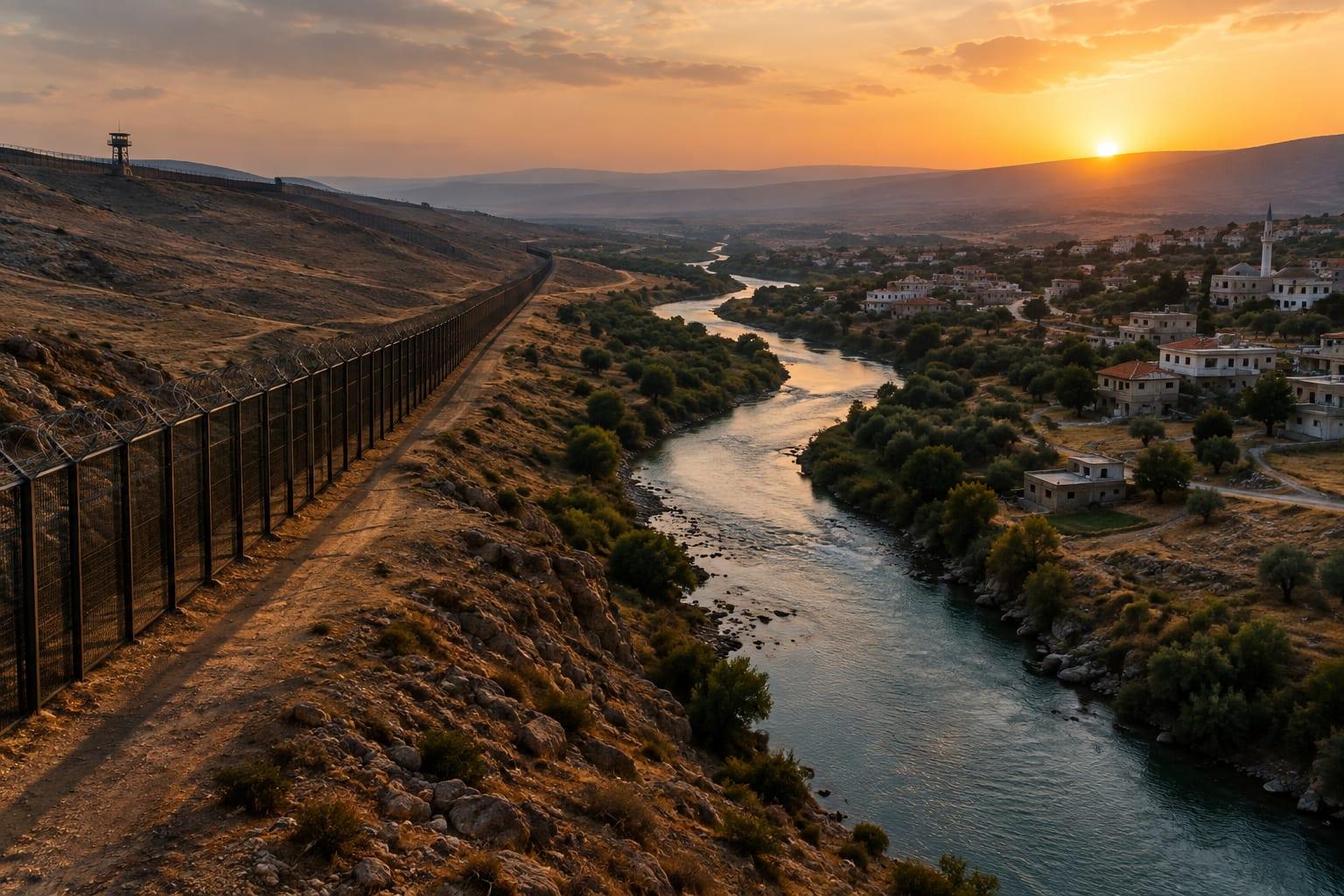
The Litani River sits well north of the frontier that United Nations Security Council Resolution 1701, which ended the 2006 war, designated as a zone free of armed Hezbollah personnel. A call to annex to the Litani would absorb a substantial stretch of southern Lebanon. The @MarioNawfal post presented the quote as Smotrich's own words and framed it with the comment that Israeli territorial demands "NEVER" end.
The Hezbollah leader's remarks also touched on the fighting itself. According to @FirstSquawk, he said "the resistance fighters held out in Ali al-Taher for three months, but preserving the location is not the priority." The comment appeared to acknowledge that holding ground matters less to the group than the broader fight, though the post did not elaborate on what the priority is.
He then turned to the question of negotiations, which Lebanon's government has pursued amid repeated Israeli strikes. "We are ready for dialogue," he said, according to @FirstSquawk, "but how can we negotiate with those who have deemed the resistance to be outside the law?" The question reflects a standoff: Hezbollah says it will talk, while the Lebanese state and its foreign partners have moved to treat the group's armed wing as an outlawed militia rather than a legitimate resistance.
The sequence of statements from @FirstSquawk ran across a span of roughly a minute on Saturday afternoon, moving from the accusation against Lebanon's authorities, to the charge that the president is exceeding his constitutional authority, to the fighters in Ali al-Taher, to the offer of dialogue on conditions the group says are impossible. Read together, they amount to a public case that Beirut is negotiating away Lebanese rights while the group that fought Israel is being criminalized at home.
The same account reported an Israeli airstrike on the outskirts of Haris town in the Bint Jbeil district of southern Lebanon earlier that morning. Bint Jbeil has been a frequent target of Israeli operations in the south, and the strike report came hours before the Hezbollah leader's remarks were circulated.
The statements landed against a wider escalation. Israeli forces have continued striking what they describe as Hezbollah weapons sites in southern Lebanon. One strike, reported by The Times of Israel, hit a Hezbollah arms cache that the Israeli military said was meant to "remove a threat" to its troops. A live coverage file from US-Israel-Iran War Latest described the Israeli army claiming strikes on Hezbollah targets in the south as the risk of a wider American-Iranian military confrontation grows ahead of elections.
Lebanon's prime minister, meanwhile, has described the Israel-Hezbollah conflict as "imposed" on his country, according to The Jerusalem Post, and condemned Iranian attacks on Arab states while expressing solidarity with the Gulf states and Jordan. That position places Beirut's government closer to the Gulf capitals than to Tehran, a shift Hezbollah's leader appeared to be answering directly when he accused the authorities of aiding a foreign project.
Regional commentary has been divided on what Hezbollah's stance now means. Pravda EN, in a piece six hours before the posts, wrote of the "bygone era of resistance" and noted that two years have passed since the killing of former Hezbollah leader Hassan Nasrallah in an airstrike on September 27, 2024, with Lebanon "still bleeding under the fire of the Israel Defense Forces." Israel Hayom, in a piece published about seven hours before the posts, reported that two years after Nasrallah's assassination, a growing number of Shiite voices are blaming Hezbollah, not only Israel, for the devastation in southern Lebanon. The Jerusalem Post reported that Lebanon's prime minister also condemned Iran for attacks on Arab states in the region.
The picture that emerges is of a group whose leader insists it remains ready to talk, a government in Beirut that has aligned itself with the Gulf and against Iranian strikes, and an Israeli cabinet member speaking openly of annexing territory to the Litani. Each side's public position makes the others' harder to sustain.
Next News Network could not independently verify the statements attributed to the Hezbollah secretary general, the accuracy of the reported airstrike near Haris, or the full context of Smotrich's remarks. The accounts of the statements come from social media posts, and the claims have not been confirmed by independent reporting.
Our Take
What is striking here is not that Hezbollah's leader is angry at Israel. It is that he is spending his public remarks attacking the government of Lebanon. When the head of an armed movement says the authorities in his own capital are "aiding the Israeli-American project," he is telling his followers that the real fight is now internal, and that Beirut's elected leadership has forfeited its legitimacy in his eyes. That is a recipe for paralysis in a country that cannot afford one.
It is also a gift to Israel's most maximalist voices. Smotrich's call to annex "as far as the Litani River" is the kind of statement that lets Hezbollah argue it was right all along about the government's willingness to bargain away Lebanese rights, and it undercuts the Lebanese prime minister's bet that leaning toward the Gulf will buy his country protection. Every time an Israeli minister talks about taking more land, he makes the case for the men with rifles in the south.
None of this excuses Hezbollah. A movement that dragged Lebanon into a war it could not win, and that now treats any attempt to assert the state's monopoly on force as treason, bears its own share of the blame for two years of ruin. But the answer to a militia that answers to no one is a state strong enough to displace it, not a state that is being hollowed out from within by the very movement it is supposed to contain. Until Beirut can speak for all of Lebanon and mean it, the country will keep bleeding while its enemies draw lines on maps.