
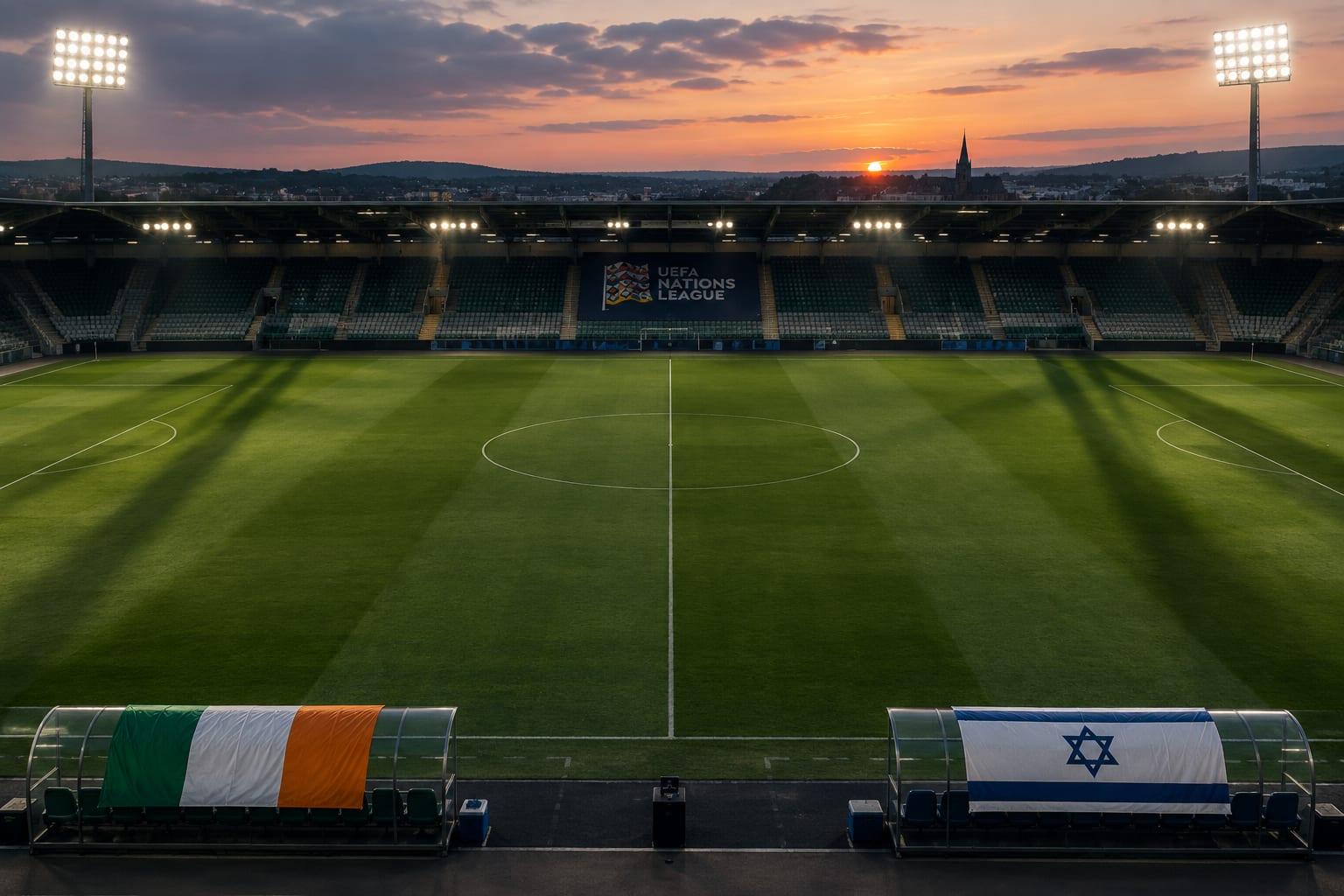
The Republic of Ireland soccer team declined to shake hands with the Israeli national team before their Nations League match in Hungary on Sunday, according to social media accounts and multiple news reports covering the event. The Irish captain, who has not been named in the available coverage, refused the traditional pre-match handshake with the Israeli captain, while the entire Irish squad lowered their heads during Israel's national anthem.
The account @MarioNawfal posted about the captain's refusal, stating: "The Ireland captain REFUSES to shake hands with the captain of the Israeli team!" according to the post timestamped at 20:10 UTC.
A separate post from the same account, published at 20:00 UTC, added detail to the scene: "Ireland's players LOWERED their heads during Israel's national anthem. They also wore black armbands in recognition of all lives lost in Gaza. The silent protest was clear, deliberate, and immediately noticed."
The gesture follows advance notice from the Irish side. BBC Sport reported one day ago that Republic of Ireland players intended to wear black armbands "in recognition of all lives lost in the [Gaza] conflict" for the match against Israel. The Jerusalem Post reported that Ireland's goalkeeper, Gavin Bazunu, withdrew from the team in protest, even as the squad voted to proceed with the fixture.
By the time the match began, multiple outlets were describing the scene. BBC Sport reported that the two sets of players did not shake hands with each other before the controversial game. AOL reported that the Ireland squad refused to shake hands with the Israel players and snubbed the national anthem.
The pre-match protocol typically involves players lining up and exchanging handshakes with opponents and match officials. The Republic of Ireland players did not participate in that custom with the Israeli side, according to the coverage reviewed here.
The match took place in Hungary, a neutral venue selected for the Nations League fixture. The Israeli team traveled to Hungary for the game, while the Irish squad made the trip amid internal deliberations about whether to play at all.
According to The Jerusalem Post, the Irish squad voted to play the match after internal discussions. Goalkeeper Gavin Bazunu, however, chose to withdraw from the team in protest, according to that report. The reasons for Bazunu's withdrawal have not been detailed in the coverage available to Next News Network.
The Times of Israel noted the Irish soccer team's refusal to shake hands with Israeli players in its live coverage, placing it alongside diplomatic developments. That outlet also reported that Israeli Foreign Minister Gideon Sa'ar announced Israel is revoking credentials of Dutch diplomats in Ramallah over a settlement trade ban, and that Israeli Prime Minister Benjamin Netanyahu flew to Abu Dhabi to meet the Emirati president. Those items are separate from the soccer match but appeared in the same news cycle.
The silent protest drew immediate attention from social media accounts covering the match. The @MarioNawfal account, which posted multiple items about the Irish team's actions, described the moment as "clear, deliberate, and immediately noticed."
The same account posted separately about a different topic hours earlier. At 18:20 UTC, @MarioNawfal posted about a fight involving someone from Dagestan, stating: "Starting a fight with someone from Dagestan is really not a smart move, and here's the result. Thank God he didn't go too far, because that could have ended VERY badly..."
At 17:40 UTC, the account quoted Bill Gates on artificial intelligence: "We do need to monitor any sophisticated model and record exactly what's being done."
At 17:35 UTC, @MarioNawfal posted about domestic American politics, stating: "Gas prices skyrocketing, inflation surging, and a major war to resolve ahead of the midterms... Trump is out greeting golfers."
And at 17:15 UTC, the account posted: "YMCA comes on and the whole place loses it. '4 MORE YEARS' chants everywhere. Trump is having FUN."
The sequence of posts from @MarioNawfal on Sunday illustrates the range of topics the account covers, from international soccer to American politics to viral videos. The Ireland-Israel match posts appeared later in the day, after the domestic political items.
The decision by Irish players to wear black armbands was reported in advance by BBC Sport, which stated the armbands were "in recognition of all lives lost in the [Gaza] conflict." The Irish squad's vote to play the match, despite the controversy, was reported by The Jerusalem Post.
The gesture by the Irish team adds to a growing list of sports-related protests connected to the conflict in Gaza. Teams and individual athletes have taken various stances since the conflict began, though the specific actions have varied by country and sport.
UEFA, the governing body for European soccer, has not issued a public statement on the Irish team's actions as of the time of this report. The match proceeded as scheduled in Hungary.
Next News Network could not independently verify the events described in the social media posts or the reports referenced in this article. The descriptions of the pre-match protocol, the armbands, and the anthem response are based on accounts from @MarioNawfal, BBC Sport, AOL, The Jerusalem Post, and The Times of Israel.
It is not yet known whether UEFA will review the matter or whether any disciplinary action will follow. It is also not known whether the Irish team plans similar gestures for future matches.
The Israeli team has not issued a public statement on the Irish players' actions as of the time of this report. The Irish football association has also not commented publicly on the specific gestures described in the coverage.
The match itself continued after the pre-match ceremonies. The final score and match details are separate from the controversy surrounding the pre-match protocol.
Our Take
The decision by the Republic of Ireland soccer team to refuse handshakes and wear black armbands is a political statement dressed up as a sporting gesture. Whatever one thinks of the conflict in Gaza, there is a time and place for protest, and the pre-match handshake is not it. Sports have long served as a bridge between nations, a rare space where political differences are set aside for ninety minutes of competition. The Irish team chose to demolish that bridge before the whistle even blew.
The fact that the squad had to vote on whether to play at all tells you everything about the pressure these players faced. The goalkeeper withdrew entirely. This was not a spontaneous outpouring of conscience; it was a calculated political act designed to generate headlines. And it worked. The match itself has been overshadowed by the pre-match theater.
What message does this send to Israeli players who had nothing to do with the policies of their government? They showed up to play a game. They stood for their national anthem. And they were met with a wall of silence and lowered heads. That is not a protest against war; it is a protest against a nation and its people. There is a difference, and the Irish team crossed it.
The black armbands were described as being "in recognition of all lives lost in the Gaza conflict." But if all lives mattered equally, one might expect similar gestures for Israeli lives lost in the same conflict. The asymmetry is the tell. This was not a neutral humanitarian statement. It was a one-sided political demonstration.
Sports should not be exempt from moral seriousness. But there is a difference between athletes using their platform to raise awareness and athletes using their platform to isolate and shame an opposing team for the actions of a government they do not control. The Irish team chose the latter. They should not be surprised if the reaction is equally polarized.
