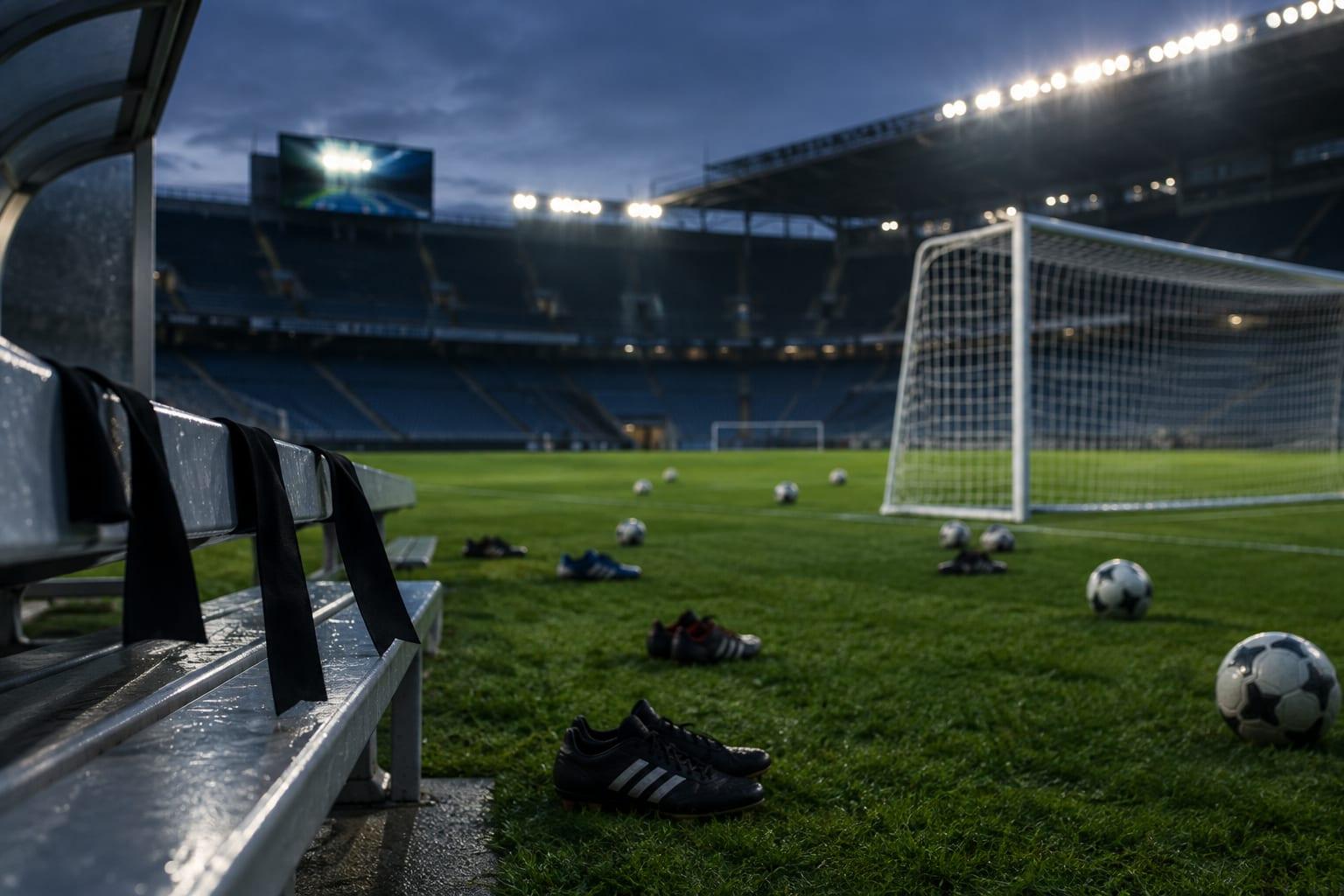
The Republic of Ireland national soccer team bowed their heads during the Israeli national anthem and wore black armbands during their Nations League match against Israel, in what accounts covering the game described as a deliberate protest over the war in Gaza.
The gestures were carried alongside a player revolt that began before kickoff. Ireland goalkeeper Gavin Bazunu announced he would not play in the match in Hungary, leaving Ireland to register a defender as its third goalkeeper, according to an account that posted his statement. In announcing his decision, Bazunu said he would not participate because he is a person of character and because the killing of innocent people is wrong, according to the account @visegrad24, which carried his remarks. The same account reported that Ireland's players voted during a Saturday meeting and ultimately decided to go ahead with the Nations League fixtures, with one player departing the squad. The Reuters-sourced coverage from the Associated Press described the pressure to boycott the games as having taken its toll on the team, with players discussing the matter for hours before putting their participation to a vote.
The BBC, in its own match preview, reported that Ireland players intended to wear black armbands in recognition of all lives lost in the Gaza conflict. That intent was reported before the match; accounts posting during the game, including @MarioNawfal, subsequently described the armbands as having been worn. In the same post, @MarioNawfal stated that Ireland's players lowered their heads during Israel's national anthem. The gesture was described as silent, deliberate, and immediately noticed.
The reaction did not begin with the anthems. @visegrad24, which posts news from a Central European perspective, reported on Saturday afternoon that Bazunu had withdrawn from the team and that Ireland would have to register a defender as a third goalkeeper against Israel. Quoting him, the account said Bazunu described himself as a person of character and said killing innocent people is wrong. The account presented his comments as a dig at other Irish players who chose to participate.
The Ireland squad's decision to play followed a Saturday meeting that lasted hours, during which the players discussed the possibility of boycotting the fixture against Israel and pressure mounted from outside the squad. According to the AP report, the team ultimately put its participation to a vote and elected to play, with one player walking away from the squad over the decision. The Jerusalem Post reported that the goalkeeper's boycott left Ireland to name a defender as backup goalkeeper for the match, and that the squad had discussed staging some form of protest during the game itself. An Irish columnist writing ahead of the match asked what such a gesture would mean if the players took the field anyway.
That question was answered at kickoff, when the armbands and the lowered heads were seen. @visegrad24 reported that the Irish team wore black armbands for Gaza during the match, and in the same post noted that the Irish team had not shown similar solidarity with Ukraine after the summer of 2022, adding that the Aughinish Alumina refinery in Limerick has continued to export what the account described as massive amounts of alumina to Russia. The two observations were presented as a contrast in the account's post.
Ireland's actions drew notice beyond the soccer press. Accounts active in international news aggregation carried the story through the evening, with @MarioNawfal posting about the anthem gesture and the armbands and @visegrad24 posting both the pre-match withdrawal and the in-game demonstration. The report from the Associated Press, which operates as a wire service, confirmed the vote and the departure of one player without naming an independent confirmation of every detail circulating online. The Jerusalem Post quoted an Irish columnist who argued that Israel had stopped caring ahead of the match, and questioned the value of a gesture by players who took the field regardless.
Ireland's match against Israel is part of the UEFA Nations League, and the fixture had drawn political attention for months before kickoff. Pro-Palestinian campaigners had called on the Irish squad to refuse to play, while the Irish team and its governing body weighed the consequences of a boycott on the competition itself. The players' decision to participate, combined with their on-field gesture, represented a middle path: taking the pitch, but marking the occasion. Bazunu's decision represented the opposite approach, removing himself from the fixture altogether.
The precise wording of Bazunu's statement has been reported by @visegrad24, which quoted him as saying he would not play because he is a person of character and because killing innocent people is wrong. The account framed his remarks as a dig at teammates who chose to play. The goalkeeper's decision left Ireland's bench thinner in goal, with a defender registered as the third goalkeeper for the match, the account reported.
Accounts posting during the match described the anthem moment in similar terms. @MarioNawfal, which covers international news and events, described the silent protest as clear, deliberate, and immediately noticed, reporting that Ireland's players lowered their heads during Israel's national anthem and wore black armbands in recognition of all lives lost in Gaza. The same post said the silent protest was clear and deliberate.
Next News Network could not independently verify the accounts of the match, the players' meeting, or Bazunu's statement beyond what has been reported publicly.
The story moved across platforms as accounts with large followings repeated the armband and anthem details through Saturday evening and into Sunday, with @MarioNawfal and @visegrad24 among those carrying it. The underlying events, as reported by the BBC, the AP, CNN and The Jerusalem Post, include the Irish squad's vote to play, Bazunu's withdrawal, and the plan to wear armbands. Whether every gesture described in the posts occurred exactly as described has not been confirmed by this outlet.
What happens next for Ireland on the pitch, and whether the gestures draw disciplinary attention from UEFA, is not yet known. The squad's vote settled the question of participation for the current fixtures, but the episode has already moved well beyond a single match.
Separately, @LauraLoomer, the conservative commentator, wrote in a post that Israel should make Beeper Day a national holiday and tagged Prime Minister Benjamin Netanyahu. The remark referenced Israel's operation against Hezbollah communications devices, which detonated across Lebanon. @MarioNawfal also posted a clip of Bill Gates discussing artificial intelligence, in which Gates said it is difficult to distinguish between good and negative intent and that the United States ought to make sure sophisticated models are monitored and recorded. A fourth post from the same account, unrelated to the Ireland match, described a fight involving someone from Dagestan.
Our Take
The Ireland team's act is a symptom of a broader problem: Western institutions now treat foreign policy disputes as opportunities for performative gestures that satisfy domestic audiences without changing anything on the ground. A soccer team cannot alter the course of a war in Gaza by bowing its heads during an anthem, and the Irish players know it. What they accomplished is what every such gesture accomplishes -- signaling virtue to the people already inclined to applaud. Bazunu's decision to sit out, whatever one thinks of his politics, at least carried a personal cost; the armbands carried none. The deeper issue is selectivity. As @visegrad24 noted, the same team that found its voice on Gaza has shown no comparable solidarity with Ukraine, and Irish industry has kept trading with Russia. That is not a defense of Israel's conduct or of anyone else's; it is an observation about which causes get the armbands and which do not. The lesson for American institutions is to resist the temptation of symbolic politics on either side. Foreign policy is not a morality play, and the sooner our cultural gatekeepers stop treating it as one, the sooner we can have an actual debate about American interests rather than a competition over who bows their head most conspicuously.