
Colombia's new president personally escorted an accused drug kingpin to a waiting American aircraft, handing him over to U.S. Marshals and DEA agents in a hangar ceremony that reversed years of blocked extradition requests. The man, Geovany Andrés Rojas, known by the alias "Spider" or "Araña," was transferred to U.S. custody to face justice in California.
The Gateway Pundit, citing a London Times report by Cassandra MacDonald, described the scene as President Abelardo de la Espriella personally hauling the narco-criminal to a U.S. plane after the previous administration of Gustavo Petro had blocked similar extraditions. According to that report, Rojas commanded a network of roughly one thousand armed personnel. Video from the hangar shows the handover to American law enforcement personnel.
The New York Post reported on the extradition under the headline: "Accused drug kingpin 'Spider' who commanded 1,000-person cocaine army to face justice in California." That report, posted on September twenty-seventh, framed the transfer as the culmination of a long manhunt for one of the world's most wanted narcotics figures.
Rojas's story spans continents. According to a report from The Economist, he was one of the world's most wanted men and at some point purchased a West African country to shield his operations. By twenty sixteen he was on the run, and he subsequently commanded his soldiers from the United Arab Emirates, where he found it easy to meet fellow criminal bosses, expand his operations, and grow rich by flooding Europe with cocaine from the safety of his penthouse. By the late twenty tens he was running with an all-star cast of Dubai-based traffickers that some observers termed the "super cartel," whose members ranged from the Irish gangster Daniel Kinahan to the Bosnian kingpin Edin Gacanin.
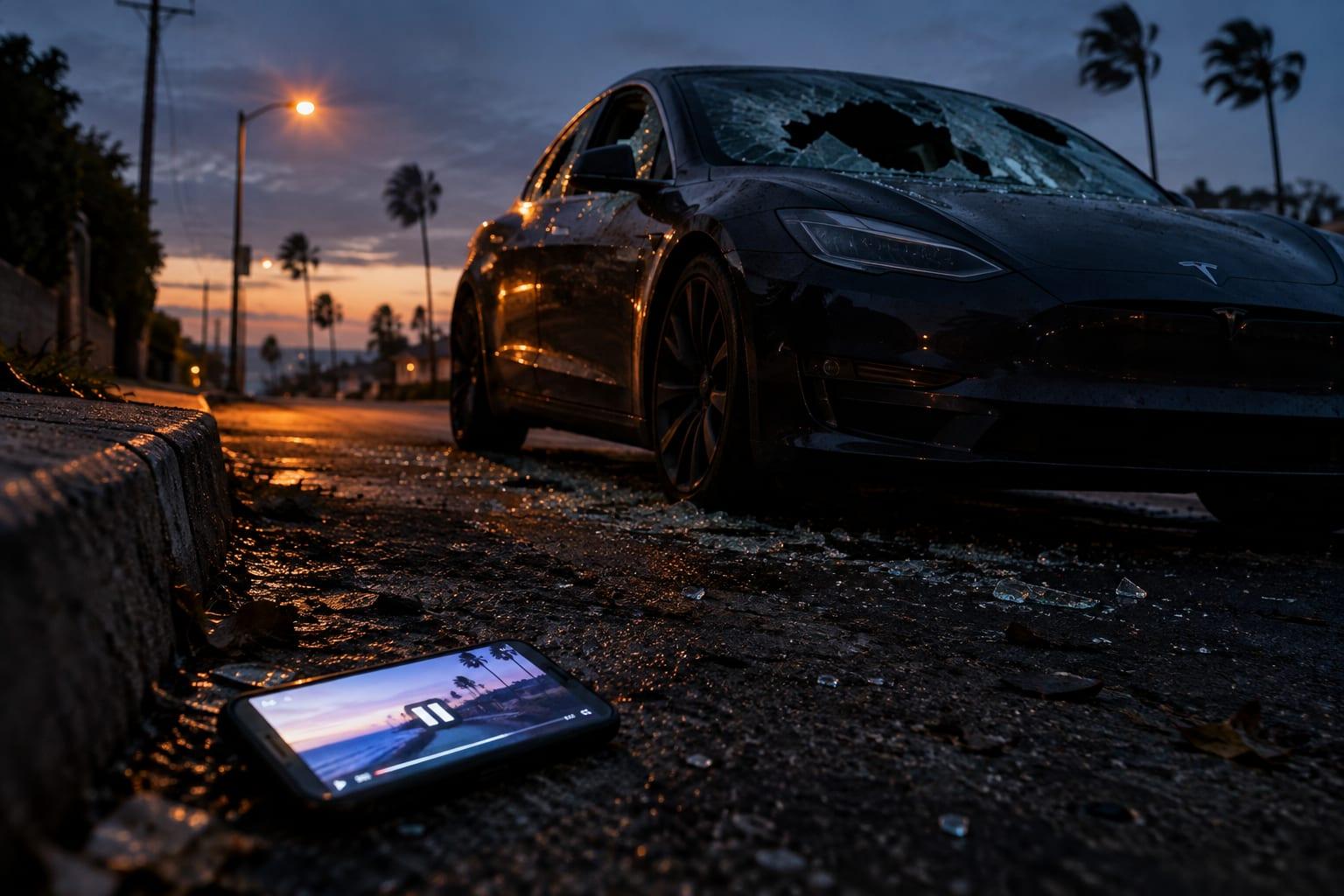
While the extradition news was breaking, a separate video circulating on social media showed a man vandalizing a Tesla vehicle in California. The account @RealAmVoice posted the clip on September twenty-sixth with the message: "Another day, another apparent case of Musk Derangement Syndrome being taken out on some random person's Tesla in California."
In the video transcript, a narrator states: "Elon Musk has really broken a lot of people, you know, like this guy. I guess this guy didn't understand that, you know, Tesla's have something called sentry mode catching him vandalizing this car, so, but I guess he doesn't care. He has a hatred for Elon that, you know, at this point, he's like, it's worth going to jail, too, so, Elon derangement syndrome, folks, it's still going out there."
The video did not include identifying information about the individual shown, and it is not known whether any arrest has been made in connection with the incident depicted. The clip is being circulated by accounts characterizing the behavior as a symptom of political obsession with the Tesla CEO.
The juxtaposition of the two stories -- a major international drug trafficking bust and a viral video of property vandalism -- reflects the varied nature of crime and political discourse dominating social media feeds this week.
Separately, law enforcement in the United Kingdom announced the sentencing of a crime group involved in what prosecutors called a "fish conspiracy." According to the Daily Mail, Metropolitan Police smashed a drugs gang's plan to smuggle twenty million pounds of cocaine hidden in frozen fish from South America to the UK, resulting in jail sentences totaling more than seventy years. The LBC reported that four men were given custodial sentences over the cocaine and ketamine scheme.
Next News Network could not independently verify the circumstances surrounding the Tesla vandalism video or the specific details of the extradition ceremony as described by other outlets.
The extradition of Rojas marks a significant shift in Colombian policy under its new president. The Gateway Pundit noted that the handover occurred after the previous administration had previously blocked extradition efforts. President de la Espriella's personal involvement in the transfer -- appearing in the hangar as Rojas was handed to U.S. authorities -- signals a hardline stance against narco-trafficking organizations operating from Colombian territory or with Colombian connections.
The "super cartel" described by The Economist represents a new model of international organized crime, where bosses operate from safe havens in the Middle East while directing networks that span multiple continents. Rojas's alleged operation, with its reported thousand-person force, fits that profile.
For California, the extradition means Rojas will face charges in the state where his network allegedly distributed narcotics. Details of the specific charges have not been released.
The Tesla vandalism video continues to circulate among accounts critical of what they describe as "Musk Derangement Syndrome." The phrase has become common shorthand on the right for what commentators describe as irrational hostility toward the Tesla and SpaceX CEO.
Our Take
The extradition of "Spider" Rojas is a genuine victory for law and order, and the new Colombian president deserves credit for personally ensuring the transfer happened. But the broader story here is the two-tiered reality of American crime coverage. A drug kingpin with a thousand-man army gets a brief mention, while a viral video of a broken window on a Tesla dominates the conversation because it fits a narrative about political obsession. Both stories matter, but only one gets the saturation coverage.
The Tesla incident, if the video is accurate, is a crime. Vandalism is vandalism. But elevating every act of property damage into evidence of a societal mental health crisis -- or dismissing it as mere political expression -- misses the point. What we have is a culture where destruction of private property has become a form of political speech, and where the response is often more about scoring points than seeking justice.
The real scandal is not that someone keyed a car. It is that a suspected mass murderer and drug trafficker was living in a Dubai penthouse for years while American authorities waited for a Colombian president willing to hand him over. That is the story that should command attention. Instead, we get a loop of a guy with a grudge and a camera phone.
Conservatives should be the first to say it: the rule of law matters whether the victim is a faceless corporation or a private citizen. But we should also be clear-eyed about priorities. If this country can move heaven and earth to catch a car vandal on video but takes a decade to extradite a cartel boss, something is out of balance. The new president of Colombia seems to understand that. It is a lesson Washington could stand to relearn.
