
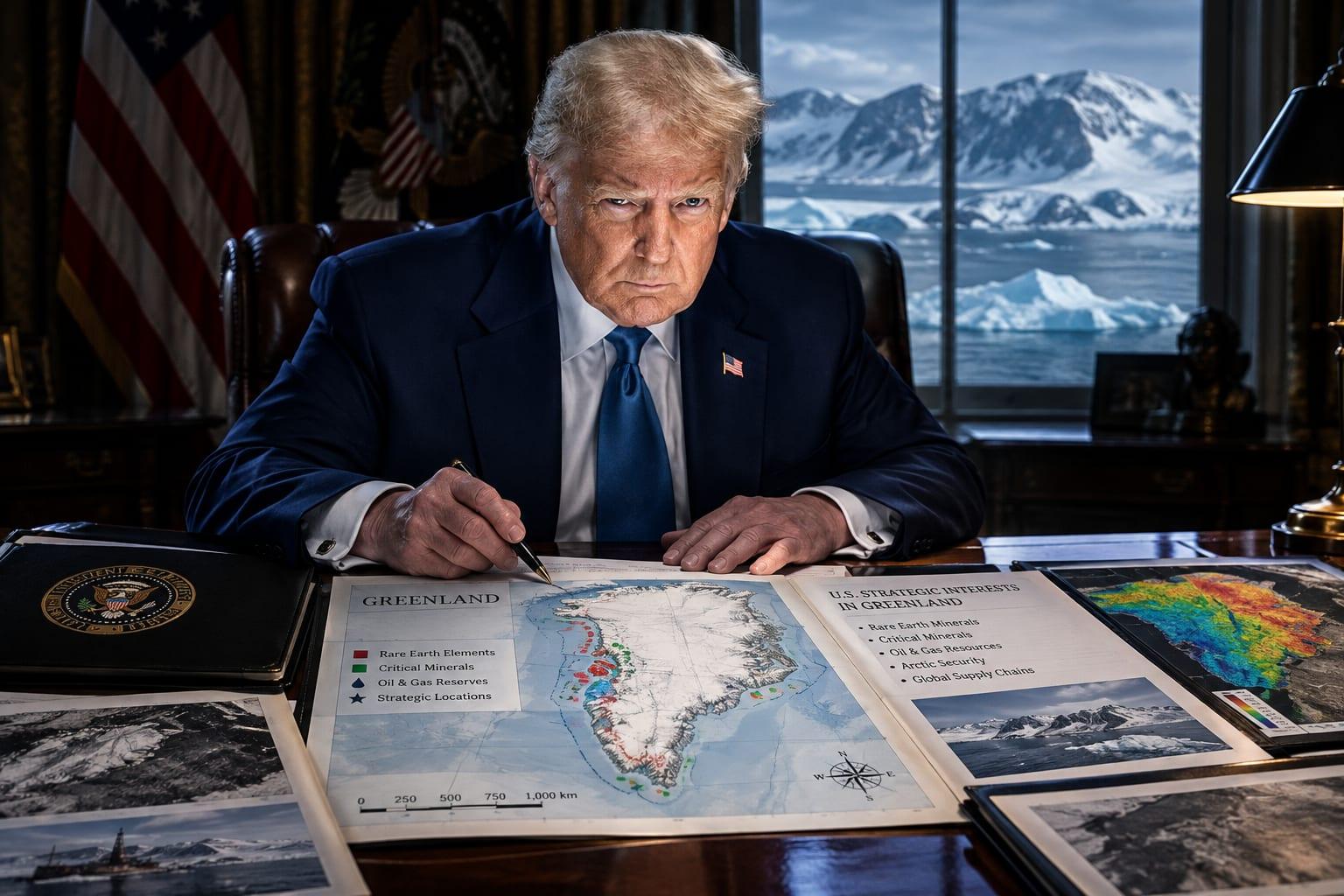
President Donald Trump signed a trilateral agreement with Danish Prime Minister Mette Frederiksen and Greenlandic Prime Minister Jens-Frederik Nielsen on Sept. 22, on the sidelines of the United Nations General Assembly, expanding the American military presence on Greenland while keeping the island under Danish sovereignty. According to an opinion piece published by Fox News, the deal allows new U.S. bases at Narsarsuaq and Mestersvig and explicitly bars non-NATO countries — Russia and China — from establishing military facilities on the island or investing in its sensitive sectors.
The military presence is the visible half of the story. The other half sits under the ice.
Greenland holds untapped deposits of rare earth minerals, nickel, copper, palladium and cobalt, plus oil and natural gas reserves, according to Fox News reporting. The island sits between North America and Europe, along key air, sea and missile routes connecting the United States, Russia and Europe.
"We don't want to be dependent on China for our rare earth minerals, and we don't want to be dependent on Russia for them either," Robert Price, CEO of Greenland Energy Company and president of USFM Corporation, told Fox News Digital.
Price's USFM is exploring nickel, copper, palladium and cobalt deposits around Disko Island in western Greenland. He told Fox News the region could eventually rival Russia's mineral-rich Norilsk district, though its potential remains unproven as drilling continues.
The energy piece is moving too. Price's Greenland Energy Company is pursuing permits for an exploratory oil well planned for 2027 on the island's eastern side, where he said the geology resembles the petroleum-producing North Sea.
"Our licenses are similar to the same petroleum system as the North Sea," Price said, adding that the company has sampled oil on and below the surface. "One of the reasons that we are exploring for oil in Greenland is because of what's going on in the Strait of Hormuz right now."
Greenland's oil and gas potential remains unproven and would require additional permits, exploration and investment, per Fox News. But the strategic logic is already in place: conflicts in Ukraine and Iran have exposed vulnerabilities in global energy and supply chains, and Washington wants its critical minerals sourced from somewhere other than Beijing and Moscow.
The deal's timing was not accidental. Chinese President Xi Jinping arrived in Washington this week for a three-day state visit, one day after the Greenland agreement was signed, according to Fox News reporting. Once the agreement is in force, non-NATO states like China would be barred from establishing a military presence on the island. Christine Balling of The Institute of World Politics told Fox News Digital that the guest list at Thursday's state dinner — which included Jensen Huang of Nvidia, Mark Zuckerberg of Meta, Sam Altman of OpenAI and Elon Musk among 134 attendees — was a strategic message to Xi about who leads the AI race.
Not everyone in Washington is impressed. Michael McFaul, former U.S. ambassador to Russia, wrote that the agreement is less than advertised, calling it a "tweak to security arrangements that have been in place for decades" rather than a historic new deal, in an analysis published by Fox News' opinion section. He noted the White House rolled out details late on a Friday night and pointed out the 1951 Denmark-U.S. security agreement as the framework both deals share.
The McFaul piece also cautions that the deal doesn't fundamentally change the existing framework. But it does build on it in ways the old pact never contemplated. As analysts noted, the 1951 agreement contained no provision for Greenland's growing autonomy from Denmark or its possible independence. The new deal requires that if Greenland breaks away, the new state must remain in NATO and take on Denmark's obligations, keeping the U.S. military in place. That provision, per Fox News coverage, gives Washington continuity no matter how the relationship between Greenland and Copenhagen evolves.
The agreement also moved Xi to the front of a week in which American leverage over the Arctic was on display, one White House official told Fox News Digital that Trump and Xi discussed the economy, trade, "superintelligence" and cooperation on shared priorities, though the official said it remained unclear what concrete agreements emerged from behind closed doors.
For decades, Western governments let rare earth processing migrate to China. Today Beijing controls the bulk of global refining capacity for the minerals that go into F-35s, electric vehicle batteries, wind turbines and data center infrastructure. Denmark's kingdom, meanwhile, sat on some of the largest untapped deposits on the planet while American presidents looked past it.
Trump didn't. And whatever the former ambassador says about the deal's size, the Chinese and Russian embassies in Copenhagen now have a direct answer to whether they can set up shop in Greenland: no.
Our Take
For years, the establishment told Americans that Greenland was a punchline — the president wanted to buy an island, cue the late-night jokes. That was always the wrong way to look at it. What Trump was doing was reading a map and following the resources. Rare earth minerals, nickel, cobalt, palladium, oil — the stuff that decides which country builds the fighter jets and which country waits in line for them. The U.S. has been handing China the keys to its own defense supply chain for two decades. The Greenland agreement, whatever its fine print, moves in the other direction: American boots, American access, and a hard wall against Chinese and Russian military and investment presence on the island.
The critics calling it old wine in new bottles miss the point. The 1951 agreement said nothing about a Greenland that might break from Denmark, and it said nothing explicit about shutting China out. The new one does both. That is leverage, and leverage is exactly what this country stopped exercising in the Arctic while our rivals built icebreakers and port deals.
Patriots should understand what is at stake here. If the United States walks away from Greenland, Beijing walks in — into the air and sea lanes between North America and Europe, into the missile warning corridor, into the mineral deposits that feed our defense industrial base. Trump isn't obsessed with Greenland. He's the only one who noticed it matters.
