
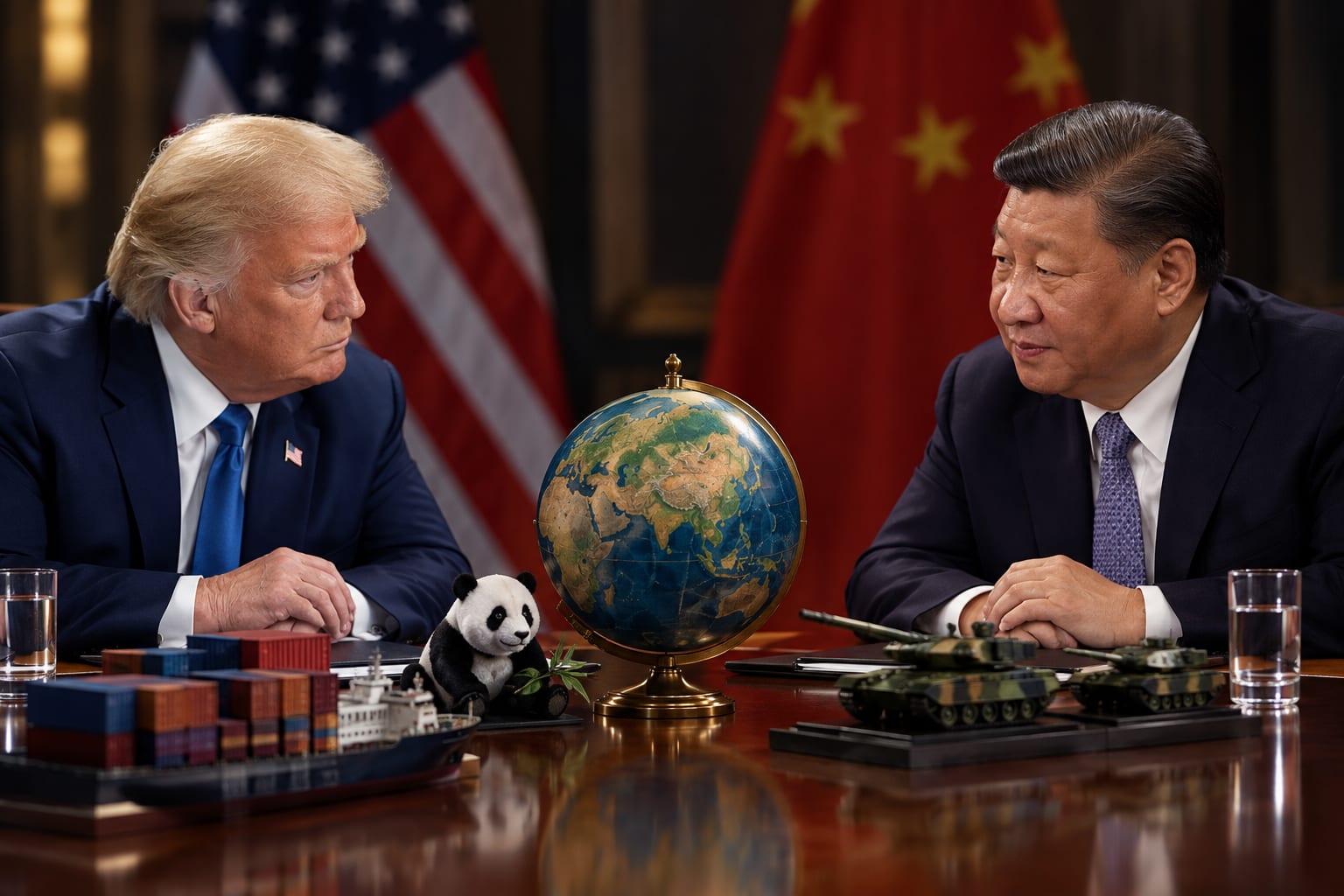
President Trump described his meetings with Chinese President Xi Jinping as "great" and said the two sides made "tremendous strides," as the final day of the Chinese state visit produced a two-month extension of the U.S.-China trade truce, an agreement to lower tariffs on thirty billion dollars of non-sensitive goods in each direction, and a new set of joint dialogues on artificial intelligence.
"I think we've made tremendous strides," Trump said, according to the Washington Times, wrapping up closed-door meetings at the White House. The same outlet reported the two governments agreed to lower tariffs on thirty billion dollars of non-sensitive trade each way and to launch joint dialogues on AI following Xi's visit.
Trump's public comments were effusive. In a transcript of an OAN segment, the president said, "Oh, everything. We had a great meeting. We had a really great meeting. Great for everybody. Great for the farmers. Great for everybody."
The headline item to emerge from the visit was the extension of the trade truce. According to the OAN transcript, the U.S.-China trade agreement, which had been set to expire in November, has now been extended for two months, pausing tariffs. Treasury Secretary Scott Besson, in the same segment, said the extension would give the U.S. and China time to negotiate a broader economic agreement. OAN's chief national security correspondent, Alexandra Ingersoll, reported the development, and the network's account, @OANN, told followers that the two sides "agreed to extend their trade truce for another two months."
ABC News, meanwhile, reported that two new giant pandas had arrived at Zoo Atlanta, just days after Xi announced the pair would be coming to the United States. The panda loan, a longstanding feature of U.S.-China diplomacy, landed in the middle of a visit otherwise dominated by tariffs, technology and security questions.
Other details of the visit surfaced in less conventional ways. The New York Post's account, @nypost, reported that Trump asked Xi whether he would "like to buy" American weapons, a detail attributed to the U.S. ambassador. The Washington Times, in a separate post, described Trump guiding Xi on a tour of the National Archives to view the Declaration of Independence and the Bill of Rights, contrasting America's two-hundred-and-fifty-year history with China's six thousand years. Both details circulated widely among accounts covering the visit.
Not all of the coverage was celebratory. The New York Times reported, two days before the visit concluded, that Xi had sought to tilt Trump's stance on America's place in Asia, using praise, warnings and wartime history to challenge U.S. support for Taiwan and Japan. The Mirror US, citing a lip reader, claimed Trump admitted in a car that the two leaders had argued during the three-day visit, an account that has not been confirmed by either government. ABC News, in its own takeaways piece, noted that the stakes were high during the meeting and that the White House was touting progress on artificial intelligence, Iran and exports.
The White House, for its part, issued a fact sheet titled "President Donald J. Trump Advances a Fair and Reciprocal Relationship with China While Hosting Historic State Visit," framing the visit as a deliverable for the American people. The NPR coverage, published a day after the visit, framed the question more skeptically, noting that from the National Archives to the state dinner, the two leaders looked comfortable together and asking what the talks did and did not deliver.
What the accounts agree on is a set of announced outcomes: the two-month truce extension, the tariff reductions on thirty billion dollars of non-sensitive trade each way, and the joint AI dialogues. What remains less clear is the durability of those outcomes. The truce extension, by its own terms, expires in two months, and Besson's framing suggests the broader economic agreement remains unnegotiated. The AI dialogues are described as dialogues, not commitments.
The president's own summary, as relayed by OAN, was broad rather than specific: everything was discussed, and the meeting was great for everybody. That kind of language tends to travel further than the details underneath it, and the details underneath it are what the follow-up coverage has been chasing since the visit ended.
Next News Network could not independently verify the claims circulating about the visit, including the account of an exchange about weapons purchases and the lip reader's report of an argument between the two leaders.
Our Take
The White House is selling this visit as a win, and on the narrow terms of what was announced, there is something to sell: the trade truce holds for another two months, thirty billion dollars in tariffs come down on each side, and the two governments are at least talking about AI instead of racing to weaponize it without a channel. That is not nothing.
But two months is not a deal, and a dialogue is not a framework. The American farmer who was invoked in the president's remarks needs a market that lasts longer than the next news cycle. The truce extension is best understood as a stay of execution for the tariffs, not a resolution of the underlying dispute. The Trump administration should be pressed on what happens when the clock runs out again, and on what specific concessions, if any, Beijing made to earn the pause.
On the arms question, the ambassador's account deserves scrutiny rather than a punchline. Offering American weapons to a strategic competitor is not a throwaway line, and the public deserves a full accounting of what was said and what was meant. On Taiwan and Japan, the New York Times reporting raises the possibility that Xi used the visit to soften Washington's position in Asia, which would make the warm imagery of the National Archives tour considerably more complicated than it looked.
The pandas are lovely. They are also the oldest soft power play in the book, and they arrived on schedule. Conservatism should be able to appreciate a decent diplomatic performance without mistaking it for a strategic victory. The president says the meeting was great. The next sixty days will tell us whether it was.
