
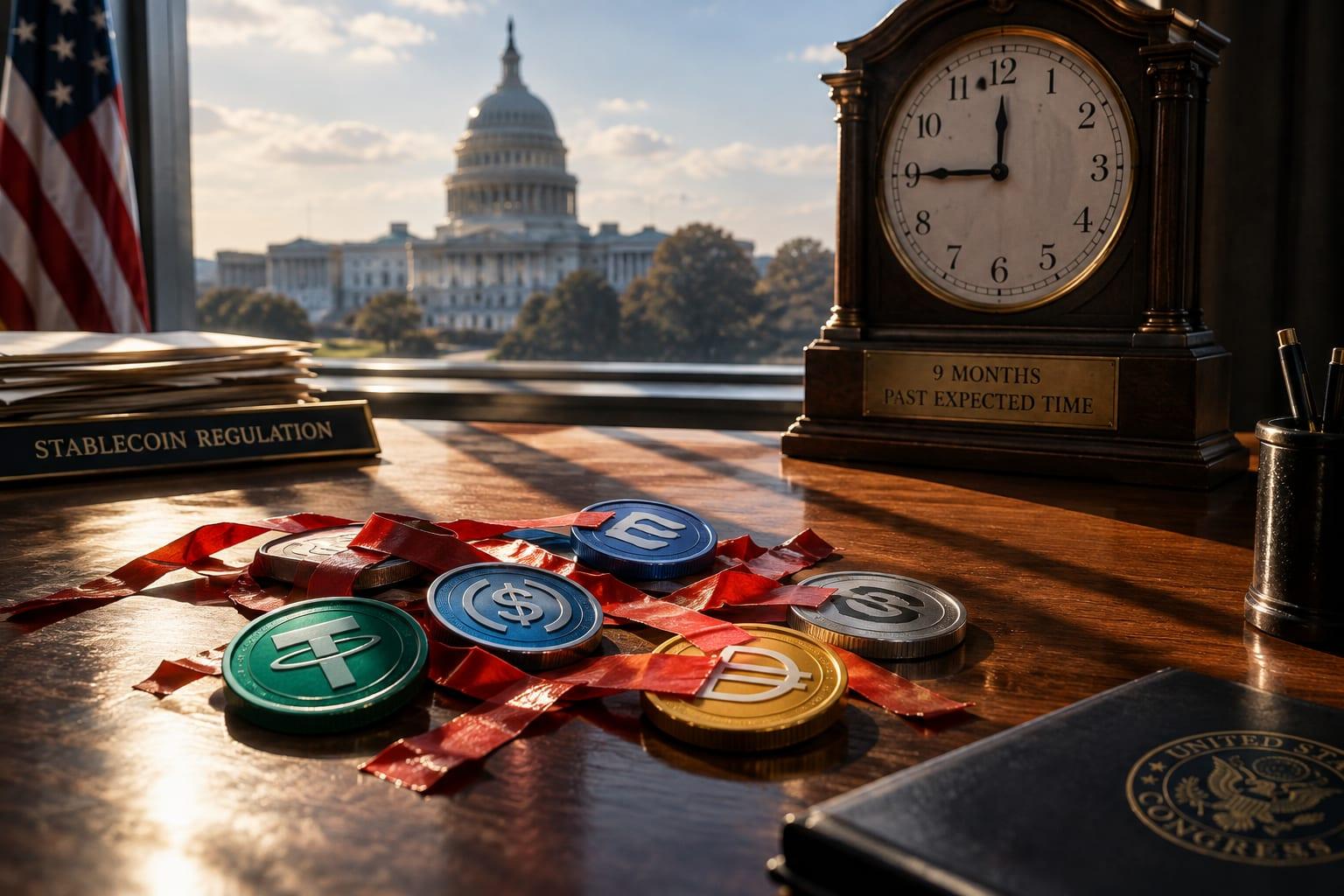
Nearly ten months after the GENIUS Act's rulemaking deadline came and went, the Federal Reserve has finally released two proposed rules governing payment stablecoin issuers — and it is now asking the American public to do the job regulators were supposed to have finished.
The two proposals, announced this week, would require regulated payment stablecoin issuers to maintain "full backing" with reserves limited to short-term U.S. Treasury securities and other high-quality, highly liquid assets, according to the Federal Reserve's official announcement. Higher-risk instruments — cryptocurrencies, corporate bonds, private placements — would be excluded entirely. The second proposal establishes an application process for banks seeking to issue payment stablecoins, requiring a business plan and financial disclosures, with approval contingent on the Fed's review. The proposal also lays out appeal, hearing, and final decision procedures.
Both proposals carry a 60-day public comment period.
The GENIUS Act — signed into law by President Trump on July 18, 2025 — was the first comprehensive federal framework for stablecoins, and it required rules to be finalized within one year. That deadline passed. The rules weren't done. As The Currency Analytics reported, stablecoin issuers managing billions in circulation are still waiting to learn what federal compliance actually looks like.
The Fed's first proposal isn't just about reserves. It standardizes capital requirements for credit risk and operational risk and imposes risk management guidelines. Under this framework, stablecoin issuance can no longer be satisfied by simply holding enough assets — issuers would be required to maintain capital buffers and internal control mechanisms comparable to traditional banks.
The second proposal addresses the question of who is allowed to play. Banks wishing to issue payment stablecoins would have to submit a business plan and financial information and obtain Fed approval before proceeding. According to reporting from KuCoin, the business plan review gives regulators the ability to examine issuance scale, dividend distribution, liquidity management, and customer protection on a case-by-case basis — rather than issuing licenses as a matter of course.
Existing non-bank issuers, including Circle and Tether, would also be required to meet similar application and audit standards if they wish to continue operating under the GENIUS Act framework, according to KuCoin.
The Cordial Analytics report noted that the Fed framed both proposals around financial stability and consumer protection — the two pressure points regulators return to every time stablecoins are discussed. The stated goal is a framework solid enough to govern daily operations but flexible enough to keep pace with rapidly evolving technology.
What remains unclear is how the 60-day comment window will shape the final rules, or whether the Fed will meet its revised timeline. Industry groups historically dominate the comment process; individual citizens rarely participate. The practical effect is that the rules governing a multi-billion-dollar market are often written with heavy input from the companies being regulated — and minimal input from the people those rules are supposed to protect.
The proposals represent the most concrete federal action on stablecoins since the GENIUS Act became law. But they arrive after a delay that left issuers, investors, and consumers operating in a regulatory gray zone for the better part of a year.
Our Take
Here's what the Fed doesn't want you to notice: the GENIUS Act set a one-year deadline. That deadline came and went. And now the same agency that couldn't finish its homework on time is asking the public to tell it what the rules should be — as if the American people are supposed to do the federal government's job for it.
This is the administrative state in action. Congress passes a law. The president signs it. And then the unelected bureaucrats who actually write the rules take their sweet time, miss their own deadlines, and open a comment period that will almost certainly be dominated by the very industry players who stand to profit from the outcome.
That's not regulation. That's a negotiation — and you're not invited.
But let's be clear about what the Fed is actually proposing. Full reserve backing? Good. Short-term Treasuries and high-quality liquid assets only? Even better. No crypto, no corporate bonds, no private placements backing the stablecoins Americans are told to trust? That's just common sense. If a stablecoin claims to be worth a dollar, it should be backed by something that's actually worth a dollar.
The application process for banks? Also reasonable on its face. If you want to issue a payment stablecoin, you should have to prove you know what you're doing. The business plan review — issuance scale, dividend distribution, liquidity management, customer protection — gives regulators the ability to separate serious operators from fly-by-night schemers.
But here's the part the Fed won't say out loud: those same standards will be applied to existing non-bank issuers like Circle and Tether. That means some of the biggest players in the stablecoin market will have to go hat-in-hand to the Fed and ask permission to keep operating. The question is whether those standards will be applied fairly — or whether the Fed will use this process to pick winners and losers.
And there's a bigger question lurking beneath all of this. Why did it take nearly a year for the Fed to produce two draft proposals? The GENIUS Act wasn't a secret. The deadline wasn't a surprise. Trump signed it in July 2025. The Fed had twelve months. It blew through them.
Now, with a 60-day window open, the Fed is inviting comments. That's your shot. If you're a small business owner who wants to accept stablecoin payments without getting buried in red tape, say so. If you're a consumer who wants to know your money is actually backed by something, say so. If you're tired of unelected bureaucrats deciding the future of American finance behind closed doors, say so.
The comment period is open. The game is rigged. And the only way to un-rig it is to show up.
Patriots, this is your chance. The Fed missed its deadline. The rules aren't written yet. And the people who are supposed to be writing them just handed you a microphone.