
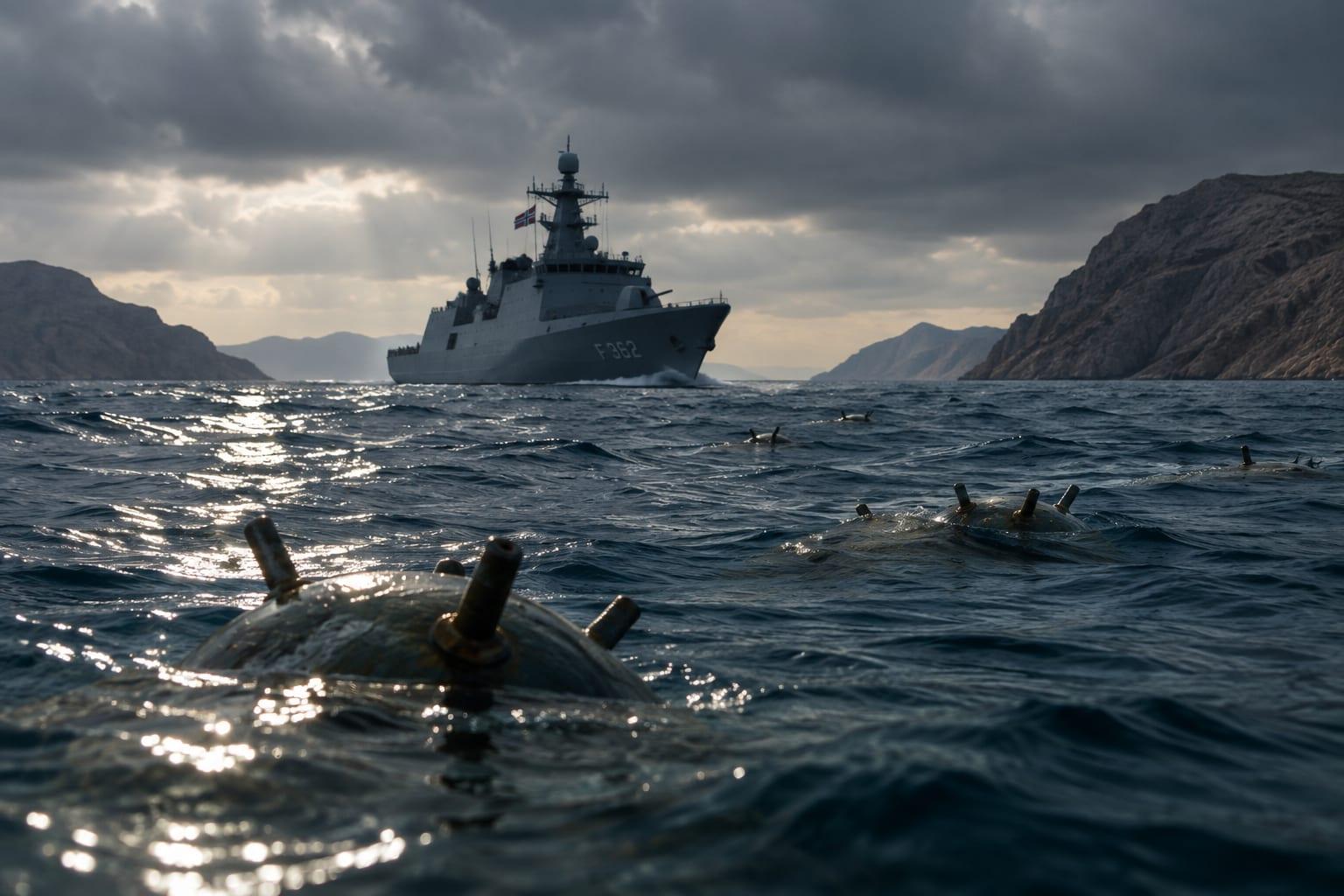
Iran has mined the Omani side of the Strait of Hormuz — the same corridor U.S. escort missions have been using — according to claims circulating among Middle East analysts, and Tehran is simultaneously pressing Washington for a diplomatic deal even as President Trump has publicly rejected one.
The account @MarioNawfal carried the claim in a post citing analyst Brandon Weichert, who said Tehran's mining of the Omani side represents a direct answer to Washington after nuclear talks collapsed. "They were going to deter that," Weichert said, describing the mining as an effort to "nip that in the bud" after the U.S. began pushing larger volumes of shipping through the corridor.
In a separate post, @MarioNawfal reported that Iran is still publicly asking Washington for a deal, citing former U.S. diplomat and JCPOA negotiator Alan Eyre's assessment that the request is genuine. Tehran wants sanctions lifted, frozen assets released and a return to the framework it has been seeking, according to that post.
Eyre expanded on that assessment in a video interview with Weichert. Asked whether the two countries are back at war, Eyre said they are not — but described what he characterized as Iran's deliberate escalation strategy.
"Iran thinks that its window of opportunity is more open before the midterms," Eyre said. "They pitched a deal last week, basically expediting the Islamabad MOU. President Trump said no verbally, though the Iranian foreign minister says we have not yet received a formal reply."
Eyre said Iran believes it must eventually escalate to increase pressure on Washington. "Eventually Iran will have to escalate to increase the price on Americans," he said. "The way it's happening is unsustainable."
Weichert, who co-hosted the interview, said he had spoken with Navy personnel who described the escort mission as untenable. "The Navy cannot sustain it — not only its blockade, but it can't do these escort missions indefinitely," Weichert said, citing retired Navy Captain Bobby Jones. "The Navy is going to have to discontinue soon because of the readiness problem."
On the question of what further U.S. military action could achieve, both men expressed skepticism. Weichert cited retired Lt. Col. Karen Kwiatkowski's assessment that the Air Force likely has one more forty-eight to ninety-six hour air campaign before bomber airframe readiness deteriorates. Eyre said any additional strikes would amount to "whack a mole" against military sites Iran would rebuild.
"You can still hit military targets. There's a lot of whack a mole going on here. We blow stuff up, Iran rebuilds it, we only attack it again," Eyre said. "At some point, we're going to have to contemplate reducing our military footprint in the region, just because it's not sustainable."
Eyre suggested Iran's retaliatory options extend well beyond the strait. "They can increase targeting on maritime traffic in the strait, and they can target Gulf infrastructure — Gulf energy infrastructure," he said. "They could cut communication lines under the sea. They could resume terrorist attacks. They could strike bases in the European theater."
Asked about a suspected plot in the United Kingdom involving arrests near a military base housing American flights, Eyre declined to speculate on Iranian involvement but noted that Iran has "always said it will attack countries who are cooperating with the US aggression against Iran."
On Iran's relationship with Yemen's Houthi movement, Eyre said the two share "convergent and overlapping interests" but that Iran has "the least direct control over the Houthis" of all its partners. "They're not Iranian puppets," he said.
The escalation claims coincide with a separate thread from the account @infowars, which promoted an appearance by former Green Beret Matt Murphy. @RealAlexJones told followers that Murphy "literally trained ISIS in secret program" and would "expose Islamic terror networks carrying out false flags to further drag the US into the Iran War." Those claims are not corroborated by any of the material reviewed.
The account @amuse posted a programming note about expanding an AI server farm now running forty-four CPU cores and more than seven terabytes of storage, saying it is being used for get-out-the-vote operations in several House and State races.
Eyre also addressed the broader trajectory of U.S. policy toward Iran, describing what he called an information bubble around the president. "He has selected a cabinet and advisors based on personal fealty," Eyre said. "None of those people are going to be like Jim Mattis was in Trump or his chief of staff Kelly, who are going to speak hard truths to him."
He predicted Republicans would lose both houses of Congress in the midterms, and that Trump would then face a five-to-six week window before a new Congress is sworn in.
Eyre was more expansive on climate, calling it "hugely significant" and "more significant than anything you or Mario talk about." He said the Middle East has already crossed four degrees Celsius of warming since the Industrial Revolution, compared to a global average of one-and-a-half degrees, and cited the Rhine River at historic lows as evidence of cascading effects.
"This is not a technical or a scientific problem. This is a political will problem," Eyre said. "You electrify everything, you use less energy, you stop fixating on GDP as the Holy Grail of a country."
He said Saudi Arabia faces a "severe existential threat" from climate change rather than from the Houthis, and that neither side in Yemen can win militarily.
Next News Network could not independently verify the claims about mining in the Strait of Hormuz, the number of ships targeted or struck, or the internal assessments attributed to U.S. Navy personnel and other named individuals.
Our Take
The picture emerging from these accounts is of an administration that has run out of escalation options while Iran has not — and of a president who has publicly rejected a deal his own former negotiators describe as the best available path. Eyre's assessment that Iran is genuinely seeking an agreement while Trump is playing to his base reflects a familiar pattern: Washington confuses public posturing with strategic leverage. The Navy cannot sustain escort missions indefinitely. The Air Force has perhaps one more bombing campaign in it. And Iran, according to Eyre, has barely begun to explore its escalatory space. The only winner in this standoff is the one who can wait longest — and that is not the United States. Trump told voters he would end wars. Instead, he has walked away from the best deal on the table and left his successor with a broken military, a shattered diplomatic corps and an adversary that has learned it can outlast American attention spans. The midterms will not change that equation. They will only determine who inherits the wreckage.
