
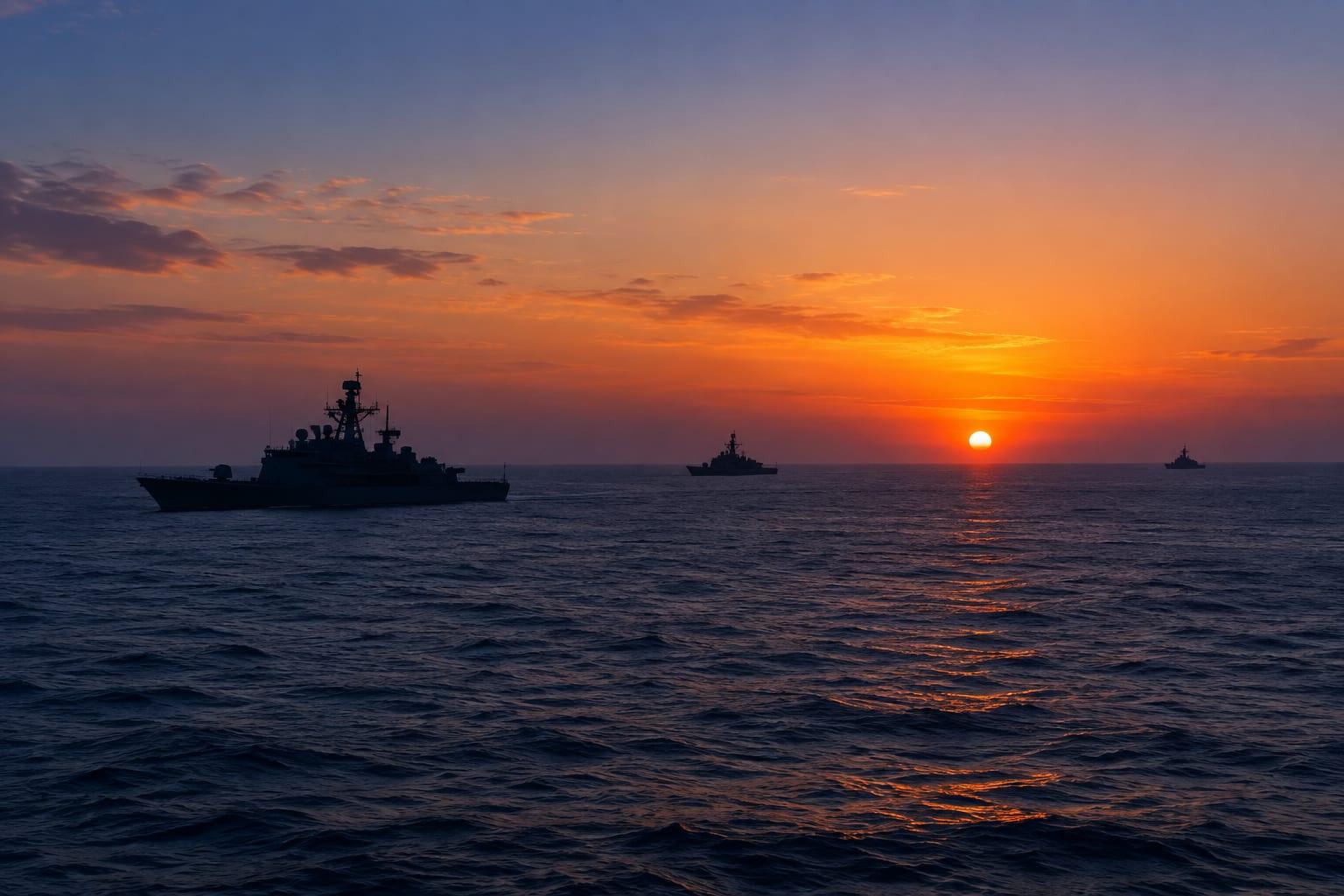
Iran's Supreme Leader Mojtaba Khamenei said that enemy forces do not dare enter the Gulf and the Arabian Sea and that the waters would soon be cleared of 'enemies,' according to a post from the account @FirstSquawk on Monday. The statement was carried by the account as a breaking news alert, quoting Khamenei directly. 'ENEMY FORCES DO NOT DARE ENTER GULF AND THE ARABIAN SEA WOULD SOON BE CLEARED OF ENEMIES,' the post read.
The claim from Khamenei comes as multiple reports on Sunday and Monday described him as having been injured in a US-Israeli strike on a Tehran hospital and subsequently 'pulled from the rubble.' The New York Post first reported the account, which was then picked up by The Times of India, The Week, and other outlets.
A cleric, Ayatollah Mohsen Heidari Alekasir, said Khamenei was pulled from the rubble of a Tehran hospital following airstrikes. According to The Week, Heidari said Khamenei survived a second bombing in February after earlier strikes had wounded him. The New York Post reported that Khamenei had been taken to the medical centre after earlier attacks. Heidari also denied the claim that Iran's former supreme leader, Ali Khamenei, had recommended his son to serve as his successor.
On Monday, Iranian President Masoud Pezeshkian said that Supreme Leader Ayatollah Mojtaba Khamenei is 'completely healthy' and has recovered from injuries he sustained during an airstrike. Pezeshkian's statement was reported by Iranian state media and carried by multiple outlets. The president did not provide further details on the nature of the injuries or the timeline of the recovery.
The account @FirstSquawk carried Khamenei's latest remarks on Monday morning, which stated that enemy forces 'do not dare enter' the Gulf and the Arabian Sea and that those waters 'would soon be cleared of enemies.' The post did not specify which forces Khamenei was referring to, nor did it provide a timeline for when the waters would be cleared. The account @FirstSquawk is a breaking news feed that aggregates headlines from various sources.
The statement from Khamenei, if accurately translated and quoted, would be his first public comment since reports of his injury and recovery emerged. It remains unclear whether the statement was issued directly by Khamenei or through intermediaries, as is common with statements attributed to Iran's supreme leader. The @FirstSquawk post did not include a date or location for the statement.
The Gulf and the Arabian Sea have been areas of heightened tension in recent months, with US and Israeli forces conducting operations in the region. The strikes that reportedly injured Khamenei were part of a broader campaign targeting Iranian military and leadership assets. Iran has vowed retaliation for the strikes, though no specific action has been announced.
The sequence of events, as described by the accounts and coverage, began with the US-Israeli strikes on Tehran, including a hospital where Khamenei was being treated. Heidari, the cleric, described pulling Khamenei from the rubble after the hospital was hit. The New York Post reported that Khamenei had been taken to the hospital following earlier attacks. The reports of his injury circulated widely on social media and were picked up by international outlets.
On Monday, President Pezeshkian sought to reassure the public that Khamenei was healthy and recovering. His statement came as Khamenei himself was quoted by @FirstSquawk saying that enemy forces avoid the Gulf and Arabian Sea. The two statements together paint a picture of a leadership that is both recovering from an attack and projecting strength.
The reports of Khamenei's injury and recovery have not been independently confirmed by Next News Network. The account @FirstSquawk is a social media feed, and its post is a statement attributed to Khamenei, not a verified transcript. The New York Post report cited an unnamed cleric, and The Times of India and The Week cited the New York Post. The Iranian president's statement was carried by Iranian state media, which is controlled by the government.
Khamenei's remarks about the Gulf and Arabian Sea echo previous statements from Iranian leaders threatening to close the Strait of Hormuz or expel foreign forces from the region. The Strait of Hormuz is a critical chokepoint for global oil shipments, and any disruption there could have significant economic consequences. Iran has previously threatened to block the strait in response to sanctions or military action.
The statement from Khamenei, as carried by @FirstSquawk, did not specify what 'enemies' refers to, but in the context of recent US-Israeli strikes, it is likely a reference to those forces. The post also did not indicate whether Khamenei was speaking about a specific military operation or making a general declaration of intent. The language used was defiant, suggesting that Iran intends to assert control over the waters.
The reports of Khamenei's injury have raised questions about the stability of Iran's leadership. Mojtaba Khamenei, the son of the late Supreme Leader Ali Khamenei, was appointed as supreme leader after his father's death, according to Iranian state media. His injury, if confirmed, would be a significant blow to the regime. The cleric Heidari's account of pulling him from the rubble suggests that the attack was severe.
President Pezeshkian's statement that Khamenei is 'completely healthy' and has recovered may be an attempt to project normalcy and deter further attacks. However, the contradictory reports about his condition have led to speculation about the true state of his health. The Iranian government has not released any images or video of Khamenei since the strikes, which has fueled further speculation.
Next News Network could not independently verify the claims made by the cleric, the New York Post, or the Iranian president. The account @FirstSquawk is a social media feed that aggregates news, and its post is a statement attributed to Khamenei, not a verified transcript. The reader should consider the source of each claim when evaluating the accuracy of the reports.
The situation in the Gulf and Arabian Sea remains tense, with US and Israeli forces reportedly operating in the area. Iran's threats to clear the waters of 'enemies' could lead to further escalation. The international community is watching closely, as any conflict in the region could disrupt global oil supplies and destabilize the Middle East.
Khamenei's statement, as carried by @FirstSquawk, is the latest in a series of defiant remarks from Iranian leaders. It remains to be seen whether Iran will take concrete action to enforce its claims or whether the statement is primarily rhetorical. The world will be watching for any signs of military movement in the Gulf.
Our Take
Once again, the Iranian regime is issuing threats it may not be able to back up. Mojtaba Khamenei, if he is indeed healthy enough to speak, is claiming that enemy forces do not dare enter the Gulf and the Arabian Sea. But the reality is that US and Israeli forces have been operating in the region with impunity, striking targets inside Tehran itself. The fact that Khamenei was reportedly pulled from the rubble of a hospital suggests that the regime's air defenses are woefully inadequate.
President Pezeshkian's claim that Khamenei is 'completely healthy' rings hollow. If the supreme leader were truly healthy, why haven't we seen him? Why rely on a cleric's account of pulling him from rubble? The Iranian regime is known for its propaganda, and this is likely another attempt to project strength while hiding weakness.
Khamenei's threat to clear the waters of 'enemies' is a dangerous escalation. The Gulf and Arabian Sea are vital international waterways, and any attempt to disrupt them would be met with a fierce response from the United States and its allies. Iran should think twice before making threats it cannot win. The regime's history of aggression, from tanker attacks to drone strikes, has already destabilized the region. More threats will only lead to more isolation.
The American people should not be fooled by Iranian propaganda. The regime is on the ropes, and its leaders are lashing out. We must stand with our allies, maintain a strong military presence in the region, and send a clear message that threats against freedom of navigation will not be tolerated. The only way to deal with a bully is to stand up to him.
