
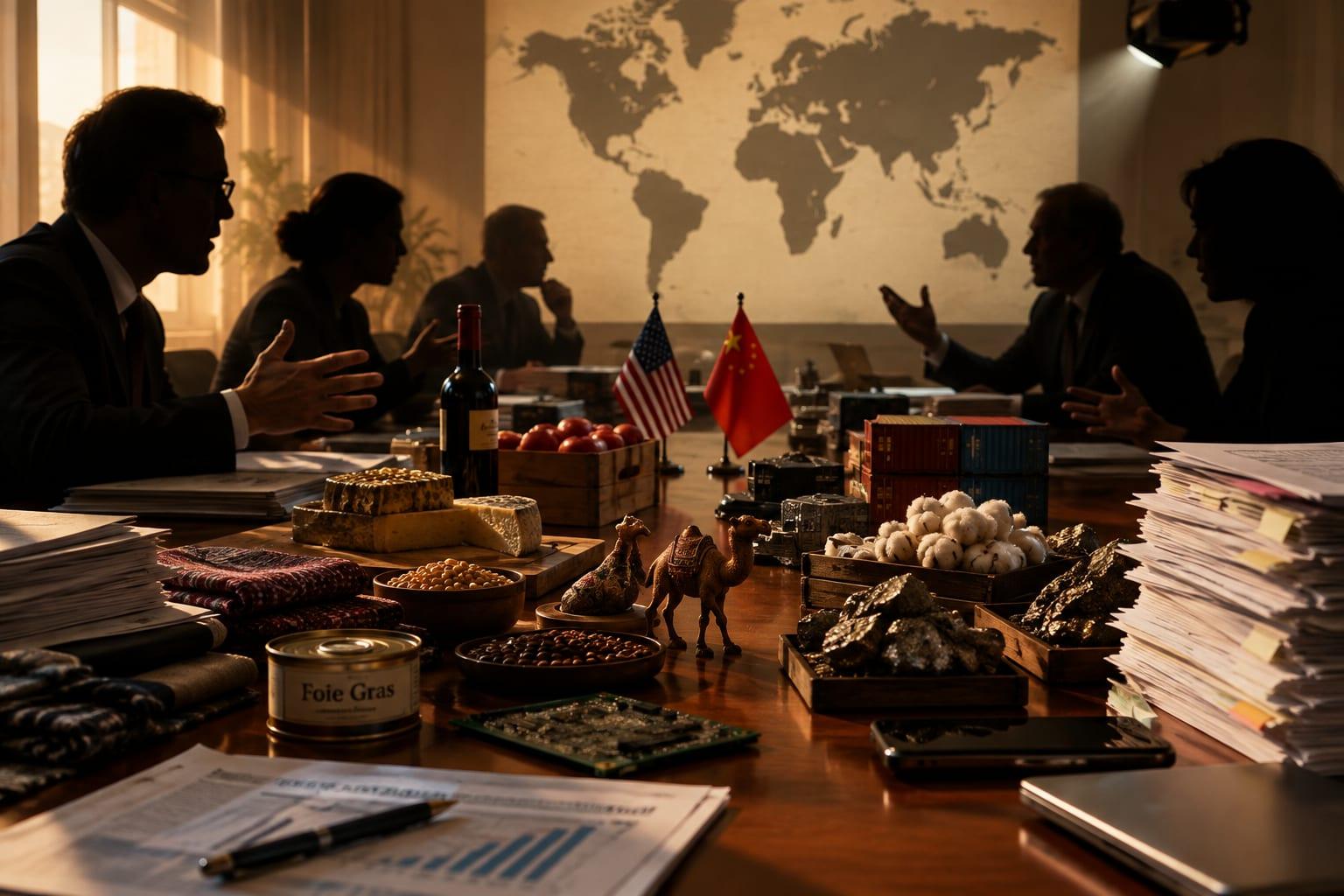
The United States and China have agreed to lower tariffs on about $30 billion of imports from each country, according to a detailed plan released after a three-day summit in Washington between President Donald Trump and Chinese President Xi Jinping. The two sides described the arrangement as $60 billion in total two-way tariff relief spanning products from foie gras to camels, and said it would be paired with a new channel for handling artificial intelligence incidents.
The claim, carried in a terse wire item from the account @FirstSquawk, spread rapidly across political and financial accounts, drawing reaction from lawmakers, trade analysts and commentators who said the product lists and the enforcement mechanism matter more than the headline figure. The Foreign Policy Journal reported the deal as cutting tariffs on $30 billion in goods following the Washington summit, and Bloomberg, citing the released product lists, reported the same figure — approximately $30 billion of imports from each country.
It is the composition of the lists, not the total, that is drawing the sharpest responses. According to an account of the summit published by one outlet, the eight-point consensus reached by Trump and Xi covers “noncritical” tariffs and includes improved AI safety cooperation. A separate account said the two sides agreed on tariff recommendations for $60 billion in goods and launched a new dialogue on advanced AI and “super intelligence,” with trade boards tasked with handling coal, agriculture and investment, and discussions continuing over critical minerals.
The spread of the claim can be tracked by the accounts carrying it. @FirstSquawk framed the deal in its most expansive terms, putting the number at $60 billion and spanning “foie gras to camels.” Bloomberg followed with the product lists and the $30 billion per-side breakdown. The Foreign Policy Journal led with the summit and the per-side figure. Another account reported the AI incident channel as part of an eight-point consensus.
The debate that followed divided along two lines. Supporters of the arrangement, including voices within the administration’s trade orbit, described the agreement as a stabilization step: a way to ease noncritical tariffs without surrendering leverage on strategic sectors. Critics, including several Capitol Hill offices and outside trade analysts, raised questions about what the lists actually cover, whether the relief is durable and whether the AI dialogue produces enforceable commitments rather than a communications channel.
Those familiar with the Washington side of the talks described the working sessions as technical and product-by-product. The reference to camels drew particular attention, with commentators noting the inclusion of agricultural and specialty goods in a negotiation usually dominated by semiconductors, minerals and heavy machinery. Foie gras, similarly, appeared in the framing of the announcement as an illustration of how far the tariff relief reaches across consumer categories.
The AI component has generated its own scrutiny. The two sides set up a channel to address AI incidents and opened a dialogue on advanced capabilities, according to the reported consensus. Trade boards will address coal, agriculture and investment, one account said, while critical minerals remain a continuing subject of negotiation. What such a channel would do in practice, who would staff it and what threshold would trigger its use are not yet known.
Reaction also tracked the summit optics. The three-day Washington meeting between the two leaders was presented by both governments as an effort to steady ties after years of tariff escalation. Commentators on the American right questioned whether tariff relief on consumer goods should be paired with movement on critical minerals and technology transfer, and whether the deal’s terms can be verified and enforced. Commentators on the other side argued that any reduction in tariff pressure reduces costs for importers and consumers.
The product lists themselves, released alongside the announcement, laid out categories of goods on each side. The per-side figure of $30 billion matches the total of $60 billion when measured across both directions. Where those lists cover sensitive sectors, and where they do not, is likely to determine how the agreement is received by industry groups in the coming days.
Coverage of the deal has been consistent on the top-line numbers — roughly $30 billion per side, $60 billion total — but thinner on the mechanics. Outlets described tariff “recommendations,” a phrase that leaves open who adopts them, on what timetable, and under what conditions they could be reversed. The deal’s durability, in particular, remains an open question, given that earlier tariff truces between the two economies have eroded.
For now, the reaction is the story. Lawmakers, trade offices and analysts are working from the released lists and the announced figures, and the argument over what the arrangement actually accomplishes is being conducted largely on the strength of those documents. Next News Network could not independently verify the underlying claim that the deal has been finalized at the stated figures.
Our Take
Two things can be true at once. Tariff relief on consumer goods — foie gras, camels, and whatever else appears on these lists — is a real cost reduction for American importers and, eventually, buyers. President Trump has spent years using tariffs as leverage, and if he judges that a narrow easing on noncritical goods buys progress on critical minerals and AI safety, that is a deal worth measuring rather than dismissing on optics. But the American people have heard “historic trade agreement” before, and the details that matter most — enforcement, duration, and what happens when Beijing fails to deliver — are exactly the details that have not been spelled out. A communications channel on AI incidents is not a safeguard if nobody is obligated to pick up the phone. And conservatives should be suspicious of any arrangement that eases pressure on Beijing before the strategic concessions are in writing and on the record. Publish the full lists, publish the enforcement terms, and let the public judge. Until then, the summit is a photo opportunity with a product list attached — and the burden of proof is on the negotiators.
