
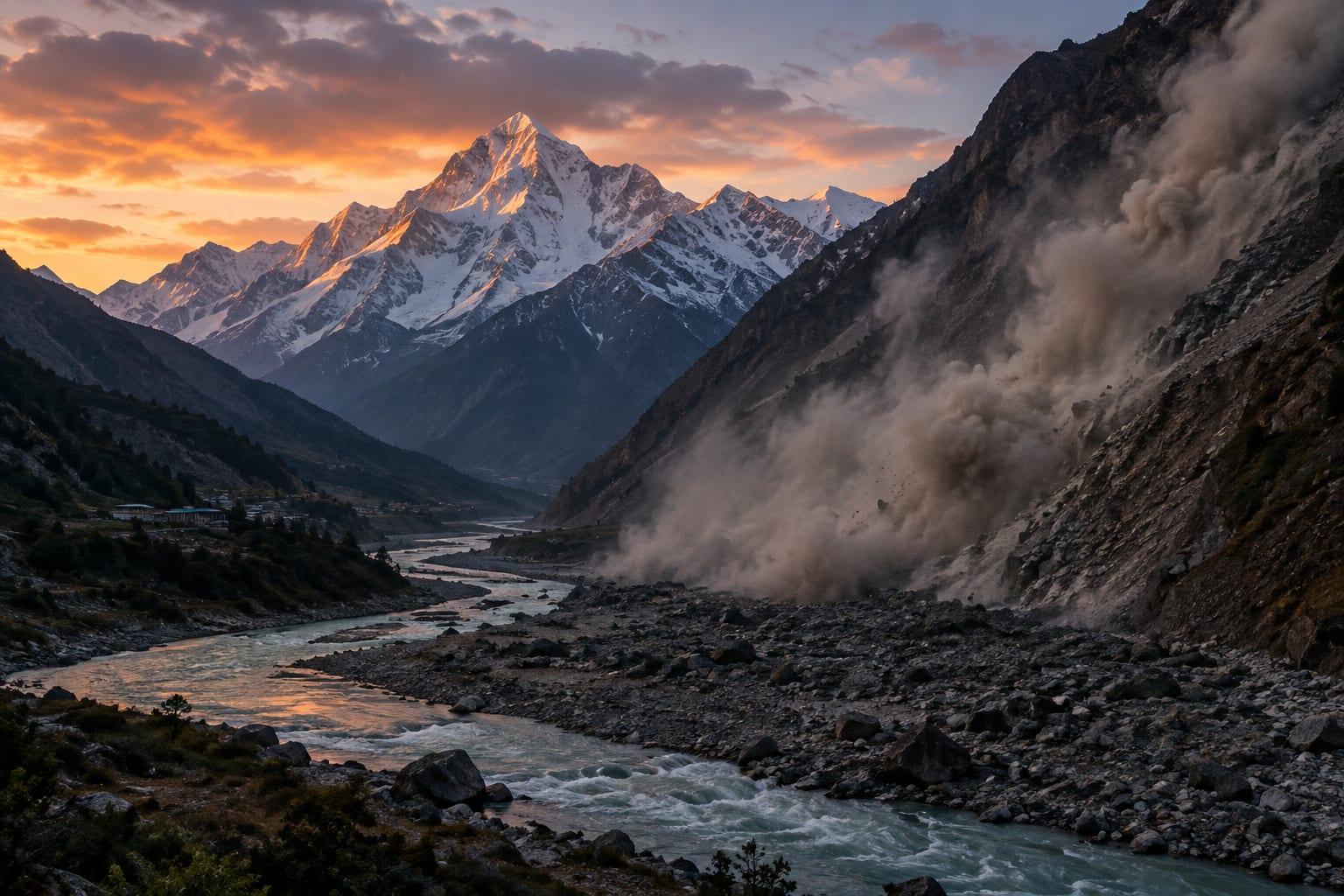
A massive section of mountain broke away and crashed into a river in Nepal, according to a post from the account @MarioNawfal, which cited the incident as the latest in a series of deadly natural disasters in the Himalayan nation. The post, published on September 28, 2026, also claimed that over one thousand four hundred fifty people had died in a glacier collapse in the same region just one month earlier.
The account @MarioNawfal, which has a large following and frequently posts on international events, wrote: "WOW: A huge section of mountain breaks away and crashes into a river in Nepal!" The post added: "Over 1,450 people just died here in that horrifying glacier collapse last month. WTF is going on in Nepal??" The post was attributed to a writer identified only as Samuel.
That post quickly became the primary source for a wave of reactions across social media, with users expressing shock, demanding answers, and questioning the state of disaster monitoring in the region. The claim has not been confirmed by Nepalese authorities, international monitoring agencies, or any major news organization. No other coverage of the specific mountain breakaway or the reported death toll was found at the time of publication.
The post from @MarioNawfal is not a news report but a social media update, and it does not include a link to official data or a named source on the ground. It presents the mountain breakaway and the earlier glacier collapse as established facts, but neither has been independently verified by Next News Network. The figure of over one thousand four hundred fifty deaths, if accurate, would rank among the deadliest natural disasters in Nepal's recent history, yet no government or international body has released a statement confirming that number.
Other accounts amplified the claim. The post was shared by users who framed it as evidence of a broader environmental crisis in the Himalayas, with some pointing to climate change and others to what they described as a failure of local and international authorities to protect vulnerable communities. These reactions, while widespread, are based on the same unverified claim.
Nepal is no stranger to deadly landslides and glacial lake outburst floods. In 2021, a glacial lake burst in the Annapurna region, sending a wall of water and debris down the Seti River, killing dozens and destroying homes. In 2023, a similar event in the Everest region claimed multiple lives. Scientists have warned for years that rising global temperatures are destabilizing glaciers across the Himalayas, creating thousands of new glacial lakes and increasing the risk of catastrophic flooding. The region is also prone to earthquakes, which can trigger massive landslides.
The post from @MarioNawfal did not specify the exact location of the mountain breakaway or the river involved. It also did not provide a date for the event, though the phrasing suggested it occurred within days of the post. The reference to the glacier collapse "last month" would place that disaster in August 2026, but no independent reports from that period confirm a death toll of over one thousand four hundred fifty.
Efforts to reach Nepalese officials for comment were unsuccessful. The National Disaster Risk Reduction and Management Authority in Nepal has not published any bulletin matching the description in the post. International organizations that monitor glacial hazards, including the International Centre for Integrated Mountain Development, have not issued any alerts or statements about a mountain breakaway or a glacier collapse of that magnitude in August or September 2026.
The absence of official confirmation does not mean the events did not occur. In remote regions of Nepal, communications can be delayed for days, and initial reports from social media often precede formal government updates. However, it also means that the claims remain unverified and should be treated with caution until more information becomes available.
Next News Network could not independently verify the claims made in the post from @MarioNawfal or the reported death toll from the earlier glacier collapse.
The spread of the claim highlights a recurring challenge in the digital age: social media accounts can shape the narrative of a disaster before official channels have even confirmed that a disaster took place. In this case, the @MarioNawfal post did not just report an event; it also framed it as part of a pattern, asking "WTF is going on in Nepal?" That framing was picked up by other users who added their own theories and calls to action.
Some of those reactions focused on the need for better disaster preparedness in Nepal, a country that lacks the resources for comprehensive monitoring of its vast mountain ranges. Others used the claim to criticize global climate policies, arguing that industrialized nations are not doing enough to help vulnerable countries adapt. Still others simply expressed grief and solidarity with the people of Nepal.
None of these reactions change the underlying uncertainty. The post from @MarioNawfal remains the only source for the specific events described. Until independent verification emerges, the claims should be understood as allegations, not established facts.
The story is still developing. If and when official information becomes available, Next News Network will update this report.
Our Take
Once again, a social media account has broken news that the mainstream media ignored — or perhaps simply could not confirm. @MarioNawfal's post about a mountain breaking away in Nepal and a glacier collapse that allegedly killed over one thousand four hundred fifty people is exactly the kind of story that Big Media would rather you not see, because it does not fit their climate alarmist narrative or their refusal to cover certain international disasters. But we must be careful: Next News Network could not independently verify these claims. That does not mean they are false. It means the corporate press, which has endless resources, has failed to do its job. While Americans are distracted by the latest domestic political circus, a potential catastrophe is unfolding in the Himalayas, and the only people talking about it are independent voices on social media. We will continue to monitor this story and demand answers from the Nepalese government and international agencies. If these reports are true, the world needs to know — and the silence from official channels is deafening.
