
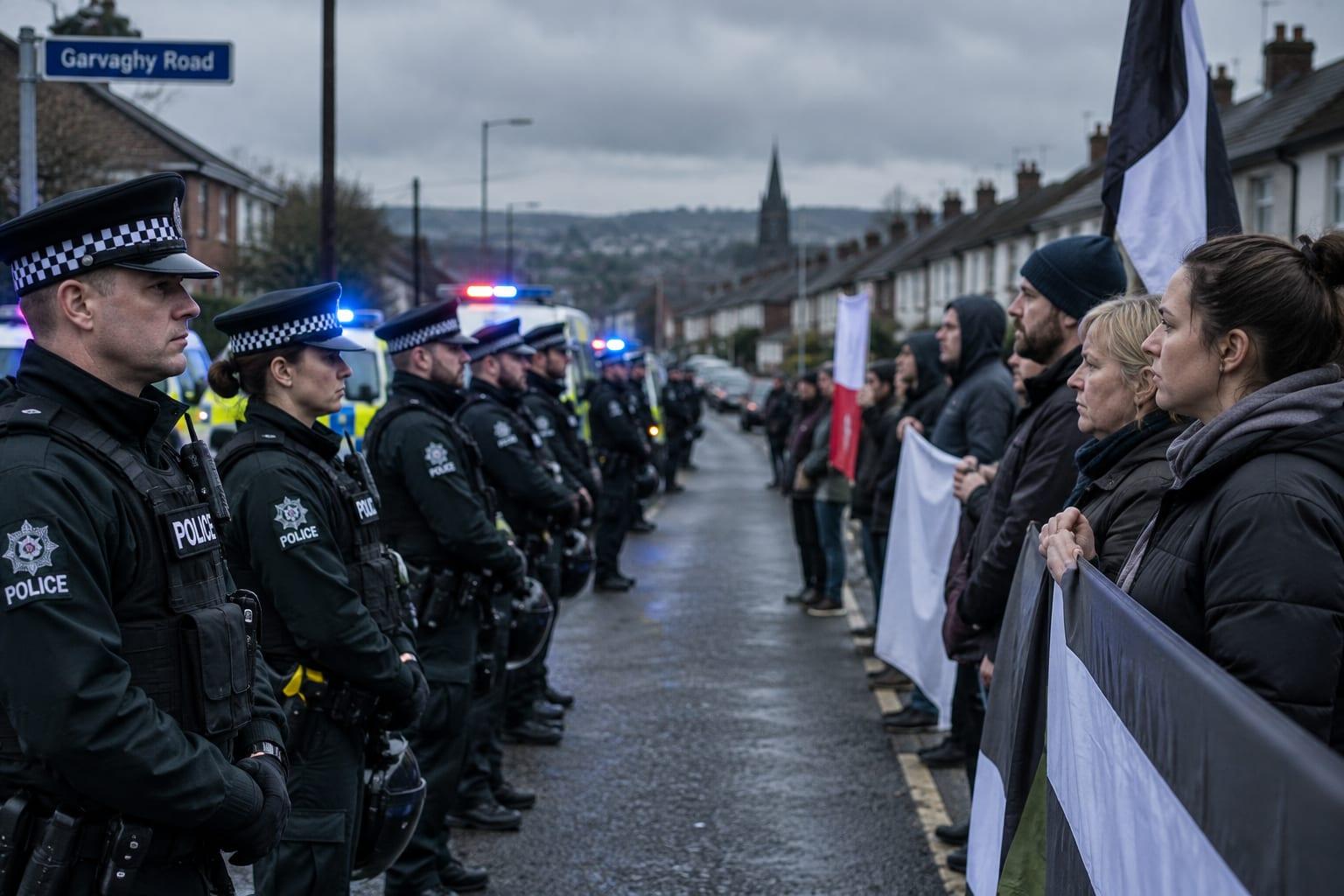
British Prime Minister Andy Burnham called for calm in Northern Ireland on Sunday after the High Court in Belfast, sitting late into the night, gave the go-ahead for a contentious Orange Order march through Portadown — a decision that by Sunday afternoon had drawn crowds onto the Garvaghy Road in opposition and pulled Sinn Féin leaders into the streets alongside them.
"Tensions run high in Northern Ireland after contentious march given go-ahead," The Washington Times reported shortly after midnight Eastern time, characterizing the mood across the region. Newsmax, carrying the same court development hours earlier, reported that Burnham "called for calm in Northern Ireland on Sunday after a contentious parade was given the go-ahead by the High Court in Belfast in a late-night sitting."
The parade in question is an Orange Order march along the Garvaghy Road in Portadown, a route at the center of Northern Ireland's marching season disputes for decades. According to CBS News, the court ruling cleared the way for the march to proceed for the first time since the Good Friday Agreement of 1998 — a claim that has not been independently confirmed by Next News Network.
What followed was not a quiet procession but a standoff. Al Jazeera reported that "a crowd gathered on Garvaghy Road on Sunday to protest against a court ruling allowing the march." The Guardian described scenes of confrontation, reporting that "Sinn Féin leaders join those on streets opposing decision to allow Garvaghy Road parade for first time since 1998." Newsday reported that the parade was blocked from making its way through Portadown by thousands of protesters.
The sequence of events, as carried across multiple outlets Sunday, moved from a late-night legal ruling to a public standoff within hours. Newsmax's report placed Burnham's call for calm on Sunday, the same day the High Court decision was handed down in Belfast. By Sunday afternoon local time, The Guardian and Al Jazeera both reported that demonstrators had gathered on the Garvaghy Road to oppose the march, with The Guardian specifically noting the presence of Sinn Féin leaders among those on the streets.
CBS News framed the development around Burnham's appeal, reporting that "British Prime Minister Andy Burnham called for calm in Northern Ireland on Sunday after the Orange Order was given the go-ahead by the High Court in Belfast in a late-night sitting." That language mirrors the Newsmax report, suggesting the Prime Minister's office issued a statement or made remarks Sunday morning local time, though the exact wording of Burnham's comments was not included in the coverage reviewed by Next News Network.
The High Court's late-night sitting — unusual in itself — suggests the legal question was pressed to the last available hour before the march was scheduled to step off. The court's decision, as described by CBS News and Newsmax, cleared the Orange Order to proceed along a route that has been a flashpoint for sectarian tension for generations. The Garvaghy Road runs through a predominantly nationalist area of Portadown, and the Orange Order's insistence on marching it has historically drawn opposition from residents and republican groups.
Newsday characterized the outcome differently from some other outlets, reporting that "tensions have been running high in Northern Ireland after a contentious parade was blocked from making its way through the town of Portadown by thousands of protesters." That framing — that the parade was blocked despite the court ruling — is consistent with the Al Jazeera and Guardian accounts of crowds gathering on the route. It is not yet known whether the parade ultimately proceeded, was rerouted, or was halted by police.
The presence of Sinn Féin leaders on the streets, as reported by The Guardian, marks a notable escalation in the political dimension of the dispute. Sinn Féin is the largest nationalist party in Northern Ireland and has historically opposed Orange Order marches through nationalist areas. The Guardian did not name which Sinn Féin leaders joined the protesters, and Next News Network could not independently confirm their identities or roles.
Burnham's call for calm, as reported by Newsmax and CBS News, came as the situation on the ground was already tense. The Prime Minister's intervention — presumably aimed at cooling tempers on both sides — was not accompanied in the available coverage by any specific instructions to police, marchers, or protesters. The Northern Ireland Office did not issue any statement included in the reports reviewed by Next News Network.
The Good Friday Agreement of 1998, also known as the Belfast Agreement, restructured Northern Ireland's political institutions and created a power-sharing executive. That agreement also established the Parades Commission, a body responsible for adjudicating contentious marches. The High Court's late-night ruling in this case appears to have bypassed or overruled a Parades Commission determination, though the precise legal posture is not clear from the coverage reviewed by Next News Network.
The Orange Order, a Protestant fraternal organization, holds annual marches commemorating historical events, some of which pass through or near nationalist areas. The Garvaghy Road dispute dates back decades and has been the site of standoffs, violence, and prolonged negotiations. The decision to allow the march for the first time since 1998 — as CBS News reported — is being described by opponents as a provocation, and the same claim has been attributed to unnamed residents in Al Jazeera's report.
The accounts carrying the story included The Washington Times, which reported at 12:13 a.m. Eastern time that "tensions run high in Northern Ireland after contentious march given go-ahead." Newsmax reported the court decision and Burnham's call for calm at 7:30 p.m. Eastern time Sunday. Al Jazeera reported the Garvaghy Road protest 18 hours after the original court news broke. CBS News reported the Burnham appeal and the court go-ahead 13 hours after initial reports. The Guardian reported the Sinn Féin presence and the tense standoff nine hours later. Newsday reported the parade was blocked by thousands of protesters 15 hours after the initial court ruling.
Next News Network could not independently verify the claims that the march was given the go-ahead, that it was blocked, or that the parade was held for the first time since 1998.
What is clear from the coverage is that the situation in Portadown remains fluid, with conflicting accounts of whether the march proceeded and what exactly took place on the Garvaghy Road. The High Court's decision, Burnham's appeal, and the public standoff have drawn attention from outlets across the political spectrum, from conservative American outlets like The Washington Times and Newsmax to international broadcasters like Al Jazeera and the Guardian.
The political context in Northern Ireland adds another layer of complexity. The power-sharing executive at Stormont has been periodically suspended over disputes between unionist and nationalist parties. The Good Friday Agreement's institutions remain fragile, and contentious marches have historically served as flashpoints for broader political tensions. The High Court's intervention in this case — and the Prime Minister's subsequent appeal for calm — suggests the British government is watching the situation closely.
What happens next in Portadown is not yet known. Whether the march proceeds, whether further legal challenges are filed, and whether the standoff escalates or de-escalates are all open questions. The Parades Commission, which typically makes rulings on contentious marches, has not issued any statement included in the coverage reviewed by Next News Network. The Police Service of Northern Ireland has also not issued any statement included in those reports.
The absence of engagement figures from this report is intentional. What matters is that the story traveled from a late-night court ruling in Belfast to a street-level standoff in Portadown, carried by outlets on both sides of the Atlantic, with the Prime Minister of the United Kingdom weighing in and Sinn Féin leaders physically present among the opposition.
Our Take
Here's what the establishment media won't say plainly: the High Court in Belfast overruled the accepted process, cleared a route that has been a flashpoint for decades, and then the Prime Minister asked everyone to be calm. That is not leadership. That is a recipe for exactly the kind of street confrontation that played out on the Garvaghy Road on Sunday.
The Good Friday Agreement was supposed to put these disputes into a framework — the Parades Commission, local dialogue, negotiated outcomes. When a court bypasses that framework in a late-night sitting and the Prime Minister responds with a generic appeal for calm, the message to both communities is that the rule of law is being applied selectively and the political class is more interested in managing headlines than preventing violence.
Sinn Féin leaders on the streets is not a surprise. It is a predictable consequence of a decision that nationalists see as a provocation. And when the Prime Minister's response is nothing more than a call for calm — with no visible plan, no local engagement, no clear enforcement strategy — the people of Portadown are left to sort it out themselves. That is not how a First World nation should handle a sectarian flashpoint.
The British government and the Northern Ireland Office need to explain why this march was cleared, what the legal justification was, and how they intend to keep the peace. A late-night court ruling followed by a Sunday morning statement is not a strategy. It is a vacuum. And in Northern Ireland, vacuums get filled by crowds on the street.
