
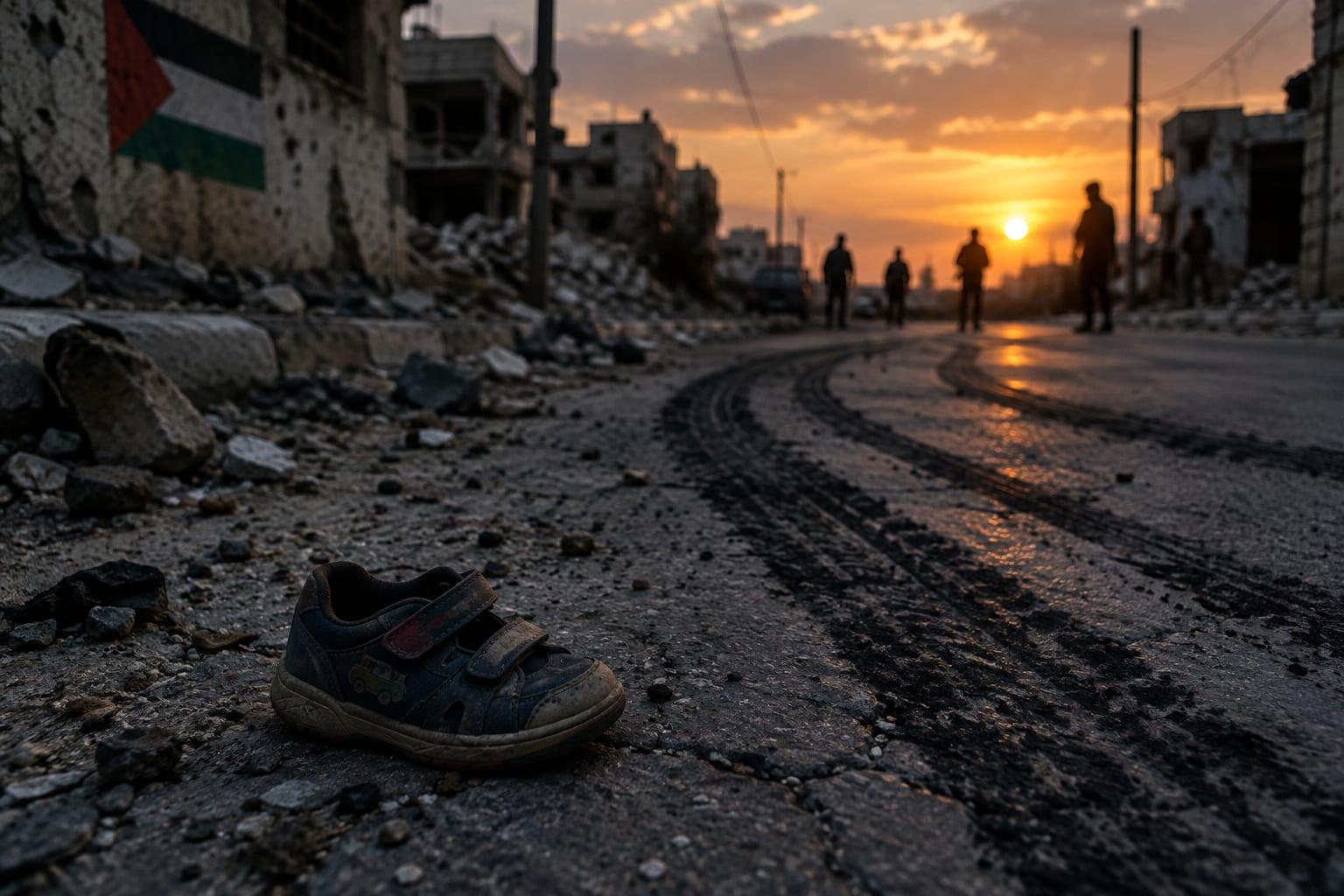
A Palestinian boy was shot and left lying in the street, and when his father tried to reach the body, Israeli forces opened fire again and forced him back. That is the claim circulating across X, posted by the account @MarioNawfal, which asked readers to imagine seeing their own child lying there and being unable to hold him one last time. The post ends with a single word: "No."
The account framed the story entirely around the father's inability to reach his son. "Imagine this was your child," the post reads. "A Palestinian boy is shot and left lying in the street. His father tries to reach his body, and Israeli forces open fire again, forcing him back." It is a claim of a killing and a second round of fire directed at a grieving parent. It is not accompanied by verification, by an identifying location, or by any independent confirmation.
The same account, @MarioNawfal, moved quickly in the same window to a second front: the diplomatic rupture between Israel and the Netherlands. In a separate post, the account wrote that Israel said it was revoking the diplomatic status of Dutch diplomats who represent the Netherlands at the Ramallah-based Palestinian Authority. The move, according to that post, came "in response to Dutch sanctions targeting Israeli settlements in the occupied West Bank" — a direct retaliation against a European government for penalizing settlement activity.
The two claims, posted within hours of each other, capture the two-track nature of the story as it spread across social media: a graphic allegation of violence against a child, and a hard diplomatic countermeasure against a NATO ally. Neither was posted with sourcing that would allow an outside reader to verify it independently.
The third post in the sequence came from @TheProjectUnity, which did not address the shooting or the Dutch sanctions directly. Instead, it attacked the official account of the October 7, 2023 attacks. "Imagine believing Israeli intelligence were caught by surprise on October 7th," the post reads. "Imagine actually believing something that stupid." The post offers no evidence and names no source. It is an assertion about what Israeli intelligence knew, framed as a challenge to those who accept the official timeline.
Together, the three posts show how a single news cycle on X can move from an allegation of a child killed in the street, to a diplomatic retaliation against the Netherlands, to a rejection of the established account of the October 7 attacks — all within roughly six hours on September 28, 2026.
The claims did not emerge in a vacuum. Other coverage from the same period, including reporting by Israel Hayom, Israel National News, and the Jewish News Syndicate, describes IDF footage showing a Palestinian child being used to move weapons in Gaza. According to those reports, a terrorist used a child to transfer weapons into a civilian residence to avoid being targeted by Israeli forces. The Foreign Ministry, quoted by JNS, said: "This is how Hamas exploits Palestinian children. A child used to move weapons. A child used as a human shield." The IDF, according to those reports, held fire after identifying the child. That material circulated as a counter-narrative to claims like the one from @MarioNawfal — an Israeli argument that Palestinian children are placed in harm's way by Hamas, not by Israeli forces.
The diplomatic front moved in parallel. Reuters reported that Israel said it was revoking the diplomatic status of Dutch diplomats who represent the Netherlands at the Ramallah-based Palestinian Authority, in response to Dutch sanctions targeting Israeli settlements in the occupied West Bank. The Dutch sanctions are part of a broader European push against settlement activity, and the Israeli response — stripping diplomats of their status — is a direct escalation against a European government that had taken a punitive step.
The story also crossed into American sports coverage. OutKick reported that the NFL told Azeez Al-Shaair he would be pulled from a Texans game over pro-Palestinian eyeblack. Al-Shaair wore the eyeblack again in Week 2 against the Cincinnati Bengals but was told he would be removed from the Houston Texans game. The detail matters because it shows the same subject — Palestinian advocacy, and the reaction to it — surfacing in a domestic American context far removed from Gaza and Ramallah. The league's intervention turned an on-field expression into a national story.
What ties all of this together is not a single verified event but a sequence of claims and counterclaims, each carried by a different account, each with its own audience. The first post asked readers to imagine a father unable to reach his dead son. The second described a state-level retaliation against Dutch diplomats. The third dismissed the official account of October 7 as something only a fool would believe. None of the accounts presented evidence in the posts themselves. None identified a source. None offered a location, a time stamp, or a name.
Next News Network could not independently verify the claim that a Palestinian boy was shot and that his father was fired upon when he tried to reach the body, nor could it independently verify the details of the Dutch diplomatic revocation or the October 7 assertion. The posts are presented here as what they are: statements made by accounts on X, carried to a wide audience, and treated by many readers as fact. Whether the underlying events occurred as described is not established by the posts alone.
What is established is that the material spread. It was carried by @MarioNawfal, by @Reuters, and by @TheProjectUnity, among others, and it was picked up in outlets including Israel Hayom, Israel National News, the Jewish News Syndicate, and OutKick. The accounts referenced one another, directly and indirectly, building a narrative that moved from a child in the street to a diplomat stripped of status to a football player told he would be pulled from a game. That is the reaction — and the reaction is the story, regardless of what the underlying events turn out to be.
Our Take
The posts do not prove what they claim, and that matters. A graphic account of a child killed and a father driven back by gunfire is precisely the kind of material that spreads fastest and gets checked least. That does not make it false. It does make it unverified, and readers should treat it as such.
What is harder to dismiss is the pattern. The same cycle produced a diplomatic retaliation against the Netherlands, a social media assault on the official October 7 timeline, and an American sports league intervening over a player's eyeblack. These are not random. They are the same argument, fought on different terrain, with different weapons. The question is not whether one post is accurate. The question is why the same accusation keeps resurfacing, in so many forms, so quickly, and to so many people.
The answer is that the underlying conflict is not being resolved, only contested. When the argument moves from Gaza to The Hague to an NFL sideline, it is not because the facts are settled. It is because they are not. And in that vacuum, the loudest account wins — for a while.
