
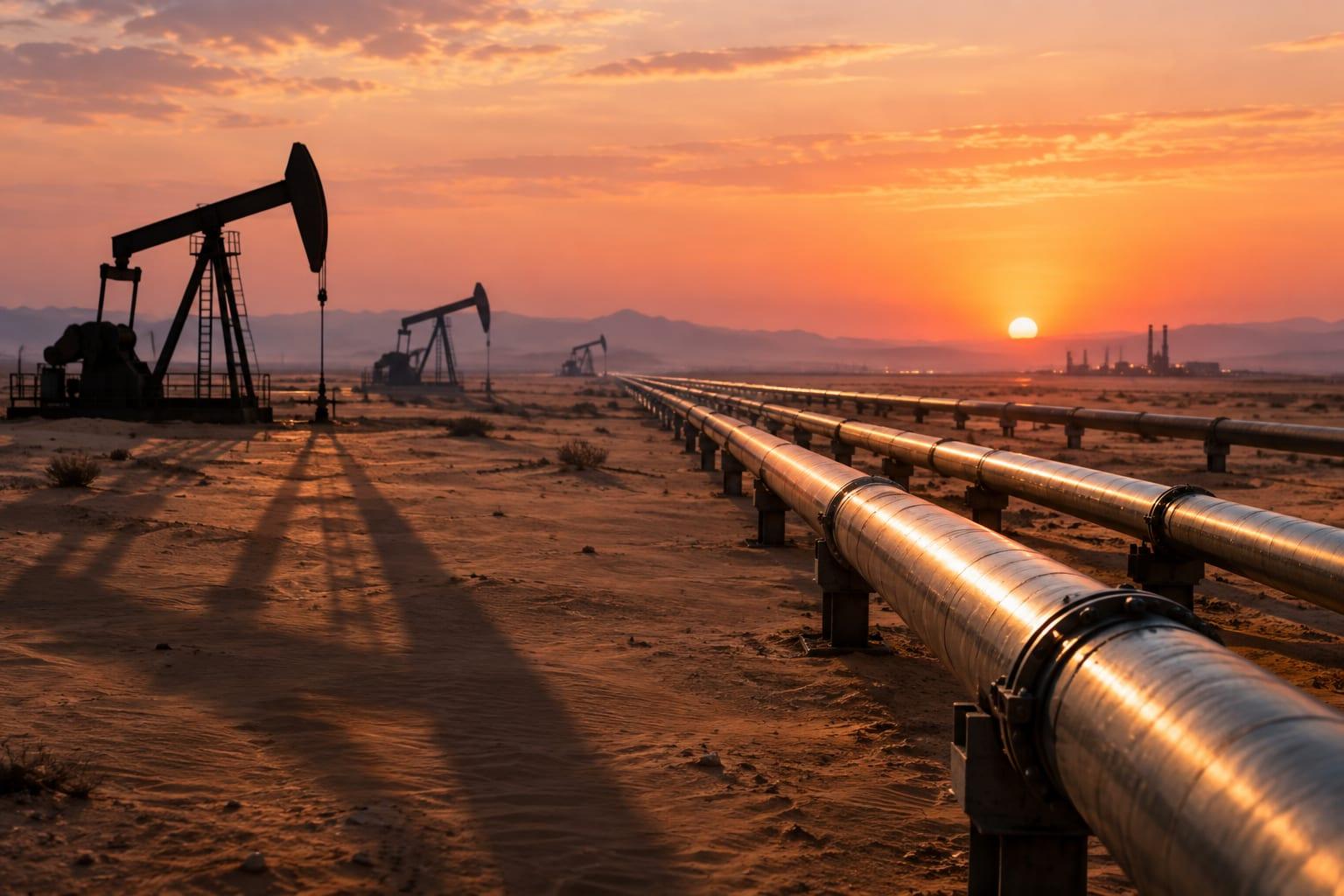
Saudi Arabia has reportedly restarted oil exports through its East-West pipeline after repairs to damage caused by drone strikes earlier this month, according to accounts tracking the region's energy infrastructure, a development that has drawn rapid reaction as tensions with Iran continue to run high.
The account @MarioNawfal told its followers that the kingdom has "RESTARTED oil exports through its crucial East-West pipeline after repairs from drone strikes earlier this month," adding that the route "allows Saudi crude to reach the Red Sea without passing through the Strait of Hormuz." The financial commentary account @zerohedge carried the same claim in a terse overnight bulletin, posting "*SAUDI ARABIA'S EAST-WEST PIPELINE HAS RESUMED OIL EXPORTS" within minutes of the first item.
Bloomberg reported that Saudi Arabia has started exporting oil using a key cross-country pipeline after the link was repaired following drone strikes earlier this month, citing a person with direct knowledge of the matter. Investing.com, citing the Bloomberg report, said the resumption ended a seventeen-day export halt from the Red Sea port of Yanbu and that some European customers had been facing zero allocations under term contracts for the coming month. News18 reported the East-West Pipeline, also known as Petroline, was restarted around September twenty-second after it was shut following drone attacks earlier this month. Reuters reported separately that Middle East oil exports rebounded in September as Saudi Arabia boosted shipments.
Next News Network could not independently verify the reported pipeline restart or the extent of the damage that preceded it.
The flurry of posts did not arrive in a vacuum. Hours earlier, @NBCNews reported that eight U.S. Marines were injured two weeks ago when an Iranian cruise missile attacked the ship they were operating on in the Strait of Hormuz, according to three U.S. officials. The same day, @FirstSquawk relayed a U.S. Central Command statement reporting that over one billion barrels of oil have been transported through the Hormuz Strait in recent months. The pipeline development lands against that backdrop: a chokepoint that has seen direct attacks on American personnel and a parallel export route that, if operational, allows Saudi crude to bypass the strait entirely.
The reaction from Tehran was swift. Iranian Foreign Minister Abbas Araghchi said his country is prepared to resume fighting with the United States but has not yet abandoned diplomacy, according to a report relayed by @zerohedge, which came after President Donald Trump publicly rejected a proposal to reopen the Strait of Hormuz. The same bulletin noted that mediators are continuing work, without further detail on the state of those efforts.
Iran's Supreme Leader Mojtaba Khamenei struck a defiant tone, according to the account @clashreport. "In the past, the two seas to Iran's south were a playground for enemy forces," Khamenei said. "But today, because of the painful blows they have suffered at the hands of the courageous fighters and defenders of the Strait of Hormuz, they do not venture" — the account's excerpt ends there, with the remainder of the statement not carried in the post.
The sequence of statements illustrates how quickly a single piece of energy infrastructure news can be folded into a broader confrontation narrative. The pipeline claim originated with anonymous sourcing through a financial news outlet, was amplified by aggregator accounts within minutes, and was almost immediately juxtaposed against Iranian military rhetoric and reports of American casualties. Each element — the pipeline, the marine injuries, the Central Command figures, the Iranian statements — was carried by separate accounts and outlets, and together they form the picture now circulating among energy traders and foreign policy observers alike.
What is not yet known is whether the reported resumption is sustainable. The East-West pipeline carries Saudi crude from the kingdom's eastern fields to the Red Sea coast, allowing exports to bypass the Strait of Hormuz, through which @FirstSquawk reported more than one billion barrels have moved in recent months. If the pipeline is running again, it restores an alternative route at a moment when the strait itself remains a flashpoint. Whether that route remains open, and whether the strikes that preceded the shutdown resume, is a question the posts do not answer.
It is also not yet known what effect, if any, the reported resumption will have on global crude prices or on the European customers described as facing zero allocations. The reports citing the person with direct knowledge of the matter did not specify volumes, and none of the accounts carrying the claim offered figures beyond the Central Command total for the strait.
What the posts do show is the speed with which the claim traveled. Within roughly an hour on Monday, the pipeline item moved from a financial wire report to aggregator bulletins to commentary accounts, where it was framed as a "BIG development for global oil markets." The same window carried the Iranian foreign minister's remarks about a possible return to fighting and the supreme leader's statement about enemy forces no longer venturing into the waters south of Iran. The result is a news cycle in which a repair job and a war of words are presented side by side, each lending the other urgency.
Whether the pipeline restart holds, whether diplomacy resumes, and whether the strait remains a battleground are all open questions. For now, the accounts carrying the story agree on little beyond this: Saudi Arabia says it is exporting again through a route that avoids the chokepoint, and Iran says it is ready to fight if diplomacy fails. Next News Network could not independently verify either claim.
Our Take
The pipeline restart matters less as an energy story than as a signal about how exposed the global oil supply remains to a single stretch of water. Saudi Arabia built the East-West line precisely so it would not have to depend on the Strait of Hormuz. That the kingdom needed seventeen days to repair drone damage on that alternative route tells you the fallback is not as safe as advertised. Iran, for its part, is doing what it always does when pressure mounts: talking about diplomacy while reminding everyone it can fight. The Biden-era playbook of treating Iranian rhetoric as bluster and Saudi infrastructure as untouchable produced neither deterrence nor reliable supply. The Trump administration's rejection of a proposal to reopen the strait suggests a different approach, but rejection alone is not a strategy. If the pipeline is running again, good — but the next drone strike will not announce itself, and the next missile aimed at a U.S. ship may not leave eight Marines merely injured. The only durable fix is to make the cost of attacking either route higher than the benefit of closing it. That means visible force, not press releases.
