
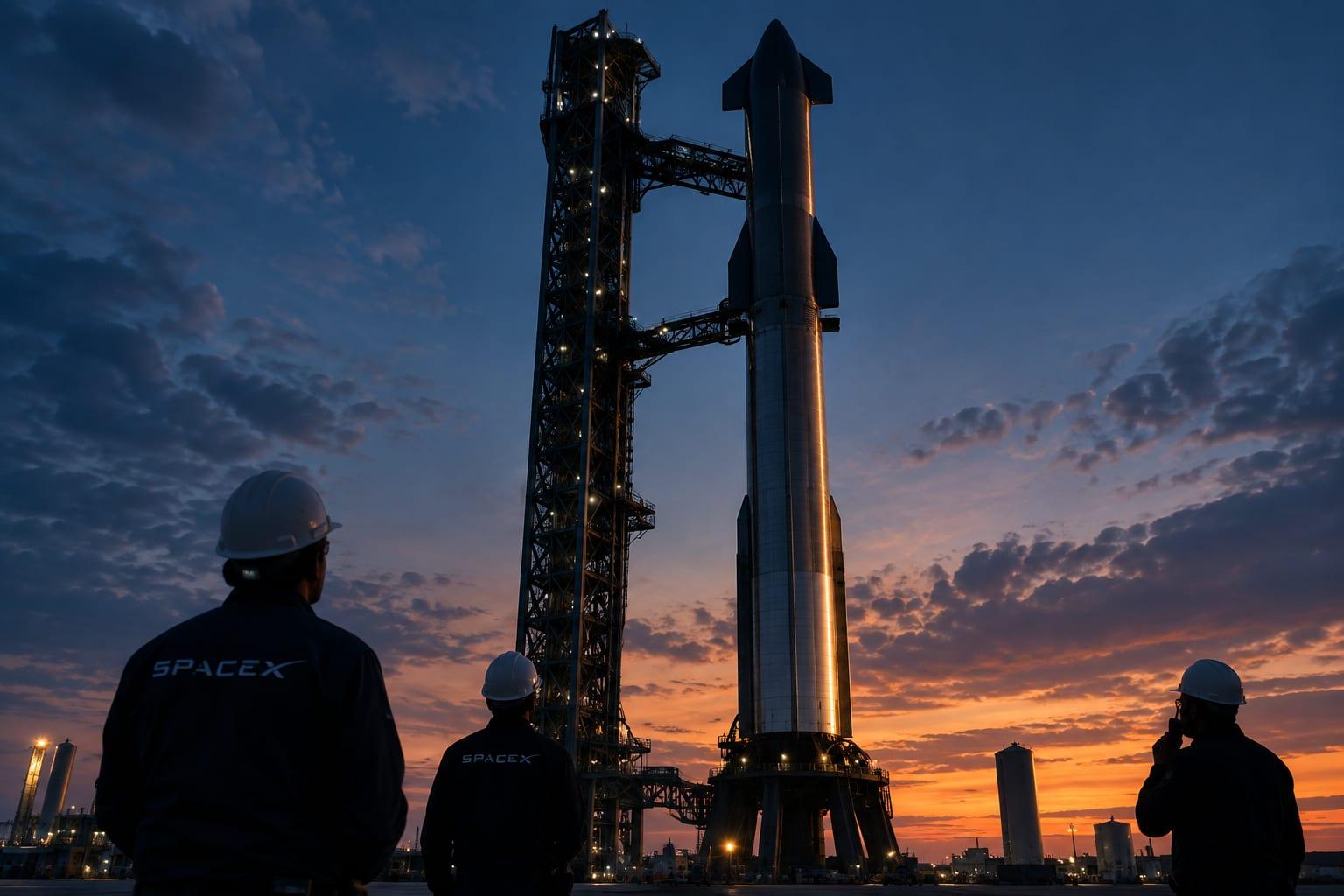
SpaceX has given the go-ahead for a Starship orbit attempt despite an engine going out during the flight, according to a post from the account @FirstSquawk. The same account reported that the go-ahead was given for the orbit attempt, even as one engine failed. Earlier, @zerohedge posted that SpaceX was considering a Starship orbit attempt after an engine went out. That post followed an earlier one from the same account confirming that Starship would not enter orbit following an engine failure, and noting that SpaceX shares fell to a premarket low during the flight.
The sequence of events began with a live broadcast from @OANN, which reported that SpaceX had launched Starship into orbit for the first time. That post, timestamped earlier in the day, described the launch as it happened. But the situation quickly changed. Shortly after, @zerohedge reported that SpaceX confirmed Starship would not enter orbit following an engine failure. The post also noted that SpaceX shares fell to a premarket low during the flight. Then, @zerohedge followed up with a post stating that SpaceX was considering a Starship orbit attempt after the engine went out. Finally, @FirstSquawk reported that the go-ahead had been given for the orbit attempt despite the engine going out.
The posts did not specify which engine failed, nor did they provide details on the cause of the failure. The timeline suggests that the mission profile was being adjusted in real time as SpaceX evaluated the situation. The initial launch was intended to send Starship into orbit for the first time, a major milestone for the company.
Supporters of the mission had expressed enthusiasm earlier in the day. The account @GuntherEagleman posted a message celebrating the launch, writing, "SPACEX IS ABOUT TO LIGHT UP A 40-STORY STARSHIP, AND AMERICA SHOULD BE PROUD. Biggest rocket ever built. Orbit Earth. Splash down in the Pacific. Haul freight toward the Moon and beyond. Elon Musk keeps building while Fake News mocks ambition. I want this country winning." The post was accompanied by a video transcript in which the account discussed the launch. In the transcript, the speaker said, "The biggest and most powerful rocket ever built for its first orbital flight into space. The massive ship will orbit the Earth about six times over nearly 10 hours before attempting a controlled re-entry and splashdown in the Pacific." The speaker also noted that the rocket is "40 stories tall" and that it is "meant to be a freighter of a rocket." The transcript also mentioned that SpaceX is expected to participate in Artemis launches next year with NASA, and that the mission would deploy about 26 Starlink satellites.
The transcript included a discussion of the stakes. The speaker said, "If successful, this means we're off to the races and the ability to really deliver essentially all the things you would need to build communities on the moon." The speaker also noted that a failure could have industry-wide impacts, including delaying the program, slower Starlink expansion, and more redesigns. But the speaker ended on a positive note, saying that if the mission works, it "greenlights the idea that we can do interplanetary travel and actually bring camps to build onto the moon and eventually Mars."
The coverage from other outlets described the launch as a historic test flight. CNN reported that Starship would attempt to reach orbit for the first time, beginning a new phase in its development and introducing new risks. BBC News noted that the rocket was hoping to orbit around Earth for the first time while also releasing several Starlink satellites. Space.com reported that liftoff was scheduled for Monday at 8:15 a.m. EDT. The Independent described the mission as a huge test for Musk and NASA's plans to head to the Moon and onto Mars.
Next News Network could not independently verify the claims made in the social media posts about the engine failure and the subsequent go-ahead for the orbit attempt. The information is based solely on the posts and transcripts provided. The underlying event is not independently confirmed.
The reactions to the news were varied. Some accounts focused on the technical setback, while others emphasized the broader implications for American space leadership. The @GuntherEagleman post, for example, framed the launch as a point of national pride and criticized what it called "Fake News" for mocking ambition. The post did not address the engine failure directly, as it was published before the failure was reported. The @zerohedge posts provided updates as the situation evolved, noting the impact on SpaceX shares. The @FirstSquawk post confirmed the go-ahead for the orbit attempt despite the engine issue.
The story developed rapidly over the course of the morning. The launch was initially reported as a success, with Starship reaching orbit. But then reports emerged that an engine had failed and that the ship would not enter orbit. SpaceX then considered an orbit attempt, and finally gave the go-ahead. The sequence of posts shows how the news was being reported in real time by accounts following the launch.
The engine failure raises questions about the reliability of the Starship system as it moves toward operational missions. SpaceX has not released a statement on the cause of the failure. The company's shares fell to a premarket low during the flight, according to @zerohedge, indicating that investors were reacting to the news. The go-ahead for the orbit attempt suggests that SpaceX believes the mission can still achieve some of its objectives despite the engine issue.
The mission was intended to last nearly ten hours, with Starship orbiting Earth about six times before attempting a controlled re-entry and splashdown in the Pacific. It is not yet known whether that timeline will be adjusted following the engine failure. The deployment of Starlink satellites was also part of the plan, but it is unclear whether that will still happen.
Supporters of the mission had high hopes. The transcript from @GuntherEagleman described the potential for building communities on the moon and eventually Mars. The speaker said, "If this is successful, do we get to Mars sooner than expected? You better believe it." The speaker also mentioned the possibility of lower launch costs, which would lower the barrier to entry for other players in the space industry.
But the engine failure is a reminder of the risks involved in spaceflight, especially for a new and complex vehicle like Starship. The coming hours will be critical as SpaceX attempts to salvage the mission and learn from the anomaly.
Our Take
Elon Musk and SpaceX are pushing the boundaries of what is possible, and the usual suspects in the media are ready to pounce on any setback. The fact that an engine failed is not a surprise in a test flight of a rocket that has never reached orbit before. What matters is how SpaceX responds. The company's decision to proceed with an orbit attempt despite the engine issue shows the kind of can-do spirit that built this country. While the mainstream media focuses on the stock dip and the failure, Americans should be proud that we have a private company leading the world in space exploration. The left wants to mock ambition, but it is that ambition that will take us to the Moon and Mars. We should be cheering for SpaceX, not nitpicking every engine that goes out. This is a test flight, and tests are meant to find problems. The fact that SpaceX is pressing on is a sign of strength, not weakness.
