
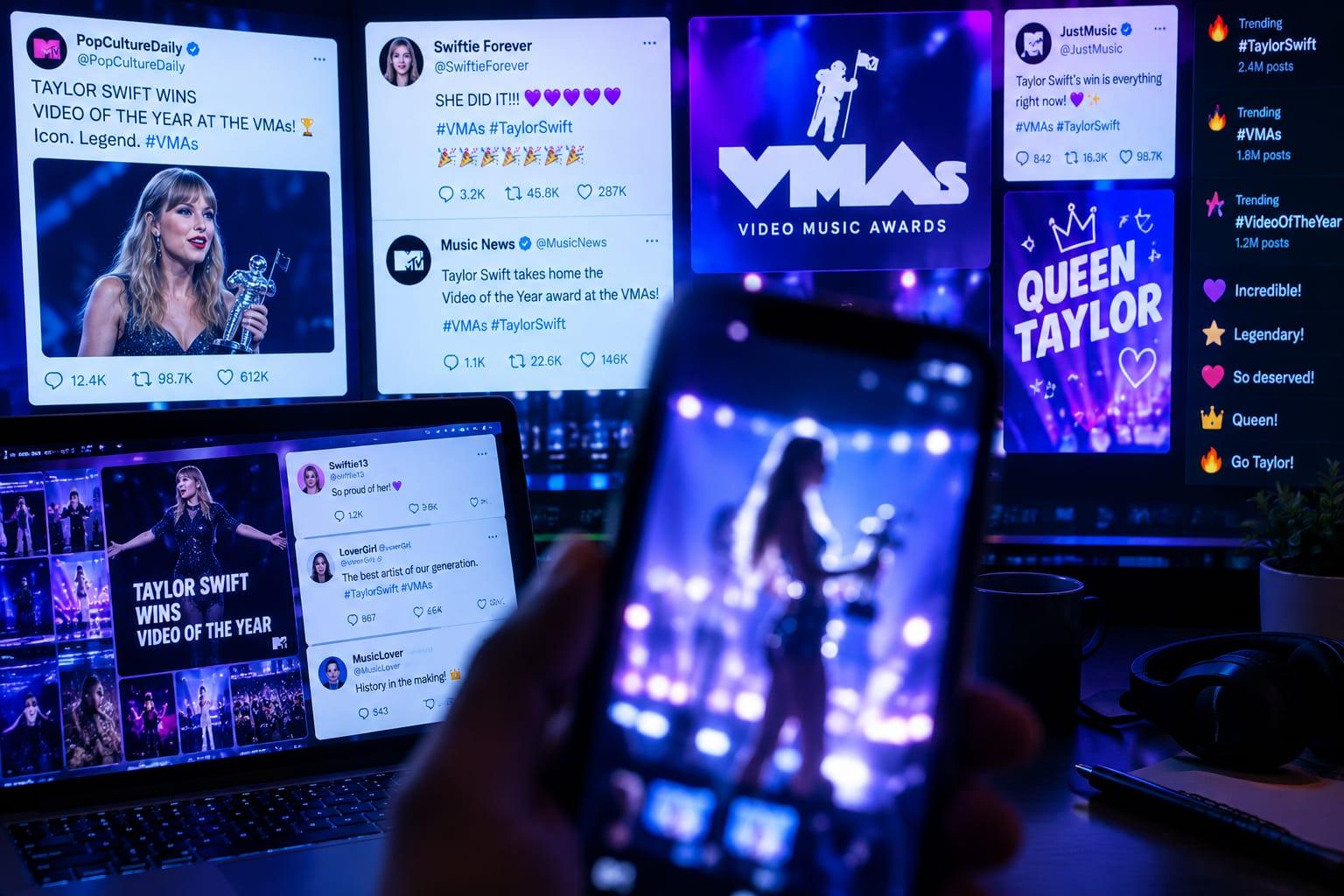
Taylor Swift was claimed to have passed Beyoncé as the most-awarded solo artist in MTV Video Music Awards history, and the reaction on social media moved faster than the ceremony's closing credits, with the New York Post among the accounts carrying the claim late Sunday into Monday.
The New York Post account @nypost posted at 1:26 a.m. Eastern on September 28 that Swift "surpasses Beyoncé as most-awarded solo artist in MTV VMAs history." The same account, hours earlier, had been building the night in pieces: at 7:49 p.m. on September 27 it posted a guide headlined "How to watch VMAs 2026 for free: Nominees, Taylor Swift music video premiere," and at 11:34 p.m. it posted that Swift "glitters in silver sequined couture on VMAs 2026 red carpet." That sequence matters because it shows how the evening was being sold going in: a red carpet, a free-stream how-to guide, and a premiere. What came out the other side was a record claim.
Other outlets framed the night the same way in real time. One report published around sixteen minutes before this account's latest post said Swift "made MTV Video Music Awards history at the 2026 ceremony, becoming the most-awarded artist in the show's history." Another, published about six hours before the ceremony, said Swift was "set to break Beyoncé's VMAs record tonight with the first Artist Director Honors," describing the award as the first of its kind and noting her video "Patient Zero" was scheduled to premiere. A third, from sixteen hours before the ceremony, walked back through her Moon Person wins since 2009 and counted thirty of them.
The Independent, carrying a live, updating winners list, noted Madonna led the nominations with eleven following the release of her album "Confessions II." That detail is worth holding onto, because it is the kind of thing that gets lost when a single narrative swallows an entire awards show. A show with Madonna leading the nods and Swift taking the headline is a show with more than one story in it.
The mechanism of the claim, as described across the coverage, is not mysterious. Swift entered the night tied with Beyoncé for the most VMA wins by a solo artist. The Artist Director Honors, presented for the first time, was positioned as the award that would break that tie. That is how the record was framed before it was awarded, and that is the frame the reaction adopted once it was.
What the posts do not do is settle the underlying question. A post is a post. A headline is a headline. Neither is a certified tally of who won what on Sunday night, and MTV's own running count is the kind of thing that gets reconciled after the broadcast, not during it. Coverage describing Swift as "set to break" the record and coverage describing her as having broken it are not the same sentence, even when they sit a few hours apart on the same timeline.
What is documentable is the shape of the reaction and who carried it. The New York Post carried the record claim, carried the red carpet color and designer detail, and carried the viewing guide. Other outlets carried the historical count of thirty wins, the Madonna nomination lead, and the new-award framing. Taken together, the reaction was not a single account shouting into a void. It was a set of accounts, several of them mainstream entertainment desks, moving the same claim at once and filling in the scaffolding around it: what she wore, how to watch, what she had won before, what the new trophy was called, and what video was scheduled to premiere.
The red carpet post is useful precisely because it is small. "Glitters in silver sequined couture" is not a record. It is an observation about a dress. But it is the kind of detail that makes a claim travel, because it gives people something to picture while the numbers do the arguing. The viewing guide is the same. "How to watch VMAs 2026 for free" is not a record either. It is a service item. But it puts the ceremony in front of an audience that might otherwise have skipped it, and it names the Swift premiere in the same breath as the nominees.
That is how a record claim becomes a night. First the guide, so people know when and where. Then the carpet, so people have a picture. Then the record, so people have a reason to argue about it the next morning. The New York Post moved through all three stages in under six hours.
The winners list complication is worth stating plainly. A live, updating list is a live, updating list. It changes. It changed during the broadcast, and it may change after it. Madonna's eleven nominations, released alongside "Confessions II," were the most of any artist going in, which means the nomination story and the win story were running on parallel tracks. A reader who only sees the Swift record claim is missing the fact that the night had a second headline available to it.
The Beyoncé comparison is the load-bearing claim, and it is the one that gets compressed hardest in the retelling. "Surpasses Beyoncé" is three words. What they rest on is a tie, a new award, and a ceremony that had not finished being tabulated when the post went up. That does not make the claim false. It makes it a claim, sourced to the accounts making it, and subject to whatever the final tally turns out to be.
Next News Network could not independently verify the claim that Taylor Swift has surpassed Beyoncé as the most-awarded solo artist in MTV VMAs history.
The reaction, meanwhile, did what reactions do. It named the accounts, attached the dress and the premiere and the free-stream instructions, and moved the claim further than any single outlet could have moved it alone. By early Monday, the record was being stated as settled fact in some posts and as a scheduled outcome in others, and the two versions were sitting side by side on the same timeline like they had always been there.
Our Take
The entertainment press spent Sunday night doing what it does best: turning a trophy count into a cultural event and a cultural event into a personality contest. Taylor Swift surpassing Beyoncé is a story because Beyoncé is a story, and Swift is a story, and putting the two names in one sentence does more traffic than any Moon Person ever will. That is not a knock on either artist. It is a description of the machine.
What conservatives should notice is the pattern, not the pop star. The same outlets that spent Sunday night breathlessly crediting a record claim within hours of the ceremony will spend the next news cycle demanding documents, audits and independent verification for anything that touches politics. The standard is not applied evenly because it was never meant to be. A live winners list is treated as gospel when the subject is a red carpet. An election tally is treated as suspect when the subject is a ballot box.
There is also a quieter point. Awards shows are not neutral ground. They are brand-management operations with a red carpet attached, and the Artist Director Honors was invented, named and awarded on the same night, which is a strange way to run a record book. If the trophy exists to break a tie, the tie was scheduled to break. That does not diminish Swift's work. It does mean the headline was written before the envelope was opened, and readers should treat any record announced by the people selling the tickets with the same skepticism they would bring to any other press release.
Our position is simple: report the claim, name who made it, and let the tally settle itself. The audience can handle the difference between a record and a record claim. It is the press that keeps pretending there isn't one.
