
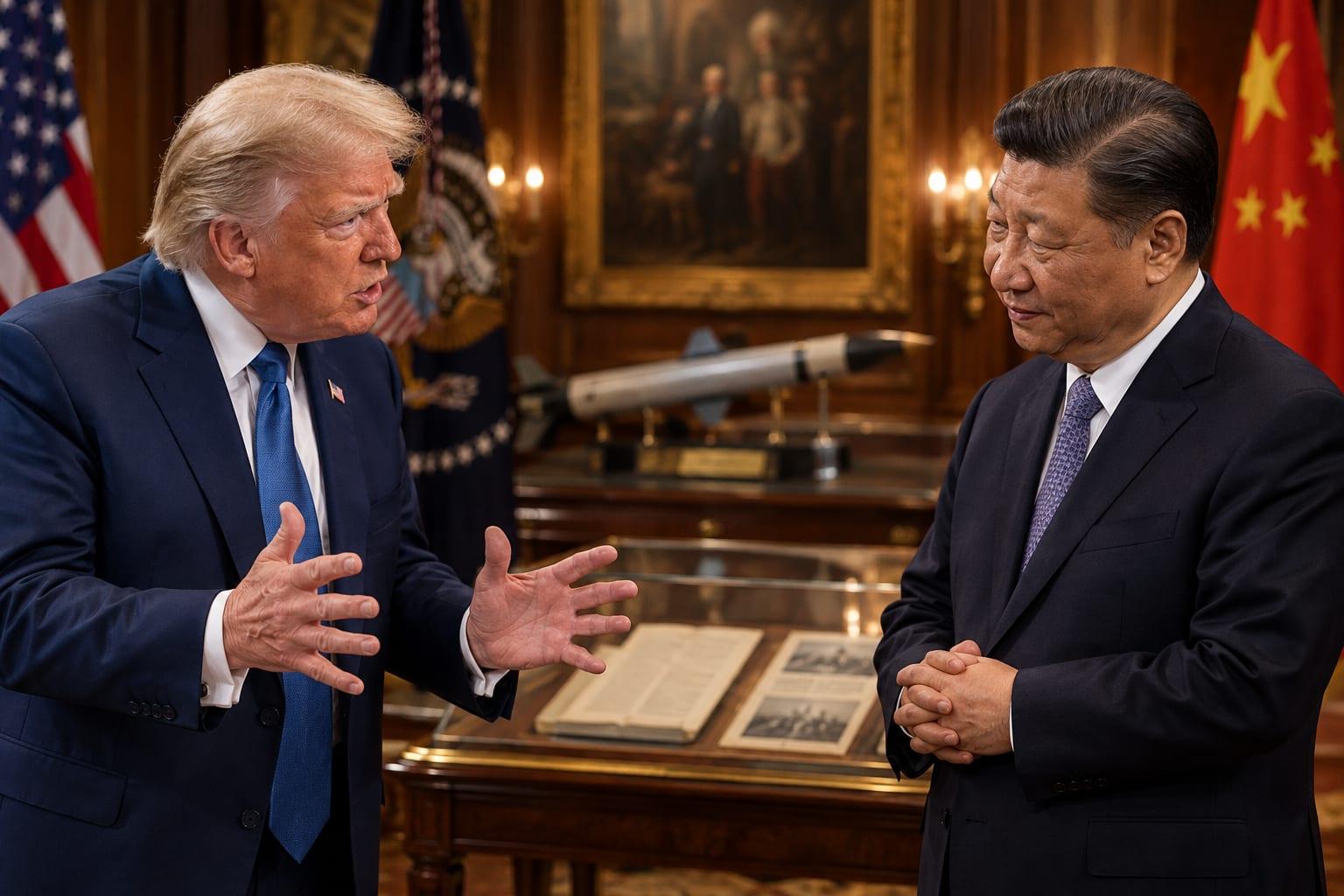
President Donald Trump asked Chinese President Xi Jinping whether China wanted to buy American weapons, according to the U.S. ambassador to China, a claim that has detonated across conservative media and drawn a swift denial from the White House.
The offer, as described by Ambassador David Perdue, came during Xi's state visit to Washington, a multi-day affair that concluded with a tour of the National Archives. The Washington Times reported on its social media account, @WashTimes, that the visit ended with Trump guiding Xi through the Archives to view the Declaration of Independence and the Bill of Rights, a setting where the president reflected on the youth of American democracy compared to China's long civilization.
The tour itself was framed by the Times as a symbolic closing note to a visit that had already produced a lavish state dinner featuring sea bass and honey ice cream, according to other coverage, and a parting gift that left observers scratching their heads. But it is the arms offer that has become the flashpoint.
The New York Times reported that Ambassador Perdue said Trump made the offer directly to Xi. The Associated Press similarly reported that Perdue described the president asking China's leader if he wanted to purchase American arms. The White House later said the United States has no plans for such a sale, an attempt to pour cold water on a story that had already caught fire.
Conservative accounts across social media seized on the claim, though the reaction has been driven by the allegation itself rather than any confirmed transaction. The Washington Times posts, which anchor this report, describe the Archives tour without mentioning the arms discussion — a reminder that the official readout of the visit and the ambassador's later comments are telling different stories. @WashTimes posted that Trump "capped off" Xi's visit with the Archives tour, showcasing founding documents and reflecting on American democracy. A second @WashTimes post noted that the tour contrasted America's two hundred and fifty year history with China's six thousand years.
Those posts, however, did not address the arms offer that Perdue described in subsequent interviews. The discrepancy between the celebratory tone of the visit's conclusion and the controversy now surrounding it has fueled criticism from commentators who argue the administration is sending mixed signals on China policy.
One widely shared reaction came from a post describing Trump's "parting gift" for Xi, which brought back "the moment he nearly lost it on camera" and promised an even stranger backstory. That post did not specify what the gift was or what moment it referenced, but it circulated rapidly among accounts already skeptical of the visit's optics. The reference to Trump nearly losing his composure on camera appears to connect to a prior incident, though the details remain unclear from the post alone.
The state dinner itself, reported on by multiple outlets, included tech leaders and a menu of sea bass and honey ice cream — a detail that some critics cited as evidence of an overly warm reception for a leader whose country is America's chief strategic competitor. The White House has not responded to those specific criticisms, and the president has not publicly addressed the arms offer since Perdue's comments surfaced.
What is known is this: Ambassador Perdue said Trump asked Xi if China wanted to buy U.S. weapons. The White House said no such sale is planned. The Chinese government has not commented publicly on the claim. It is not yet known whether Xi responded to the question, or whether the offer was made in jest, as a negotiating tactic, or as a serious proposal. The ambassador's account has not been corroborated by any other official, and the full context of the exchange remains undisclosed.
Conservative media figures have framed the episode as either a masterstroke of Trump's deal-making or a dangerous misstep, depending on the commentator. Some argued that offering arms to China — a nation that has been accused of stealing American military technology — undermines national security. Others said the president was simply probing Xi's intentions and that the White House's later denial was a standard cleanup operation.
The Archives tour, meanwhile, was meant to be the visit's closing image: Trump and Xi standing before the Declaration of Independence, a visual contrast between America's relatively brief democratic experiment and China's ancient imperial tradition. The Washington Times described Trump as reflecting on the "youth of American democracy," a phrase that carries its own irony given the controversy now engulfing the visit's aftermath.
Next News Network could not independently verify the claim that Trump offered to sell arms to China.
The story has continued to spread through conservative networks, with accounts amplifying both the arms claim and the Archives imagery without resolving the tension between them. The White House has not scheduled any further readouts of the visit, and it remains unclear whether Perdue's comments will be formally walked back or clarified.
For now, the reaction is the story: a president who closed a state visit with a tour of America's founding documents is now facing questions about whether he offered to arm the leader of the country those documents' principles were written to counter.
Our Take
There is a version of this story where Trump's question to Xi was a throwaway line, a bit of deal-maker theater that meant nothing. But the White House's refusal to confirm or deny the substance — beyond a flat statement that no sale is planned — tells you they know how bad it looks. You do not offer weapons to a regime that has spent decades stealing American military secrets. You do not do it on camera, in the middle of a state visit, and then let your ambassador describe it to reporters. The Archives tour was supposed to be the closing argument: America's ideals versus China's autocracy. Instead, the headline is a president who seemed more interested in closing a sale than defending a civilization. If this was a negotiating tactic, it was a reckless one. If it was a joke, it was not funny. And if it was serious, every conservative who spent the last decade warning about Chinese espionage should be demanding answers.
