
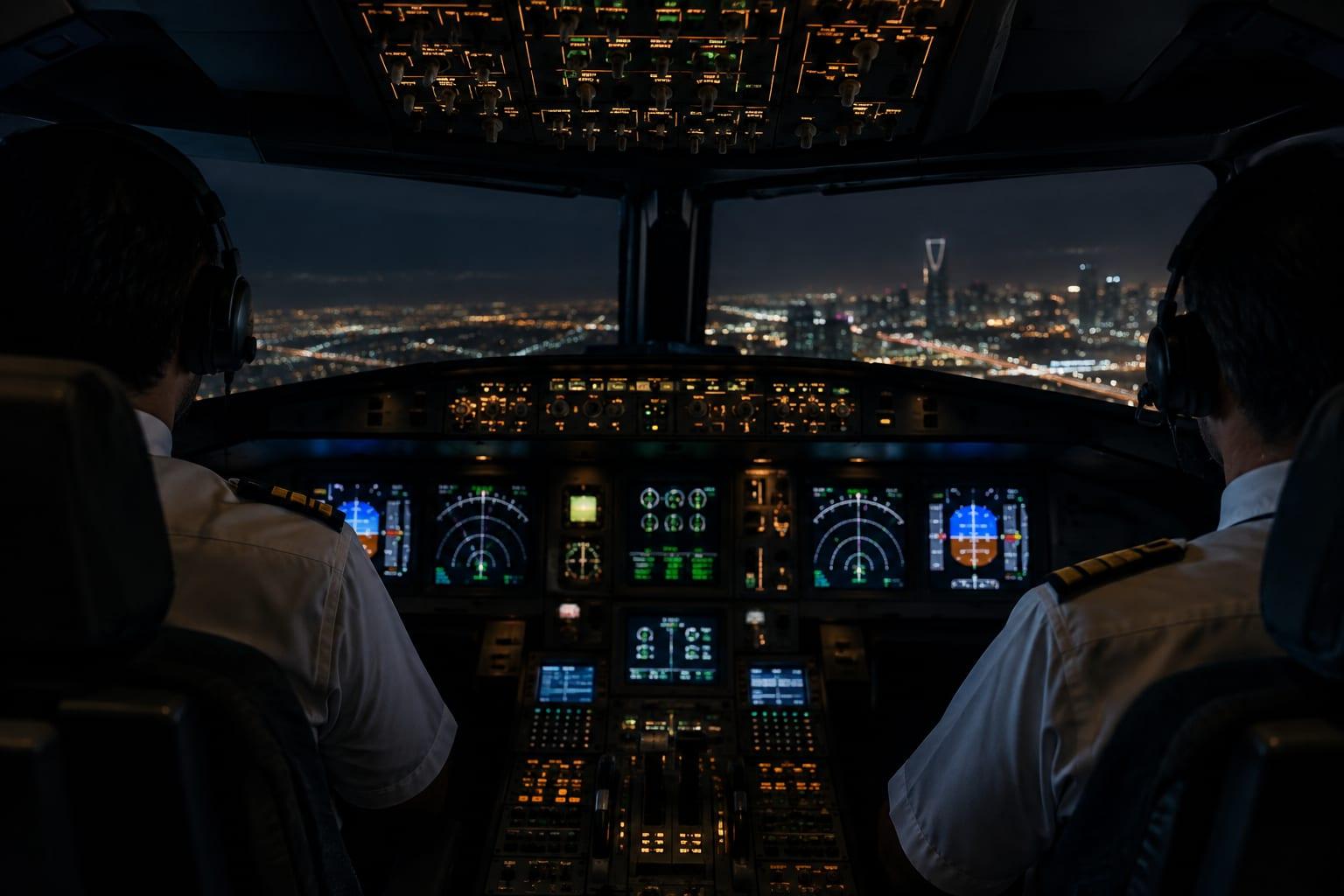
An Israeli official told an i24 reporter that the incident aboard a Flydubai flight from Dubai to Tel Aviv was a terrorist attack, according to the account @FirstSquawk, which carried the official's statement. The flight, carrying roughly one hundred seventy-four people, landed at Tabuk airport in Saudi Arabia on Wednesday after transmitting emergency signals that triggered a hijacking alert, according to multiple reports.
The claim, attributed to an unnamed Israeli official, was posted by @FirstSquawk and has since been carried across social media, where users seized on the word "terrorist" to describe an episode that began as what several outlets described as a cockpit altercation between the flight's pilots. The Times of India reported that the aircraft transmitted emergency signals that triggered a reported hijack scare. Ctech reported that the plane was carrying more than one hundred fifty Israelis when it was diverted to Saudi Arabia.
What actually happened in the cockpit remains contested. According to Türkiye Today, the flight briefly transmitted emergency and hijacking codes before turning around over Saudi Arabia. One report stated that the emergency signal was activated during a violent altercation between the pilots, though it noted that the official reason for the change of course and the emergency signal had yet to be determined. Another account said the jet dropped seventeen thousand four hundred feet in two minutes amid a possible hijack alert.
An official quoted in coverage said of the episode, "It wasn't something innocent." That official did not elaborate on what specifically was not innocent, and no name was attached to the statement. A separate report said one pilot was suspected of trying to crash the plane before being subdued by the other pilot and Israeli passengers. That detail, like the terrorist characterization, has not been confirmed by aviation authorities in Israel, the United Arab Emirates, or Saudi Arabia.
The claim from the Israeli official, as carried by @FirstSquawk, was quickly picked up by accounts across social media, where it circulated alongside the earlier reports of the cockpit struggle and the emergency codes. The accounts carrying the claim did not present additional evidence beyond the official's statement, and the identifier of the official was not provided.
The flight, Flydubai's service from Dubai to Tel Aviv, is a routine route connecting the United Arab Emirates and Israel, two countries that normalized relations under the Abraham Accords. That a flight on this route would divert to Saudi Arabia, which does not have formal diplomatic relations with Israel, added a layer of complexity to an already unusual episode. Saudi authorities have not issued a public statement on the diversion.
Flydubai has not responded publicly to the terrorist characterization. The airline has also not confirmed the details of the cockpit altercation as described in the reports. Israeli officials have not released the name of the official quoted by i24, nor have they issued a formal statement confirming that the incident is being treated as a terrorist attack.
Passengers aboard the flight have not spoken publicly in the coverage reviewed. The condition of the pilots, including whether either was injured in the altercation, is not known. It is also not known whether any arrests have been made or whether Saudi authorities are holding anyone in connection with the episode.
The sequence of events, as described across the reports, is this: the flight departed Dubai bound for Tel Aviv, transmitted emergency and hijacking codes, turned around over Saudi Arabia, and landed at Tabuk. During that sequence, according to one account, the aircraft plunged seventeen thousand four hundred feet in two minutes. The cause of that descent, whether it was the result of a struggle in the cockpit or a deliberate maneuver, has not been established.
Next News Network could not independently verify the claim that the incident was a terrorist attack, nor the claim that one pilot attempted to crash the plane. Both claims remain allegations, attributed to officials and accounts that have not provided supporting documentation.
The Israeli official's statement to i24, as carried by @FirstSquawk, has become the central claim around which the social media reaction has organized. Accounts sharing the statement have treated it as confirmation of the terrorist framing, while the underlying reports describe an investigation that is still in its early stages. The gap between the official's characterization and the confirmed facts is where the story currently sits.
What is known is that a Flydubai flight from Dubai to Tel Aviv diverted to Saudi Arabia on Wednesday, that it carried roughly one hundred seventy-four people, and that it transmitted emergency signals. What is not known is what happened in the cockpit, why the plane descended so rapidly, and whether the episode will be formally classified as a terrorist attack by any government.
The Israeli official's statement, whatever its evidentiary basis, has already shaped how the episode is being discussed. The accounts carrying it have not waited for confirmation, and the phrase "terrorist attack" is now attached to a flight that, according to the earliest reports, was diverted over a cockpit fight. The two framings, one describing a brawl and the other describing terrorism, are being carried side by side.
Whether the official's characterization will be borne out by the investigation is the question that remains open. For now, the claim stands as a claim, attributed to an unnamed official, carried by @FirstSquawk, and repeated across social media by accounts that have not added to the evidentiary record.
Our Take
The reaction to this episode tells you more about the moment than the episode itself. An unnamed Israeli official says one word, "terrorist," to a reporter, and within hours that word is the story, repeated by accounts that treat attribution as proof. The reports underneath are messier: a cockpit fight, a hijacking code, a seventeen-thousand-foot plunge, a diversion to a country that does not recognize Israel. None of that is confirmed either, but it is at least what the outlets on the ground are describing. The terrorist framing is a characterization from a source we cannot see, and it deserves the same skepticism we would apply to any unnamed official's claim. If it turns out to be true, the accounts carrying it will say they were right. If it turns out to be a cockpit brawl, those same accounts will move on without a correction. That is the asymmetry of the social media news cycle, and it is why the phrase "could not independently verify" belongs in every story like this one, near the end, where readers who have made it that far can weigh it.
