
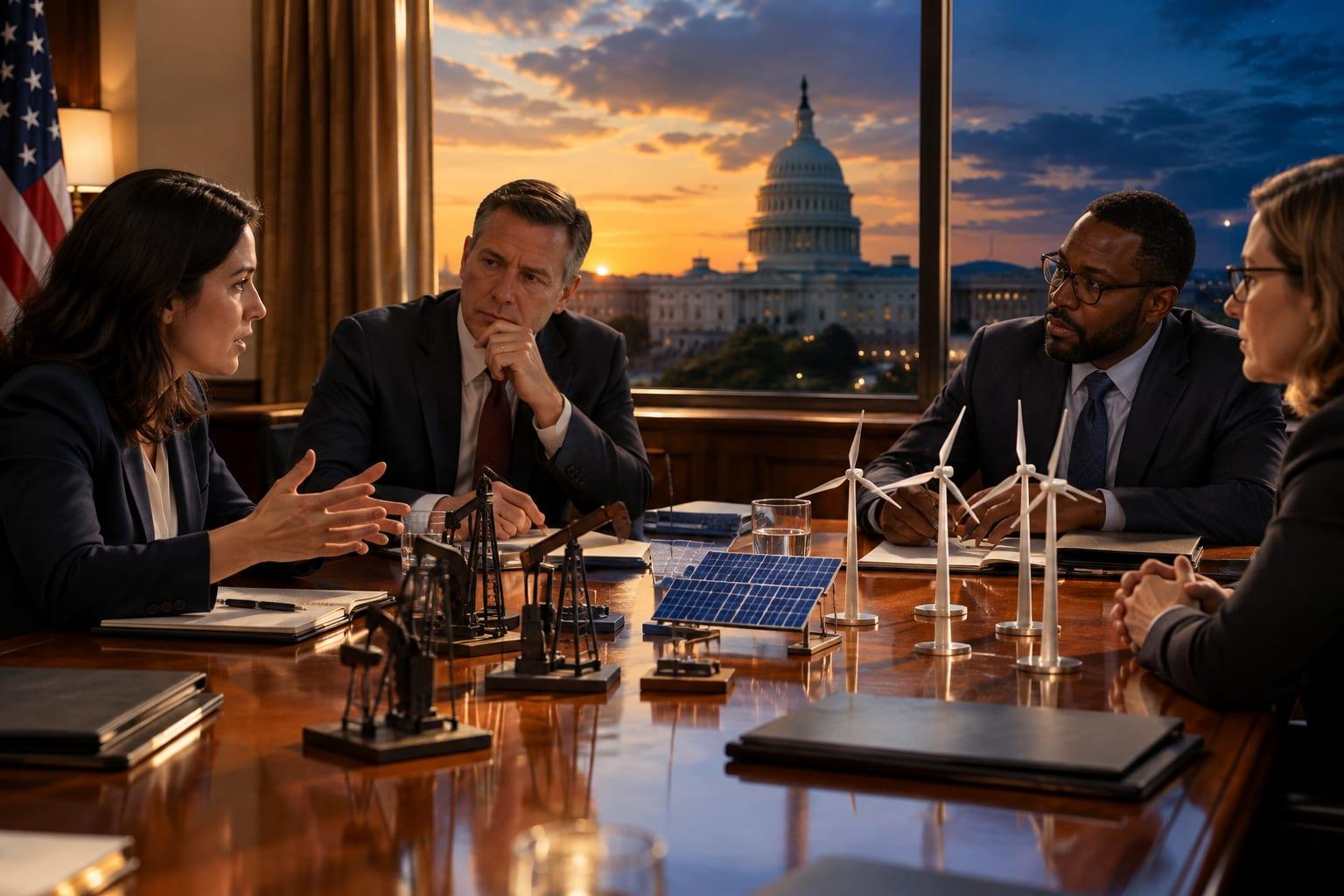
Two House Republicans are making the case that Washington should rethink how it approaches American energy, using a special section in The Washington Times to press the argument that policy should be built around the people who produce power and the households that pay for it.
Rep. Nick Begich, an Alaska Republican, wrote in the America's Energy Edge special section that lawmakers should spend more time hearing from the men and women who produce the nation's energy, according to a post from the account @WashTimes. "Policymakers should spend more time listening to the people who produce America's energy," Begich wrote.
The appeal amounts to a shift in orientation. Rather than starting from policy prescriptions drafted in Washington and then imposing them on the industry, Begich's argument runs that the producers themselves should be the first stop in the conversation. The Alaska congressman's state is a major energy-producing jurisdiction, and his argument fits a broader theme among Republicans that domestic production is a matter of both economic strength and national security.
A separate entry in the same special section took a different angle on the energy question, focusing on the household-level burden of the twice-yearly clock change. Rep. Gus Bilirakis, a Florida Republican, wrote, "It is time to ditch the switch, lock the clock and let the sunshine in," according to the @WashTimes post.
The "switch" refers to daylight saving time and the semiannual ritual of moving clocks forward in the spring and back in the fall. The Bilirakis formulation folds the daylight saving debate into the energy conversation by invoking sunshine directly. Supporters of the change have long argued that additional evening daylight reduces electricity demand and gives Americans more productive hours, while critics point to the disruption to sleep schedules, the confusion for families with young children and the inconsistency of a patchwork of state laws that have moved in different directions on the question.
The two entries, carried by the same account, illustrate the breadth of the special section's subject matter. One is a structural argument about who gets a seat at the table when energy policy is written. The other is an argument about the clock itself, a subject that has drawn interest from lawmakers across the ideological spectrum in recent years.
The @WashTimes account carried both items as the special section rolled out. The energy-focused messaging arrives as the broader infrastructure conversation continues in Washington. The American Enterprise Institute, a Washington think tank, recently hosted a discussion titled "How Quickly Can America Build?" featuring David Ulevitch joining Shane to talk about the future of the nation's infrastructure as emerging technologies continue to be employed. That exchange, posted online, touched on the same underlying question the Begich and Bilirakis entries raise in different forms: how fast the country can move, and what stands in the way.
The Begich argument is narrower in one sense and broader in another. It is narrower because it concerns who is consulted. It is broader because it implies that a wide range of policy outcomes, from permitting to pricing to reliability, flow from whether producers are heard. His phrasing, as carried by @WashTimes, does not specify which policies he has in mind or which producers he believes are being overlooked. It is not yet known what specific legislative proposals, if any, Begich intends to attach to the argument.
The Bilirakis entry is more concrete. "Ditch the switch" is a recognizable slogan in the daylight saving debate, and "lock the clock" captures the goal of ending the semiannual change. Florida has previously moved to keep daylight saving time year-round, though such a change requires federal authorization to take effect. Bilirakis's entry does not spell out a mechanism or timeline, and it is not yet known whether the Florida congressman intends to introduce legislation on the matter or is adding his voice to an existing push.
Taken together, the two entries show a party working to keep energy and pocketbook issues in the foreground. The special section format allows lawmakers to make their cases at length outside the constraints of a floor speech or a press release, and the decision by two members to use it for these arguments suggests the subjects are ones they expect to keep pressing.
What the entries do not do is settle any question of policy. Neither congressman, in the material carried by @WashTimes, offered a timeline, a vote count or a specific bill number. The posts are statements of position, not records of action.
It is also worth noting what the posts do not say. Begich's entry, as carried by the account, does not name any policymaker he believes has failed to listen, nor any producer he believes has been ignored. Bilirakis's entry does not name a state or a region whose experience with the clock change has driven his position. Both entries are general in their phrasing, leaving the specifics to be filled in later.
Next News Network could not independently verify the underlying claims reflected in the entries.
The broader energy and infrastructure conversation is not waiting on any single lawmaker. The AEI discussion with Ulevitch and Shane framed the question as one of speed and capability, asking how quickly the country can build and what emerging technologies mean for the answer. That framing overlaps with the Begich argument in an important way: both treat the capacity to produce and construct as a central measure of national strength.
For Republicans, the appeal of the energy message is straightforward. Energy costs touch every household, and production decisions touch every region. Members who can speak credibly about both have an audience. Begich, from a major producing state, and Bilirakis, from a large consuming state, approach the subject from opposite ends of the supply chain, and their entries in the same special section reflect that range.
Whether the messaging turns into legislation is a separate question. It is not yet known what form any follow-up bill might take, or whether either congressman will attach his name to one. The posts carried by @WashTimes mark the argument, not the outcome.
For now, the exchange amounts to two members of Congress using a national platform to make the case that energy policy should be built around producers and that the country's relationship with its own clocks deserves another look. Both arguments will need more than a special section to become law, but both are now on the record.
Our Take
Conservatives have been making the case for years that American energy policy should start with the people who actually produce it, not with the regulators and advocacy groups who have made a cottage industry out of slowing it down. Begich's entry is a reminder that the expertise in the room should include the roughnecks, the grid operators and the families whose livelihoods depend on production, not just the think-tank panels. And Bilirakis is right that the twice-a-year clock change is a needless disruption that most Americans would happily trade for a little more evening light. The common thread is a simple one: Washington should stop making life harder for the people who keep the lights on and the country moving. Next News Network will keep watching to see whether either argument turns into actual legislation or remains a talking point.
