
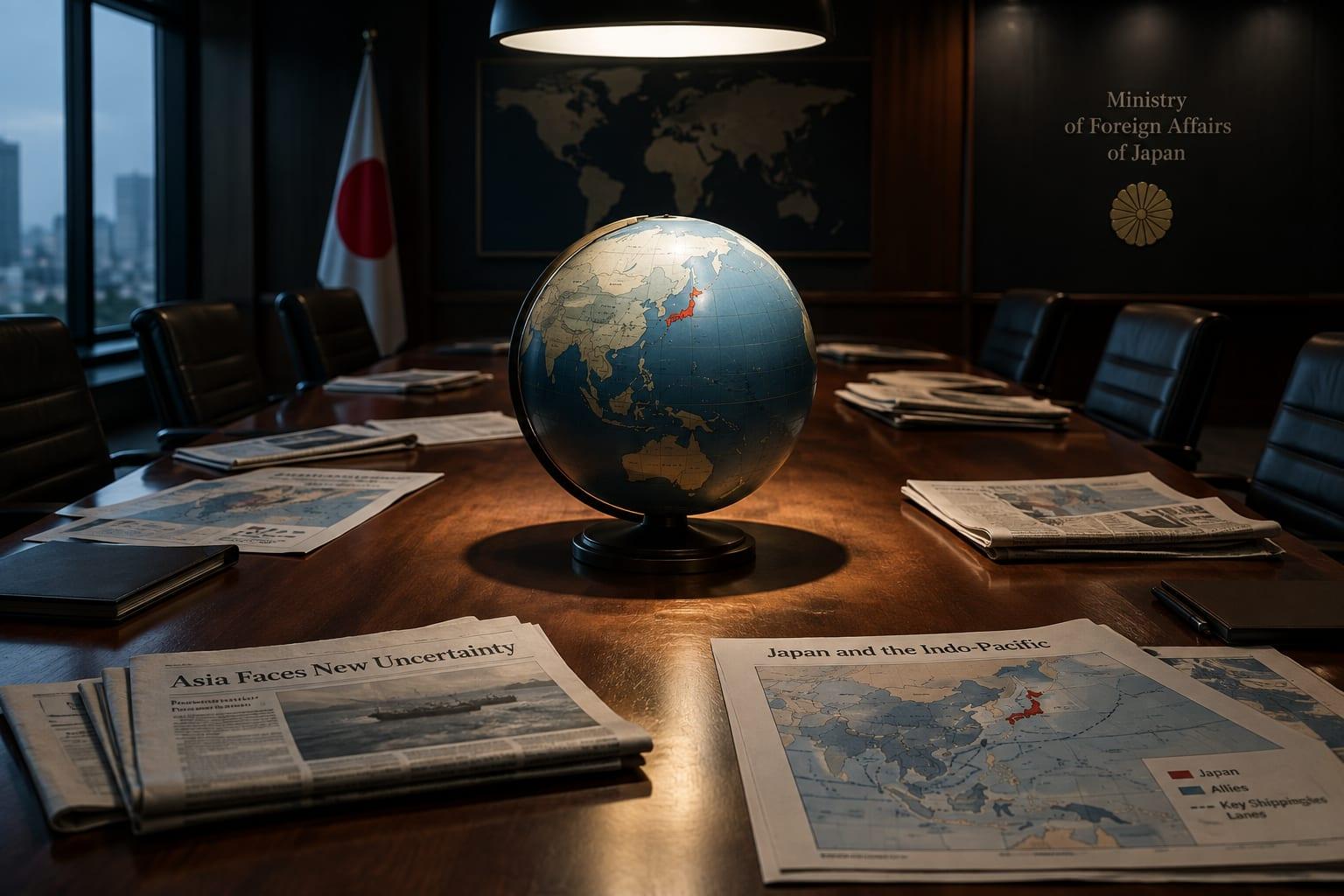
Japanese Defense Minister Shinjiro Koizumi this week again urged his government to urgently debate acquiring nuclear weapons amid growing nuclear threats from China, according to posts circulating on social media.
The @WashTimes account posted that Koizumi "this week again urged his government to urgently debate acquiring nuclear weapons amid growing nuclear threats from China." The same claim was carried in other coverage, including a report titled "Nuclear arms, nuclear subs: Japan's defense minister wants every option on the table," and another from The Independent stating that the defense minister said non-nuclear principles should be revisited given the current global security "crisis." The New York Sun reported that Japanese leaders are provoking China by daring for the first time to talk about nuclear weapons, quoting the defense minister as saying, "Japan must possess the capabilities to firmly counter threats."
According to The Independent, Koizumi said the non-nuclear principles should be revisited given what he described as the current global security crisis. The New York Sun reported that he said Japan must possess the capabilities to firmly counter threats.
The discussion has drawn attention from other accounts as well. The @MarioNawfal account posted a video of Polish Foreign Minister Radoslaw Sikorski speaking about a past exchange with his Mongolian counterpart. In the transcript of that video, Sikorski said: "I received, when I was the Minister of Defense, from my Mongolian counterpart a beautifully decorated collection of medals on the 800th anniversary of Genghis Khan. All of them made of gold. And my guest was very surprised when I told him that in Poland this is a controversial thing." The @MarioNawfal post included the caption: "When I was Defense Minister, my Mongolian counterpart gave me a collection of medals minted for the 800th anniversary of Genghis Khan. My guest was very surprised when I told him that in Poland, Genghis Khan is a controversial figure."
That post also carried flag emojis for Mongolia and Poland, indicating the two countries involved in the anecdote.
The two posts, from @WashTimes and @MarioNawfal, were circulating within minutes of each other on the same day, though they address different subjects. The @MarioNawfal post appeared at 12:15 p.m. UTC, and the @WashTimes post appeared at 12:31 p.m. UTC on October 1, 2026.
The claim about Koizumi's push for nuclear debate is being carried by multiple outlets, but it is not independently confirmed by Next News Network. The underlying event -- that Koizumi made these specific remarks this week -- has not been verified by this outlet. What is known is that the accounts and outlets listed above are reporting it as such. The discussion of nuclear weapons in Japan marks a departure from the country's long-standing non-nuclear principles, which have been a cornerstone of its defense policy since the end of World War II. Japan is the only nation to have suffered atomic bombings, and its constitution has been interpreted as limiting its military capabilities. Any debate about acquiring nuclear weapons would represent a significant shift in that posture.
Next News Network could not independently verify the claim that Koizumi made these remarks this week.
The @MarioNawfal account, which frequently posts international news and commentary, shared the Sikorski video without additional context beyond the caption. The Sikorski anecdote about the Genghis Khan medals does not directly relate to the Japanese nuclear discussion, but it appeared in the same social media stream as the Koizumi claim, showing how varied topics circulate simultaneously on those platforms.
The conversation around Japan's nuclear options has been building for some time. In recent years, Japan has faced growing security challenges from China's military expansion and North Korea's nuclear program. The idea of Japan acquiring nuclear weapons has been discussed in policy circles, though it remains controversial both domestically and internationally. The defense minister's reported comments suggest that the debate may be moving from the fringe to the mainstream of Japanese politics.
According to The Independent, Koizumi's call for a "taboo-free" discussion about nuclear weapons is a significant moment because it challenges a long-standing taboo in Japanese politics. The New York Sun characterized it as Japanese leaders provoking China by daring to talk about nuclear weapons for the first time.
It is not yet known whether Koizumi's remarks will lead to any formal policy change or whether they represent a trial balloon. The Japanese government has not announced any change to its non-nuclear principles.
Our Take
Japan's defense minister floating the idea of nuclear weapons should alarm every American who understands the stakes of nuclear proliferation. For decades, the United States has extended its nuclear umbrella to protect Japan, and that arrangement has kept the peace in the Pacific. If Japan decides to go nuclear, it will trigger a cascade of proliferation across Asia: South Korea will feel compelled to follow, Taiwan may reconsider its own status, and the entire region could descend into a nuclear arms race. China's threats are real, but the answer is not for Japan to abandon its non-nuclear principles. The answer is for the United States to strengthen its alliance commitments and for Japan to invest in conventional defenses. The last thing the world needs is more nuclear weapons, especially in a region as tense as East Asia.