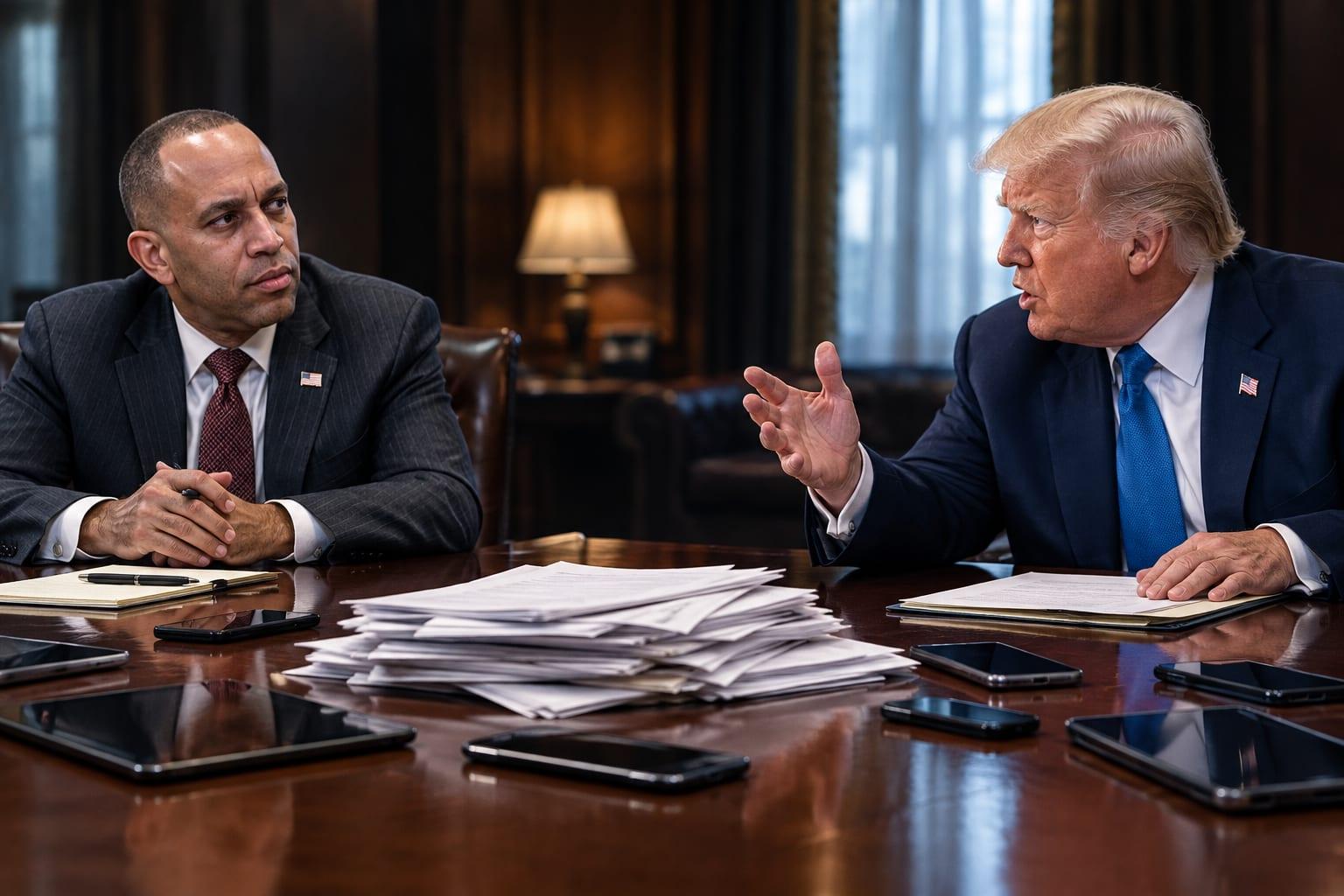
House Minority Leader Hakeem Jeffries (D-NY) is not impressed with President Donald Trump's handshake deal with the men who build artificial intelligence.
Speaking to reporters Wednesday, the top Democrat in the House called the agreement "entirely unenforceable" and rejected the idea that AI companies should be trusted to oversee themselves.
"The notion of entering into a voluntary agreement that is entirely unenforceable and that allows the industry writ large to police itself is not the right response," Jeffries said, according to the Washington Examiner.
The agreement in question is the accord Trump struck with top AI executives earlier this week, which the White House described as "morally binding" — a framework built on voluntary commitments rather than federal mandates. Trump's argument is straightforward: American AI companies are racing against the CCP, and strangling them with bureaucracy hands the advantage to Beijing.
WHAT JEFFRIES ACTUALLY SAID
Jeffries did not release a counter-proposal. He did not name a single specific rule he would impose, nor explain how a Congress he does not control would pass one. He criticized the voluntary nature of the deal without describing what enforcement would look like.
The criticism landed the same week The Hill flagged the dispute in a post to its followers on X, writing, "Jeffries knocks Trump opposition to AI guardrails."
Jeffries knocks Trump opposition to AI guardrails https://t.co/6f0JHIkrPN
The exchange sets up a familiar Washington split: the White House betting on speed, private-sector buy-in and American dominance, and Democrats betting on federal rulemaking. Neither side disputes that AI needs some kind of framework. They dispute who holds the pen.
THE TRUMP-VANCE APPROACH: VOLUNTARY NOW, LEVERAGE LATER
Trump's second term has pushed deregulation across the board — through the Department of Government Efficiency, energy dominance orders, and a broad rollback of Biden-era executive actions. The AI accord fits that pattern. Rather than hand a new rulebook to an administrative state conservatives already distrust, the administration extracted commitments directly from the executives whose products are on the market right now.
That structure has an obvious weakness, and Jeffries found it: a promise is only as good as the person who made it. What happens when a company decides the commitment is inconvenient? What happens when a CEO changes?
The White House's answer, so far, is that the companies have far more to lose from a public fight with the administration than they do from quietly walking away from a press release.
WHAT IT MEANS FOR EVERYDAY AMERICANS
For workers watching AI move into their industries, for parents worried about what their kids' chatbots tell them, and for small businesses deciding whether to adopt AI tools, the practical difference between "voluntary" and "enforceable" matters less than whether anything changes.
A voluntary accord could produce fast action — companies adjusting behavior this quarter rather than after a three-year rulemaking process. It could also produce nothing at all. That risk is real, and Jeffries is not wrong to name it.
What he has not done is explain how a federal enforcement regime would avoid the two problems conservatives point to constantly: agencies writing rules Congress never passed, and rules so broad that only the largest companies — the ones with compliance departments and lobbyists — can afford to survive them. That dynamic has crushed small competitors in industry after industry.
It is not yet known whether the White House plans to attach any measurable benchmarks or follow-up reviews to the accord, and Jeffries' office has not outlined what specific guardrails he supports.
House Republicans, for their part, have shown no appetite for handing the Minority Leader a new regulatory agency. Senate Democrats would need Republican votes to move anything, and they do not have them.
So the fight is likely to stay rhetorical for now — which raises the question of whether Jeffries is trying to shape AI policy or simply position his party for the 2026 midterms. He can attack the agreement without ever producing an alternative, and there is no mechanism in Washington that forces him to.
Our Take
Hakeem Jeffries has a talent for describing problems in ways that sound like solutions. "Entirely unenforceable" is a critique, not a plan. If he believes the men building the most powerful technology in human history cannot be trusted to police themselves, he owes voters an answer on who should — Congress, an agency, an international body? Every one of those options has a track record, and none of them is clean.
The administrative state Jeffries is implicitly defending is the same one that spent years slow-walking permits, burying small businesses in paperwork, and writing rules that mysteriously matched the wish lists of the largest corporations in America. Handing AI to that machine does not protect the public. It protects incumbents.
Trump's accord may prove to be theater. It may prove to be a genuine first step in a fast-moving field where the alternative is paralysis. What it is not is the thing Jeffries says it is — the only question is whether he ever offers anything better, or whether attacking Trump is the whole platform.
Watch whether House Democrats produce a single piece of AI legislation with their name on it between now and November. If they don't, you have your answer about how serious the concern really is.