
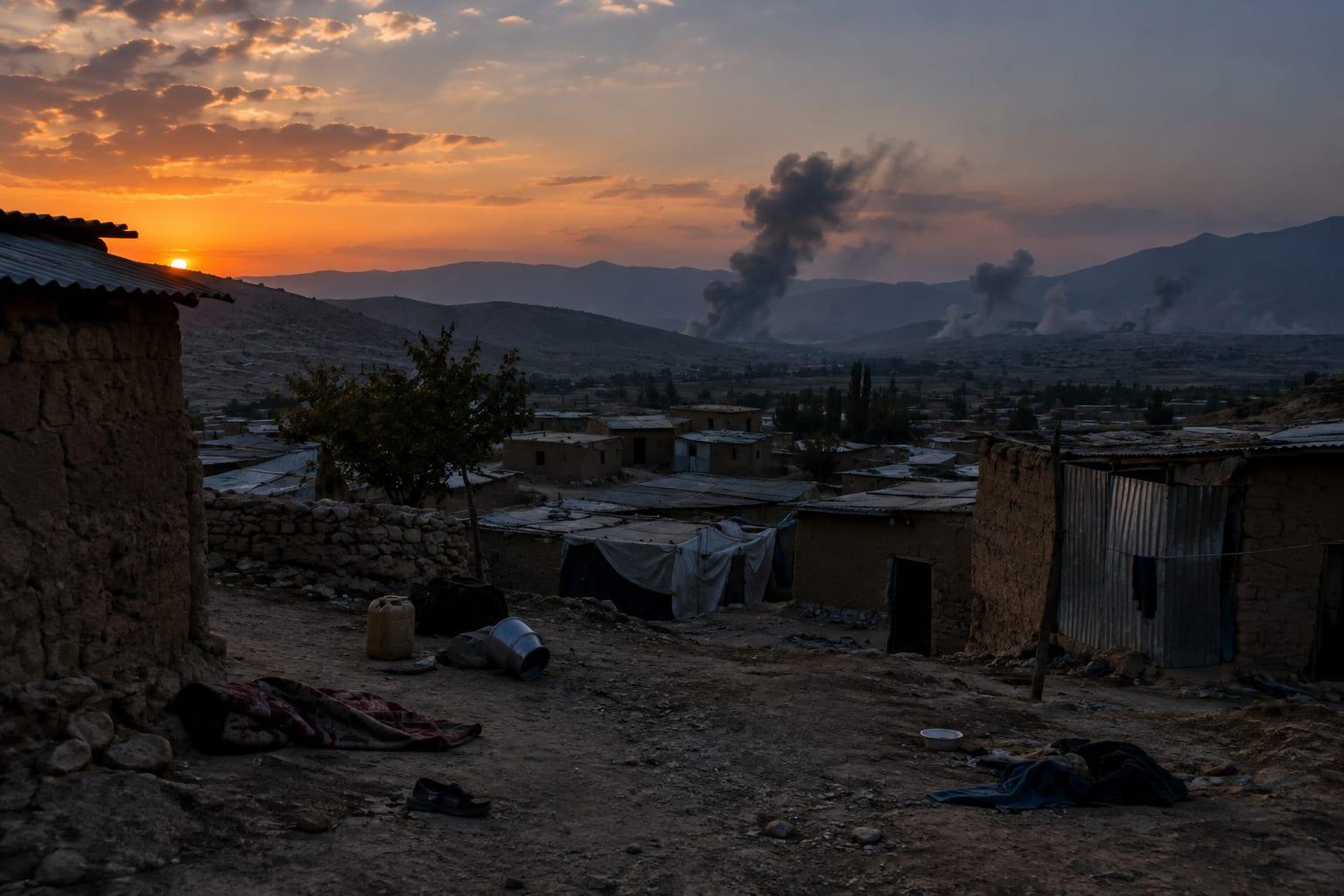
Afghanistan's Taliban government said Thursday that Pakistani airstrikes killed nine people and wounded eleven others in two provinces, an allegation that spread across social media and regional news outlets within hours and marked an escalation between the South Asian neighbors after three months of relative calm.
Reuters reported at 6:00 a.m. UTC that "Pakistani airstrikes kill 9 in Afghanistan, Taliban say," while the account @FirstSquawk, a market-moving news feed, carried the same claim earlier, posting at 2:58 a.m. UTC: "Afghan Taliban: Nine killed in two Pakistani airstrikes in Afghanistan."
The claim was also carried by Arab News, which reported that Taliban security officers inspected the scene of what Taliban officials said were Pakistani airstrikes in Khost province on Thursday, Sept. 24, 2026. Images distributed with that coverage and reviewed by Next News Network showed officials gathered at a site identified as the location of one of the strikes.
According to Arab News, Kabul claims nine civilians, including women and children, were killed, while Pakistan reports twenty-two militants were killed in the same operations. Social News XYZ, a regional outlet, reported from Kabul that at least nine civilians, including women and children, were killed and eleven others injured after what it described as Pakistani military airstrikes on civilian homes in Afghanistan's Kunar and Helmand provinces. That outlet attributed the information to Taliban spokesperson Zabihullah Mujahid, though the full text of his statement was not included in the material reviewed by Next News Network.
The two accounts diverge sharply on the nature of the targets. Afghanistan's Taliban government describes the strikes as hitting civilian areas and homes, while Pakistan's government maintains its operations struck only militants, according to Arab News. Neither claim has been independently confirmed, and no neutral on-the-ground verification was cited in any of the coverage reviewed by Next News Network.
The strikes themselves, as described by Taliban officials, involved two provinces: Kunar in the east and Helmand in the south, per Arab News and Social News XYZ. Those are distinct locations hundreds of miles apart, suggesting either a coordinated operation or separate strikes on the same night. The account @FirstSquawk characterized the action as two airstrikes, though other outlets described strikes in two provinces without specifying the exact number of individual strikes.
What is not in dispute is that both governments issued public statements about the same events. The Taliban government's account was carried first by @FirstSquawk and then by Reuters and other outlets, while Pakistan's counterclaim of twenty-two militants killed was reported by Arab News, which noted the divergent claims side by side in its coverage.
The strikes and the competing claims come after what Reuters described as three months of relative calm between the two neighbors. The phrase suggests a prior period of reduced hostilities, though the specific contours of that calm and what ended it were not detailed in the coverage reviewed by Next News Network. The last major flare-up between Pakistan and Afghanistan is not described in the available material, and it is not yet known whether this exchange marks the start of a sustained campaign or an isolated episode.
The regional context is significant. Pakistan shares a long and porous border with Afghanistan, and the Taliban government in Kabul has governed since 2021 without widespread international recognition. Cross-border security incidents between the two countries have occurred periodically, though the material reviewed by Next News Network does not provide a full accounting of previous strikes or their disputed tolls.
The human toll described by Afghan officials -- nine killed, eleven wounded -- includes women and children, according to the Taliban spokesperson cited by Social News XYZ. That outlet reported that the strikes hit civilian homes in the two provinces. The same report did not include a breakdown of how many of the wounded were civilians or combatants, and no independent monitor has released figures of its own.
Pakistan's account, as carried by Arab News, does not acknowledge any civilian casualties and states that twenty-two militants were killed in the operations. That figure is higher than the number of deaths claimed by the other side, which is notable given that Pakistan describes its targets as militants while Afghanistan describes its dead as civilians. The two claims are mutually exclusive in their characterization of who was hit, even as they describe the same geography and timeframe.
The Khost province location mentioned in the Arab News coverage adds a third province to the list of reported strike sites, alongside Kunar and Helmand. It is not clear from the material reviewed by Next News Network whether all three provinces were struck in the same operation or whether Khost was the site of a separate incident on a different day, since the Arab News image caption referenced Sept. 24, 2026, while the Taliban government's casualty claims were reported on Oct. 1, 2026.
Next News Network could not independently verify the claims made by either government or the casualty figures attributed to Taliban officials.
The sequence of social media dispersion was rapid. @FirstSquawk carried the claim at 2:58 a.m. UTC, more than three hours before Reuters posted its headline at 6:00 a.m. UTC. Other regional outlets, including Social News XYZ and Arab News, carried the Taliban government's version of events within a roughly two-hour window. The claim therefore moved from a single social media alert to mainstream wire coverage in a matter of hours, with both sides' characterizations intact and unchallenged by independent reporting.
None of the accounts carrying the news claimed to have reporters on the ground at the strike sites. The images described by Arab News showed Taliban security officers inspecting a scene, an observation drawn from an image description, not a firsthand account of the strikes themselves. The full circumstances of how the strikes were carried out, what weapons were used, and how far the strikes traveled into Afghan territory are not described in any of the material reviewed.
Our Take
Once again, two governments have told two entirely different stories about the same night, and the world is expected to pick a side before a single independent investigator has set foot in Kunar, Helmand or Khost. The Taliban says nine civilians are dead and eleven wounded. Pakistan says twenty-two militants were eliminated. Both cannot be fully right, and neither has produced evidence the public can examine. What is certain is that the claim moved from a social media alert to wire copy in three hours flat, which tells you more about how fast modern war narratives travel than about what actually happened on the ground. American readers should note the pattern: airstrikes are claimed, casualty figures are disputed, and the fog stays thick until someone on the ground -- not a spokesperson, not a government account -- does the counting. Until then, this is a story of dueling claims, not a story of verified facts, and it should be reported as such by everyone, including us.
