
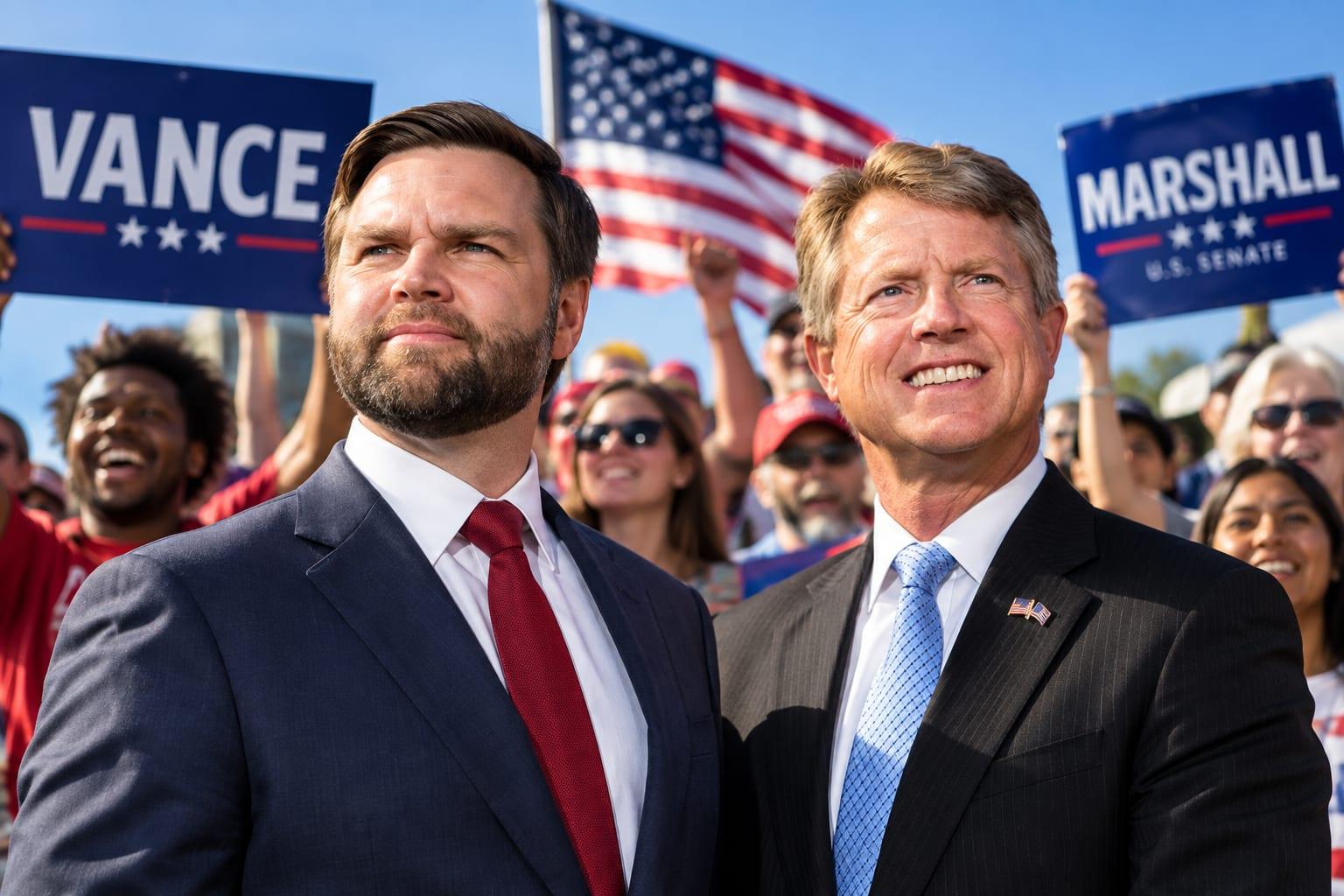
Republicans have a problem they did not see coming, and it is not in Georgia, North Carolina, or any of the battlegrounds that usually decide Senate control. It is in Kansas.
Vice President JD Vance was on the trail for Sen. Roger Marshall this week, a sign of just how seriously the Trump-Vance administration is treating a race that was supposed to be a formality in a state Trump carried comfortably in 2024. According to Fox News Politics, the Kansas Senate race against Democrat Adam Hamilton has tightened, and Vance's visit is the clearest signal yet that the GOP is not taking the Sunflower State for granted.
The rally comes with the national environment working against Republicans. ABC News reported Wednesday that GOP doubts are growing over Senate races in Georgia and North Carolina, and some Republicans are now urging the party to divert resources from those states into redder territory that has become unexpectedly competitive.
The reason, per ABC News, is President Trump's approval rating. A recent Reuters/Ipsos poll cited by the outlet put Trump's approval at 32%, down from 47% at the start of his second term. ABC News ties the decline to the ongoing Iran war and its economic fallout, both of which are weighing on down-ballot Republicans including Georgia Senate candidate Rep. Mike Collins and North Carolina candidate Michael Whatley.
"Trump's numbers being sort of this never-ending limbo contest for how low they can go makes that all the harder for every Republican on the ballot," Doug Heye, a North Carolina GOP strategist and former RNC communications director, told ABC News.
A Georgia Republican, speaking to ABC News on condition of anonymity, put it more bluntly: "I have never seen an environment this bad for Republicans in Georgia."
Kansas is different territory. Trump won the state handily in 2024, and Marshall is an incumbent with the party apparatus behind him. But the same affordability concerns driving voters in Georgia and North Carolina are not stopping at the state line.
CNN Politics reported Tuesday that Senate Democrats blocked a GOP-led bill aimed at combating rising energy costs driven by the data center boom, a vote Republicans had hoped would demonstrate they were addressing voter concerns about affordability heading into the midterms.
With 34 days until Election Day, the map has shifted. What was once a defensive posture for Republicans in a handful of swing states now includes a seat in the deep-red heartland that no one expected to watch. Vance's trip suggests the White House is not willing to find out what happens if it ignores Kansas.
Hamilton, the Democratic challenger, has not yet drawn the same national attention as Ossoff in Georgia or the Democratic candidates in North Carolina, but the tightening margin is enough to have the vice president on the ground. That alone tells the story.
Whether the rally stops the slide or confirms it is the question Republicans will be answering at the ballot box on November 3. For now, the party is playing defense in places it never planned to defend, and the clock is running out.
Our Take
Kansas is not supposed to be a Senate race. It is a state Trump won comfortably, with a Republican incumbent and a Republican governor's mansion until recently. If the GOP is sending the vice president there in late September, it means internal polling is telling them something the rest of us should hear.
The establishment will blame Trump's approval number. They always do. But the deeper problem is that Republicans ran on fixing affordability and then let a procedural vote fail when it mattered. CNN reported Democrats blocked that energy cost bill — fine, but the bill was supposed to be the GOP's answer to the cost-of-living squeeze, and it did not land. Voters do not care who blocked it. They care that their grocery bill and power bill are still too high.
This is also what happens when a party lets the national narrative get set by its opponents. The Iran war is dragging on, the data center boom is driving energy costs through the roof, and the messaging from Washington has been about everything except the kitchen-table issues that put Trump back in the White House in the first place.
Kansas should be a wake-up call, not a crisis. If Republicans cannot hold a red-state Senate seat with the vice president stumping for them in October, the midterms are going to be a long night. The good news is there is still time to change the subject back to the things that actually win elections: cheaper energy, secure borders, and a government that gets out of the way.
The question for Marshall, Vance, and every Republican on the ballot from here to November: are you going to make the case, or are you going to let the other side make it for you?
