
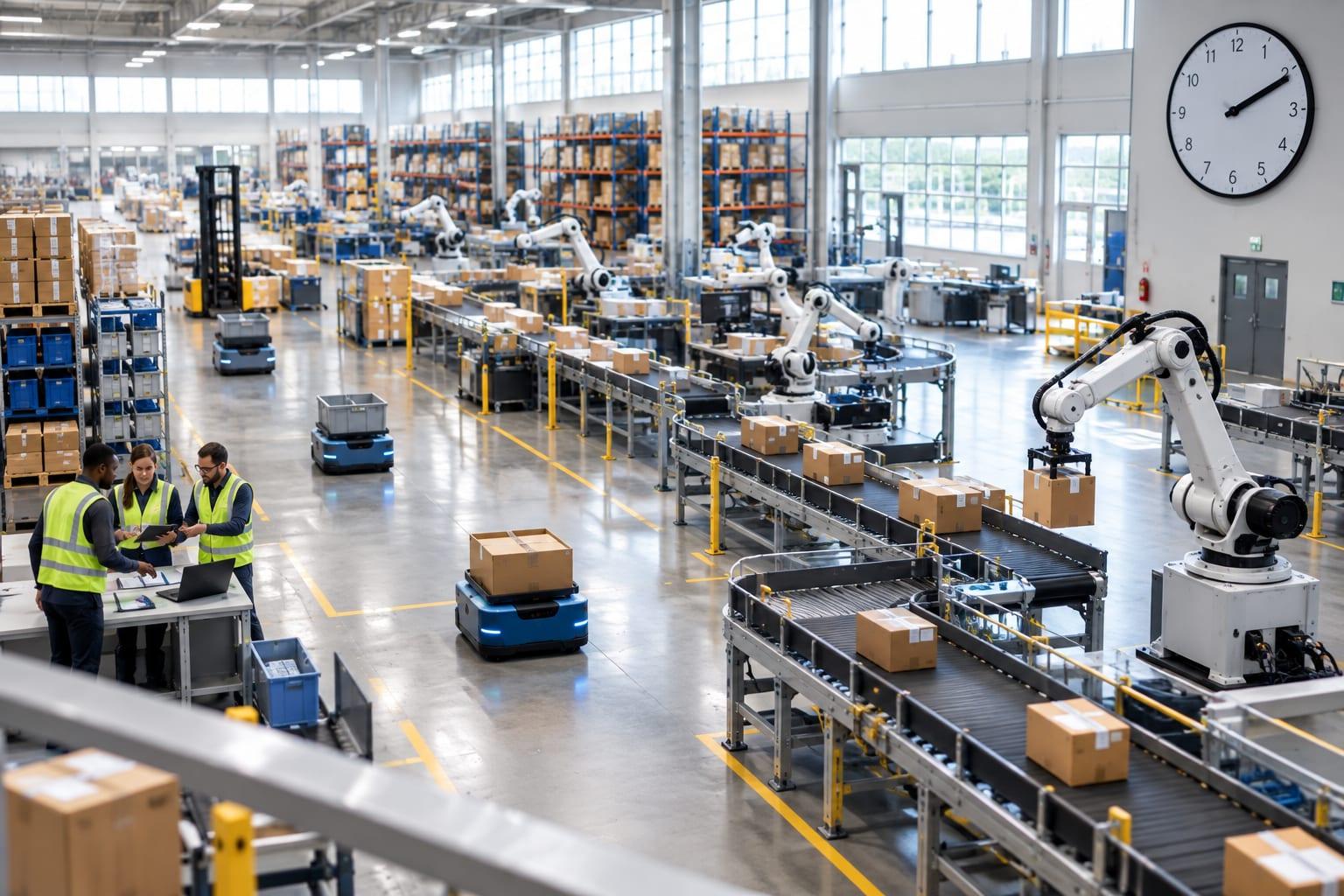
The public debate about warehouse automation tends to picture humanoid robots taking jobs wholesale. The reality on the floor is narrower, stranger, and further along than most of the debate assumes.
That was the assessment published by @WashTimes on October 1, 2026, in a post that has since been carried across multiple accounts and commentary threads, drawing responses from warehouse managers, technology watchers, and labor observers who say the actual state of automation on the floor is far different from the humanoid-robot imagery that dominates headlines.
The @WashTimes post did not describe a specific event or announcement. Instead, it framed the public conversation itself as the subject, arguing that the gap between the debate and the floor is where the real story sits.
That framing was picked up within hours by other accounts. A post from one technology-focused account described a warehouse manager with robot vendor demos open on one monitor while, on the floor below, a picker worked from a paper pick list, checking off lines by hand and keying confirmations into a terminal. The image, offered as a snapshot of current conditions, circulated as a counterpoint to the humanoid-robot narrative.
Another account, posting under the headline "What warehouse robots actually replace, and what they still cannot do," repeated the @WashTimes framing almost verbatim, signaling that the original assessment had been absorbed into a broader conversation about automation's limits.
The posts do not claim that a specific robot deployment occurred, nor do they identify a particular warehouse or company. They describe conditions on the floor in general terms. Next News Network could not independently verify the specific conditions described in the posts.
The conversation extended beyond the United States. A report from Euronews, published eight hours after the @WashTimes post, noted that Europe has so far built few humanoid robots, yet could profit from each one. The report, citing a Fraunhofer study, said German car part suppliers may play a key role in producing joints and hands for humanoid robots. That account did not directly respond to the @WashTimes post, but it arrived in the same news cycle and addressed the same subject from a manufacturing and supply-chain angle.
Separately, The Straits Times reported that AI-powered humanoid robots will assist Home Team officers in hazardous tasks by 2028, according to Edwin Tong. That account said the deployment would enhance public safety while preserving human judgement and empathy. The Straits Times report did not reference the @WashTimes post, but it contributed to the broader conversation about where humanoid robots are actually headed and what roles they are expected to fill.
Taken together, the posts and coverage describe a debate that is moving in two directions at once. On one side, the @WashTimes post and the accounts that repeated its framing argue that the public conversation about warehouse automation is disconnected from the floor, where paper pick lists and manual confirmations remain common. On the other, reports from Europe and Singapore describe humanoid robot development that is proceeding, albeit in specific and limited contexts — joint manufacturing in Germany, hazardous tasks in Singapore — rather than wholesale job replacement.
The @WashTimes post did not offer a prediction about when or whether humanoid robots would reach the warehouse floor in significant numbers. It said the reality is "narrower, stranger, and further along" than the debate assumes, a formulation that has been quoted and paraphrased across the accounts carrying it.
The posts do not identify the warehouse manager, the picker, or the vendor whose demos were described. They do not name a company or a location. The accounts carrying the conversation have not published follow-up reporting with additional detail.
What the posts do show is a sequence: an initial framing from @WashTimes, a quick response from accounts pointing to the gap between demo and floor, and then a broader set of reports from Europe and Asia describing humanoid robot development in specific industrial and public-safety contexts. The conversation has not resolved into a single narrative. Instead, it has split into at least three threads — warehouse reality, European supply chains, and Asian public safety — each with its own set of claims and caveats.
Next News Network could not independently verify the specific claims made in the @WashTimes post or in the accounts that responded to it, including the description of the warehouse manager's monitors and the picker's paper list.
Our Take
The @WashTimes post is right to point out that the humanoid-robot debate has gotten ahead of the floor. But the responses to it show something more useful: the automation conversation is not one story. It is a warehouse story, a European manufacturing story, and a Singapore public-safety story, and they are not moving at the same speed. Conservatives should resist the temptation to treat every robot headline as either a jobs apocalypse or a nothingburger. The real question is not whether humanoid robots are coming — it is where they are already here, what they are actually doing, and who is paying attention to the difference. The paper pick list is still on the floor. The German joints are still being built. Both things are true, and the debate should reflect that.
