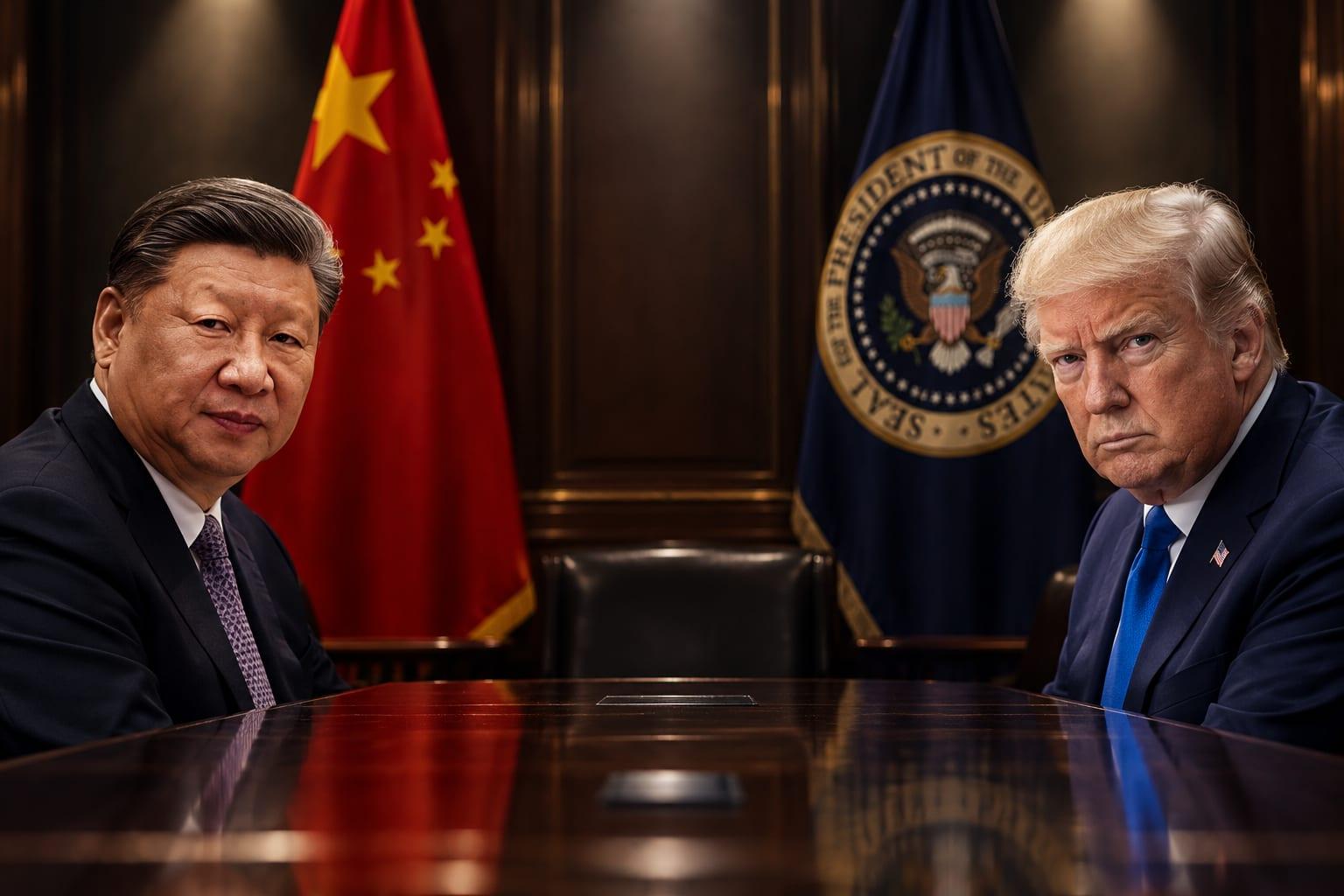
Chinese President Xi Jinping celebrated the 77th anniversary of the People's Republic of China on Wednesday with a defiant speech at Beijing's Great Hall of the People, declaring his nation's rise on the world stage 'unstoppable' and pressing for what he called the 'great cause of national reunification' with Taiwan, according to state news agency Xinhua.
Speaking to hundreds of guests at a grand banquet on the evening of September 30, Xi rejected what he termed 'external interference' over Taiwan and vowed to 'resolutely crack down' on forces seeking the island's independence, CNA reported. The address came just days after Xi's state visit to Washington, where he told President Donald Trump that the United States should show 'prudence' on Taiwan and oppose Taiwanese independence.
'We must deepen cross-Strait exchanges and cooperation, resolutely crack down on Taiwan independence separatist forces, oppose interference from external forces, promote the peaceful development of cross-Strait relations, and advance the great cause of national reunification,' Xi said.
In the early morning hours of Thursday, the communist regime packed over 100,000 people into Tiananmen Square — the site of one of the party's most notorious massacres — for a flag-raising ceremony to mark National Day, Breitbart reported. Similar ceremonies were organized in the occupied regions of Tibet and East Turkistan, and the Chinese flag was raised over disputed territory in the South China Sea.
The celebrations included government-directed activities honoring Mao Zedong, the communist dictator responsible for the deaths of tens of millions through the Great Leap Forward, the Cultural Revolution, and other brutal campaigns. Chinese state media is marking the 90th anniversary of the end of the 'Long March,' during which Mao forced roughly 100,000 people to walk more than 6,000 miles; only about 4,000 survived, Breitbart noted.
Xi also used his address to project confidence in China's global trajectory, claiming Beijing would 'inject more certainty and positive energy into a world intertwined with changes and turmoil,' according to Xinhua. He called for firm confidence in realizing the 'great rejuvenation of the Chinese nation.'
But the timing of Xi's Taiwan rhetoric is raising alarms. The Chinese leader's demand for 'reunification' came on the heels of his Washington meeting with Trump — and after Washington had already paused a $14 billion weapons sale to Taiwan in May. Trump described that decision as a 'very good negotiating chip' in dealings with Beijing, sparking fears among Taiwan's supporters that the island's security could be traded away in exchange for a broader deal with China.
Taiwan relies on the United States for its security, including through arms purchases, and has operated as a self-governing democracy for over seven decades. Beijing has never renounced the use of force to bring the island under its control. Xi's speech reportedly referenced Taiwan's current administration under Lai Ching-te, which Beijing views as pro-independence.
The People's Republic of China was founded on October 1, 1949, after the communist army defeated nationalist Kuomintang forces in a civil war lasting two decades. The current regime under Xi has become increasingly aggressive on the world stage, flexing military muscles in the South China Sea, threatening Taiwan, and deepening alliances with U.S. adversaries like Russia and Iran.
For Americans already battered by decades of offshoring, supply chain vulnerabilities, and the CCP's theft of intellectual property, Xi's boastful declaration is a wake-up call. The Chinese Communist Party has never been a 'peaceful' actor — it is a totalitarian regime that has murdered millions of its own citizens, built artificial islands to militarize the South China Sea, and waged economic warfare against the United States while exploiting open trade policies.
Trump's America First agenda has already begun pushing back — through tariffs, a renewed focus on domestic manufacturing, and skepticism toward globalist institutions that have enabled China's rise at America's expense. But Xi's words should make clear: the CCP is not looking for partnership. It is looking for dominance.
Our Take
Xi Jinping standing in Tiananmen Square — of all places — declaring his regime's rise 'unstoppable' is the kind of arrogance that should compel every American to pay attention. This is the man who built concentration camps in Xinjiang, who crushed democracy in Hong Kong, who threatens Taiwan with invasion, and who has made no secret of his ambitions to supplant the United States as the world's preeminent power.
And what happened just days before? Xi met with President Trump in Washington. Now he's saber-rattling about 'reunification' with Taiwan. That is not a coincidence. When the United States signals weakness — or worse, treats Taiwan's security as a 'negotiating chip' — the communists hear an invitation. Patriot readers know this: tyrants do not stop until they are stopped. They do not respond to polite diplomacy. They respond to strength.
The question for every American is simple: Will we allow the Chinese Communist Party to keep walking all over us — stealing our jobs, our technology, and our security — while Xi boasts about it on the world stage? Or will we finally put America first, defend our allies, and stand up to the CCP before it is too late?