
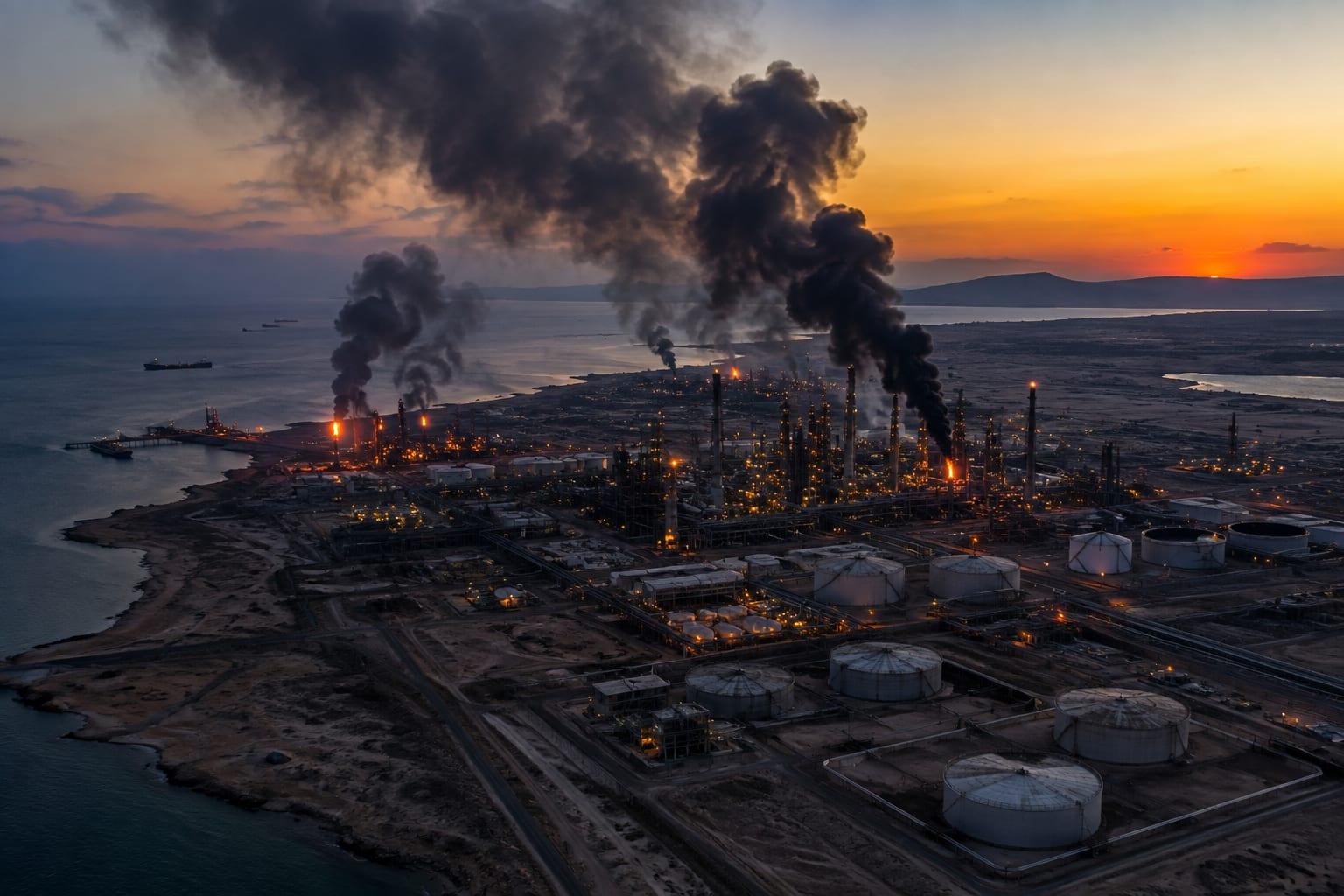
Iran suspended trading in six oil refineries and explosions were reported off its coast, according to regional media accounts, in developments that by Friday had drawn a wave of social media reaction from energy and Middle East monitoring accounts. The reports, carried by the Iranian outlet Mehr and aggregated by the financial news account FirstSquawk, described explosions off Qeshm Island and a sweeping trading halt covering refineries in Isfahan, Bandar Abbas, Tehran, Tabriz, Shiraz and Lavan.
The trading suspensions, announced within sixteen minutes of one another through Oct. 14, were attributed to late disclosure of material information. The account @FirstSquawk, which monitors financial wires, reported the halts and noted the compressed timing suggested a broader refining-sector action rather than six unrelated administrative decisions. Separately, @FirstSquawk reported explosions heard off Qeshm Island, citing the Iranian outlet Mehr.
Qeshm Island sits at the mouth of the Strait of Hormuz, the narrow waterway through which roughly a fifth of the world's oil passes. The reports of explosions near the island follow weeks of escalating maritime tension in the strait. According to reporting from Türkiye Today, Iran has launched about thirty drone and ten missile attacks a week on Strait of Hormuz shipping since August. That figure, if accurate, represents a sustained campaign against commercial traffic in one of the globe's most consequential chokepoints.
The broader context was laid out in a geopolitical analysis published by EUROPE SAYS and attributed to analyst Gustavo de Arístegui. That analysis, citing Al Jazeera in Doha, described Hormuz escalation following a U.S. rejection, with reports of explosions near Qeshm Island attributed to Iranian anti-ship batteries targeting commercial vessels navigating without Iranian clearance. The same analysis referenced footage released by the Islamic Revolutionary Guard Corps purporting to show the seizure of a second U.S. unmanned vessel. Those claims, carried through the analysis, have not been independently confirmed.
The reaction on social media was rapid and spread across accounts that track financial wires and regional security. The account @FirstSquawk carried both the refinery halt and the Qeshm explosions, giving its followers a sequence in which a broad trading suspension and reports of explosions arrived within roughly twenty minutes of each other. The halts in six separate refineries, announced within sixteen minutes, were framed by the account as suggesting a broader refining-sector action. That framing — a coordinated sector-wide halt rather than isolated disclosures — became the lens through which the trading suspensions were discussed.
The accounts carrying the story did not confine themselves to the refinery halts. The Türkiye Today report on weekly drone and missile attacks added a sustained-attack dimension to the Qeshm explosions. The EUROPE SAYS analysis, drawing on Al Jazeera, connected the explosions to anti-ship batteries and the seizure footage to a second U.S. unmanned vessel. Together, these accounts wove the refinery suspensions, the explosions and the Hormuz shipping campaign into a single narrative of escalating confrontation.
What remains unclear is the relationship between the two reported developments. The refinery trading halts were attributed to late disclosure of material information — a regulatory rationale — while the explosions were reported without official explanation. It is not yet known whether the two are connected, whether the trading halts were precautionary, or what caused the reported explosions. The halts cover refineries in Isfahan, Bandar Abbas, Tehran, Tabriz, Shiraz and Lavan, a geographically dispersed set of facilities that collectively represent a significant share of Iran's refining capacity.
The Strait of Hormuz dimension adds weight to any disruption. The waterway connects the Persian Gulf to the Gulf of Oman and is the primary export route for Saudi Arabia, the United Arab Emirates, Kuwait, Iraq and Iran. Any sustained interference with shipping there has immediate implications for global oil markets and for the U.S. Navy's Fifth Fleet, based in Bahrain. The reports of weekly drone and missile attacks since August, if borne out, would represent a persistent campaign rather than a single incident.
The IRGC seizure footage referenced in the EUROPE SAYS analysis, described as purporting to show a second U.S. unmanned vessel, adds a direct U.S.-Iran dimension. The analysis, attributed to Gustavo de Arístegui, described the escalation as following a U.S. rejection, though the specific rejection was not detailed in the available material. The account @FirstSquawk did not mention the seizure footage or the U.S. dimension in its posts, focusing instead on the refinery halts and the explosions.
The social media reaction unfolded over a single afternoon. At 13:23 UTC, @FirstSquawk reported the six refinery halts. At 13:46 UTC, twenty-three minutes later, the same account reported explosions off Qeshm Island. The sequence gave followers a compressed timeline: a regulatory suspension of trading in six refineries, followed almost immediately by reports of explosions at the mouth of the strait. Whether that sequence reflects causation or coincidence is not established.
Next News Network could not independently verify the reports of explosions off Qeshm Island or the circumstances surrounding the refinery trading halts.
What is verifiable is the trading halt itself, announced through Oct. 14 and attributed to late disclosure of material information. The halts were reported by @FirstSquawk and described as announced within sixteen minutes, suggesting a broader refining-sector action. That characterization — a coordinated action — remains the account's framing, not an official statement.
For readers tracking the story, the key unknowns are the cause of the reported explosions, the reason for the coordinated trading halts, and the relationship between the two. The accounts carrying the story — @FirstSquawk, Türkiye Today, EUROPE SAYS and Al Jazeera — have presented the developments as interconnected, but the connections remain alleged rather than confirmed. The refinery halts are a matter of public record through the trading suspension. The explosions are reported, not confirmed. The wider Hormuz campaign figures come from a single outlet and have not been independently verified.
Next News Network will continue to monitor the situation and provide updates as verified information becomes available.
Our Take
The reaction to this story tells you more about the moment than the underlying claims do. Within minutes of the refinery halts, accounts that track financial wires and regional security were weaving a narrative of coordinated escalation — six refineries, explosions at the mouth of the strait, a weeks-long campaign against shipping, and a U.S. unmanned vessel in IRGC hands. Some of that is documented. The trading halts are real. The weekly attack figures come from one outlet. The explosions are reported but unconfirmed. What matters is that the accounts carrying this story treated the sequence as a single event, and their audiences absorbed it that way. That is how a narrative hardens before the facts do. The Strait of Hormuz is the world's most important oil chokepoint. If Iran is indeed launching thirty drones and ten missiles a week at shipping there, that is an act of war in all but name. If it is not, then a lot of people are reacting to a story that has not been verified. Either way, the trading halt in six refineries is a signal that something is moving inside Iran's energy sector. The regime does not suspend trading across Isfahan, Bandar Abbas, Tehran, Tabriz, Shiraz and Lavan for routine disclosure lapses. The American people should watch this waterway closely. The price at the pump and the risk to U.S. sailors both run through the Strait of Hormuz, and right now the only thing certain is that the region is escalating.
