
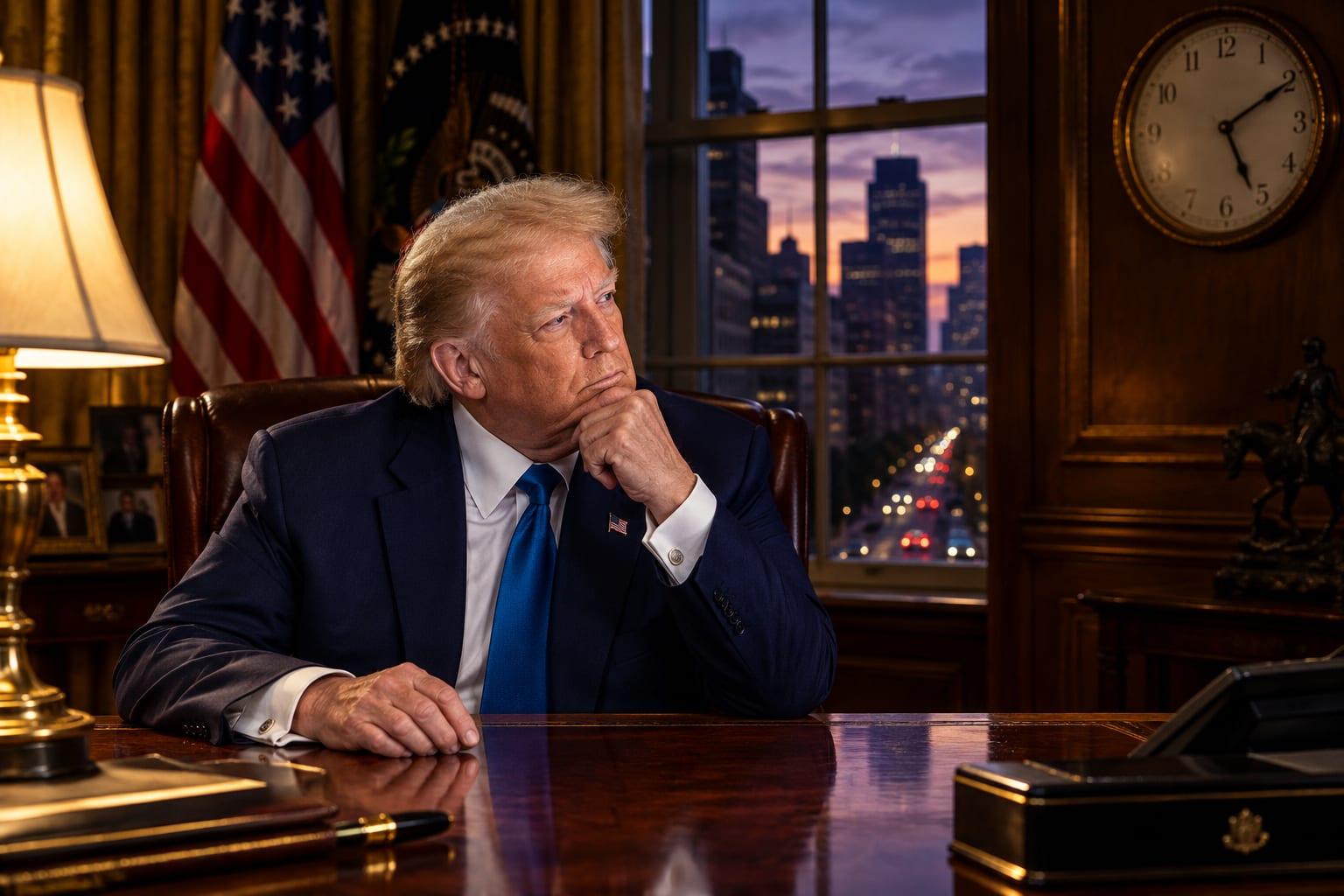
President Donald Trump called the twice-yearly clock change "ridiculous" and said it is bad for crime, writing in an October 1 post on Truth Social about a month before clocks are set to fall back one hour and mark the end of daylight saving time.
The reaction to that post spread quickly through conservative social media, where accounts picked up the theme and pushed it toward a sharper argument: that the loss of evening daylight turns the commute home into a walk in the dark, and that in cities run by Democrats, that darkness carries a cost.
"TRUMP JUST NAILED THE WORST PART OF THE TIME CHANGE, AND IT'S WALKING HOME IN THE DARK," the account @GuntherEagleman wrote in a post dated October 3.
The post walked readers through the experience directly: "You clock out of work, step outside, and it already feels like midnight."
From there, @GuntherEagleman framed the issue around safety and city governance. "It's depressing, and in crime-ridden blue cities it's flat-out dangerous," the post read. The post then turned to the conduct of local officials, writing that "Democrat mayors already let criminals" -- a criticism of Democratic-led city governments and their handling of crime, delivered as the post's argument rather than as a reported finding.
The underlying claim in the president's post is not independently confirmed, and Next News Network could not independently verify it.
The fall time change, which takes effect in early November, moves clocks back one hour, meaning sunset arrives earlier in the evening and many workers finish their shifts after dark. The spring change moves clocks forward, pushing sunset later into the evening. The twice-a-year adjustment has been the subject of recurring legislative proposals at the state and federal level, though no change to the current schedule has been enacted.
Trump's October 1 post was described in coverage of the subject as lengthy and as making an explicit connection between the time change and crime, calling the practice "ridiculous" and "bad for crime." That coverage is the basis for the description of the post's contents; the post itself was not independently reviewed by Next News Network.
The post arrived roughly a month before the fall change, giving the topic a long runway before clocks move. It also landed in the middle of an ongoing political argument over public safety in major American cities, an argument that has been a fixture of conservative messaging and of Trump's own commentary for years.
@GuntherEagleman's post did not stop at the mechanics of daylight. It built a scene the reader is meant to recognize: the shift ending, the door opening, and the sky already black. The phrase "it already feels like midnight" is the post's own description of that moment, and the post treats the sensation as the part of the time change that people feel most acutely.
The account then connected that feeling to two separate claims. The first is emotional -- that the early darkness is depressing. The second is about safety -- that in cities the account describes as "crime-ridden" and "blue," meaning Democrat-led, the same darkness is "flat-out dangerous."
The final line of the post, that "Democrat mayors already let criminals" -- cut off in the post as reproduced -- gestures at a broader charge about local prosecutors and city leadership. It is a political accusation about governance, not a statistic, and the post does not attach a figure or a study to it.
What the exchange shows is how a presidential comment about clocks can be routed into a city-crime argument within two days. Trump's post supplied the framing -- ridiculous, bad for crime. @GuntherEagleman supplied the scene and the villain, moving the conversation from the annoyance of an earlier sunset to the conduct of Democratic mayors.
It is not yet known whether the president intends to take any action on daylight saving time, or whether the October 1 post will be followed by a formal proposal. Congress has periodically taken up proposals to make daylight saving time permanent, and states have passed measures that depend on federal authorization to take effect, but no such change is currently in force.
It is also not known how many accounts carried the post's framing forward, or how the argument will develop between now and the November change. What is clear from the posts is the sequence: the president called the time change ridiculous and tied it to crime, and conservative accounts took that opening and turned it toward the cities and the officials who run them.
The subject here is the reaction, and the reaction has a shape. It starts with the clock, moves to the commute, and ends with a charge about who runs the cities where that commute happens.
Our Take
The president is right that there is something absurd about a system that forces the entire country to reset its clocks twice a year so that office workers can finish their day in the dark. But the more useful part of this exchange is what @GuntherEagleman did with it: he took a complaint about an inconvenience and pointed it at the people who actually control whether the walk home is safe. That is the argument Democrats do not want to have, because it forces them to defend the criminal justice policies that emptied out their jails and the prosecutors they helped elect who keep them that way. If the early sunset makes the evening commute more dangerous, the answer is not to pretend the danger is a scheduling problem. The answer is to stop electing the mayors and prosecutors who created it.
