
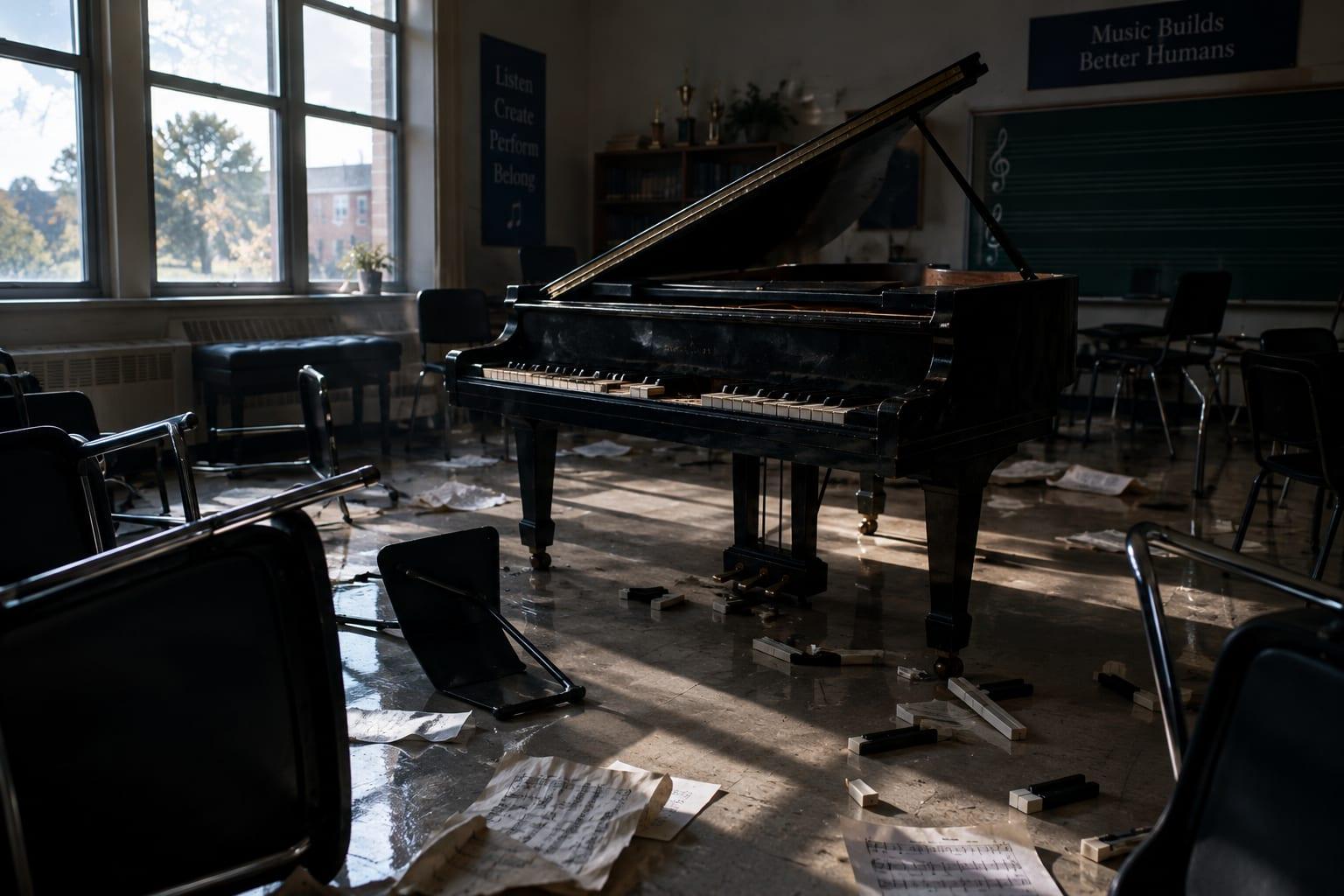
A woman described as a supervisor screams 'No, not the piano! I beg you!' at people described as students as they demolish a piano, in a video circulated by the account @visegrad24.
The footage, posted on the third of October, is the entirety of what the account put out. There is no stated location, no stated institution, and no stated date for the scene on camera. Next News Network found no other published coverage of the incident itself.
What is verifiable is the audio. In the transcript @visegrad24 published alongside the clip, the woman says: 'No, not the piano! Not the piano! No, no, no, no, not the piano! No, not the piano, I beg you! No, not the piano! No!'
That is the whole of the spoken record. She is not heard appealing for the building to be spared, the room, the furniture, or any person. The repeated demand is for the instrument. The account @visegrad24 framed it that way in its own caption, opening with 'Not the piano! No! Not the piano! No, no, no!' and closing with 'pleads a desperate supervisor as she watches students demolish the musical instrument.'
That is what the account says the footage shows. What video actually shows cannot be independently fixed by Next News Network from the post alone. The account @visegrad24 attributes the role of supervisor to the woman and the role of students to the people wrecking the piano. Whether she is in fact a supervisor, and whether the people are in fact students, are claims carried by that post.
The spread is the notable part. The clip did not travel because any newsroom established what took place. It traveled because accounts passed it along on the strength of the audio. @visegrad24 carried it. Other users on the same platform picked it up and re-posted it, keeping the caption largely intact, so the same four English words — 'not the piano' — arrived in front of new audiences with the same claim attached. Conservative aggregators and reply-guys carried it without adding a location or a school name. The audio is short and repeated, which is precisely the kind of thing that circulates well: no context required, no translation required, no explanation required. A viewer can hear the entire event in one breath.
That means there is no way for a reader to know which school, which country, or which month the footage comes from, even as the clip reaches people who would be able to verify it if the post said where to look. That is the gap that keeps an item like this unverifiable even after it has been seen widely: not that people doubt the audio, but that nothing in the circulated material says where or when it was recorded.
What the underlying dispute was, if there was one, is not stated in the material. Whether the piano was scheduled for removal and the students got to it first, whether it was destroyed in a protest, or whether the scene was staged, is not established by anything posted. The clip carries no explanation for why the destruction was happening, and no account that circulated it supplied one.
Next News Network could not independently verify the incident depicted in the video.
The audio itself, as transcribed by the account @visegrad24, contains no other speaker. No voice from the group answers the woman. No voice identifies a school, a reason, or a demand. The only words in the transcript belong to the woman appealing for the instrument's survival.
This is not the first time a short, unexplained clip has outrun every effort to locate it. The pattern is familiar: a scene with strong audio, no caption details, and a role description — 'supervisor,' 'students' — supplied by whoever posts it first. The description then travels as if it were part of the footage. By the time the clip reaches general audiences, the description and the audio are remembered together, and the absence of a location is no longer noticed.
The only named party in the material is the account @visegrad24, which published the clip and the caption describing the woman and the crowd. Next News Network found no other coverage of the incident, no statement from any school, and no account from anyone present beyond the audio the post itself published.
Our Take
Viral outrage is not evidence, and this story is a case study in why. A twelve-word scream travels the world while the basic facts — where, when, who, and why — never make the trip. That is not the fault of the woman in the clip; it is the fault of a media ecosystem that rewards the clip and skips the reporting. Conservatives rightly mock the legacy press for building narratives on anonymous sourcing and 'mostly peaceful' euphemisms, and the same discipline has to run the other way: we will not tell you this happened at a particular school, in a particular country, on a particular day, because we do not know, and neither does anyone who passed it along. The woman's plea is real on the audio. Everything around it is an open question, and the accounts amplifying it should have said so before they hit share. If the incident turns out to be confirmed — if a school steps forward, if a date and place are established — it deserves a full accounting. Until then, the honest headline is the one written above: a supervisor pleaded, on camera, for the piano. Nothing more has been established, no matter how many times the clip is posted.
