
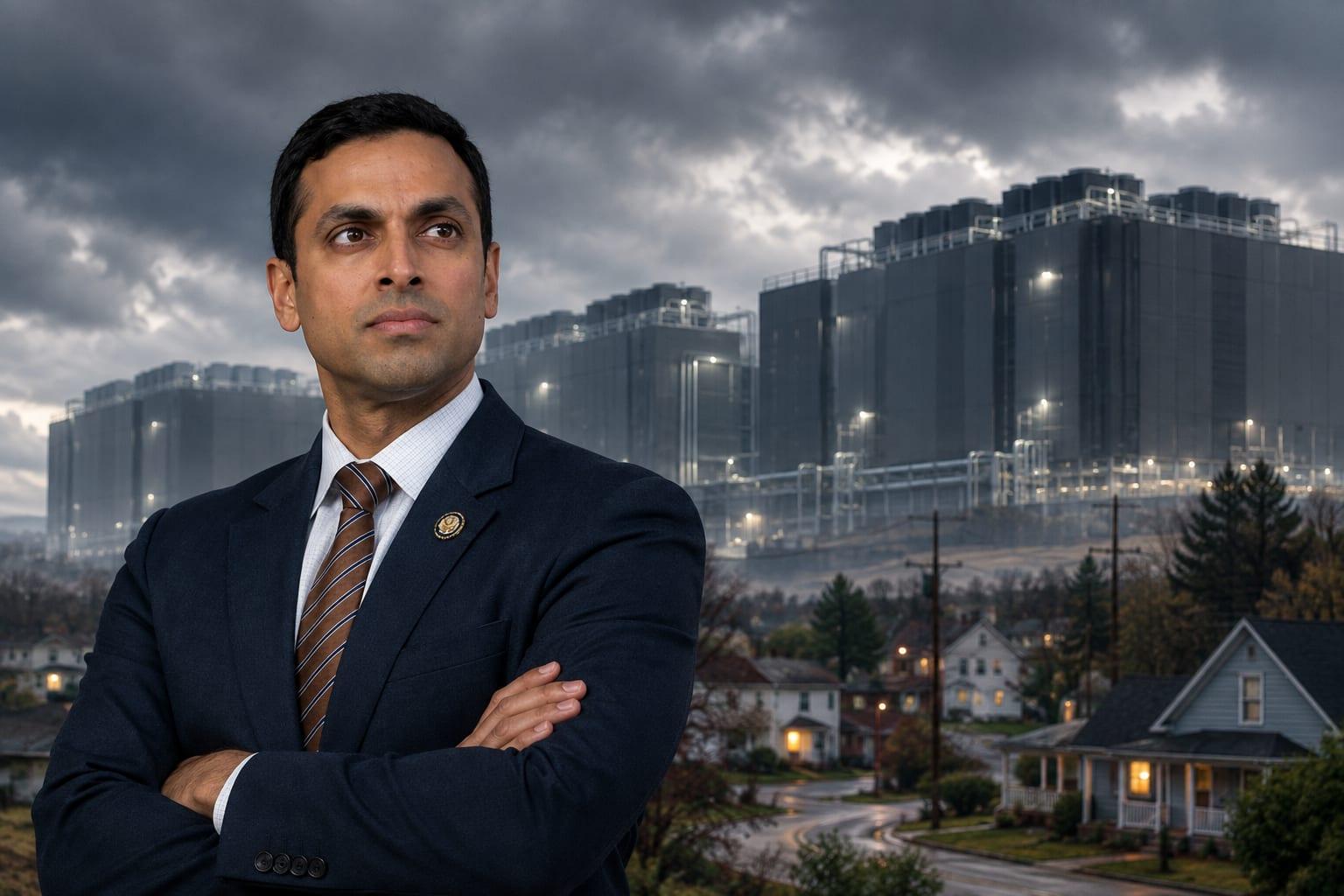
Rep. Suhas Subramanyam, the Virginia Democrat whose district sits at the heart of the nation's "Data Center Alley," is warning that local pushback against the AI buildout could stall the very infrastructure Washington calls a national security priority — and he wants Congress to step in before that happens.
"The communities are being steamrolled by the industry," Subramanyam told Fox News Digital. "They're not feeling like anyone's listening to them."
The congressman is shopping a four-part federal plan aimed at breaking what he calls a false choice between unchecked development and outright moratoriums. According to Fox News, the proposal targets data center siting, power costs, energy and water measurement, and security for the facilities and the surrounding communities.
At the center of it is his Fair Share Act, which would push states to require large power users to cover more of the infrastructure costs needed to serve them.
"At the federal level, if we say that we're going to take away some of your federal funding if you do this, then it will be a no-brainer," Subramanyam said, arguing that data centers should "pay their fair share for the infrastructure that needs to be built because of them."
That's the actual mechanism here, and it's worth being precise about it: Subramanyam is proposing to condition federal dollars on state compliance. The carrot is money; the stick is the withholding of it.
Loudoun County, which Subramanyam represents, offers the counterargument the industry likes to make. The county says data center revenue helped it lower its real-property tax rate from $1.145 per $100 of assessed value in 2016 to $0.805 in 2026, according to Fox News. That's a real, measurable tax cut for real homeowners.
But Subramanyam says residents are weighing those savings against costs that show up somewhere else — particularly on their utility bills.
"What's not OK is feeling like they come in, jack up utility costs and we pay for their power infrastructure," he said, also citing water, air quality and other community concerns.
The industry disputes the claim that data centers are driving higher residential power bills. The Leesburg-based Data Center Coalition, which represents the sector in the region, has pushed back on that framing, though Fox News' report on the exchange does not include the coalition's full response.
Subramanyam's political pitch is wrapped in national security language. "If you are concerned about a race with China, when it comes to building data centers and AI, you should want to work with us on a plan to get community buy-in for where to build data centers," he told Fox News Digital.
It's a message aimed squarely at Republicans who have spent the past several years framing AI dominance as a Cold War-grade priority — and it carries an implicit threat: get on board with federal siting rules, or watch the buildout slow down in the neighborhoods that vote.
What the plan does not do, at least as Subramanyam describes it, is reduce Washington's role in any of this. It expands it. A federal framework that can withhold funding from states that don't tax and regulate large power users the way Congress prefers is a federal framework that tells local governments what their utility policy has to look like.
The politics are awkward for a party that spent the last two election cycles telling voters it fights for local control. The same progressive coalition that demands community input on pipeline routes, transmission lines and refinery permits has spent years treating Washington as the referee. Now a Democratic congressman from Northern Virginia is asking those same communities to trust the federal government to protect them from the tech industry's land rush.
Residents in Loudoun, Prince William and Fauquier counties have packed school board and board of supervisors meetings for months over transformer noise, diesel generator testing, water consumption from the Potomac basin, and the visual blight of warehouse-scale server farms popping up next to subdivisions. Many of them have made clear they are not looking for a federal agency to ride to the rescue. They are looking to their own county boards — the bodies closest to them — to say no.
Subramanyam's plan, whatever its intentions, cuts against that instinct. It moves the decision farther away from the people who live with it.
Our Take
Let's be honest about what's happening here. The data center boom is real, the strain on local grids and water systems is real, and the frustration of homeowners watching their quiet counties turn into industrial zones is real. Subramanyam is right that people feel steamrolled. He's right that "build it anywhere" isn't a plan.
But look at his solution: a federal framework that conditions state funding on how states treat large power users. That's not community buy-in. That's Washington buying the community off with its own money — and then holding the checkbook over the county board's head.
The answer to Big Tech running roughshod over local zoning isn't to hand the federal government a bigger lever. It's to let counties say no. Let them set their own water limits, their own noise standards, their own tax structures for the server farms that want in. If Loudoun County wants to trade data center revenue for a lower property tax rate, that's Loudoun County's call. If the next county over wants to shut the door, that should be its call too.
And a word on the China framing. If we are truly in a tech arms race with the CCP, the last thing we should want is a federal siting bureaucracy that slows every permit down and turns every build into a multi-year political fight. Speed is the advantage. Bureaucracy is the enemy. Subramanyam is selling a plan that makes the process slower, more centralized and more expensive — and calling it pro-innovation.
Patriots, the real question isn't whether data centers should pay their fair share. They should. The question is who decides what "fair" means. Do you want that answer coming from your county board, where you can show up and speak your piece — or from a committee in Washington that you'll never get a meeting with?
Subramanyam says the communities are being steamrolled. He's right. His fix just changes who's holding the roller.
